You’ve chosen your surrogate, matched with an agency, and then someone hands you a legal retainer agreement for $6,500. Before the medical side starts. Before a single injection. Just paper.
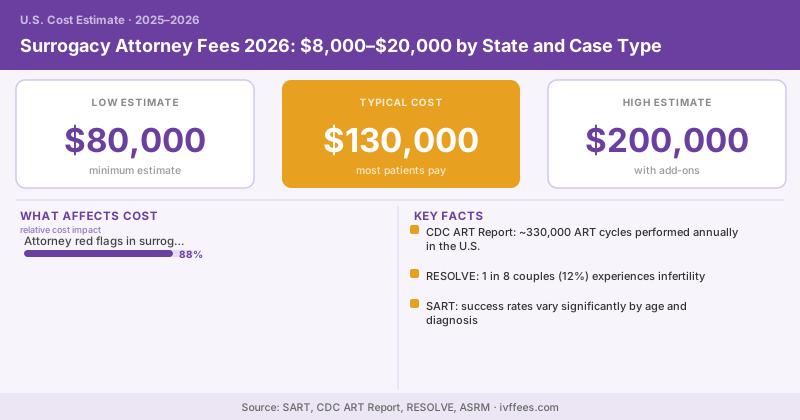
That moment trips up a lot of families. Surrogacy attorney fees aren’t the biggest line item in a total surrogacy cost of $130,000–$170,000 — but they’re the least visible, and people routinely underestimate them by half. The American Academy of Adoption and Assisted Reproduction Attorneys (AAAA) estimates that surrogacy legal fees account for 8–15% of total surrogacy costs nationally. On a $150,000 journey, that’s $12,000–$22,500.
Here’s exactly what you’re paying for, and why cutting this corner is a mistake you’ll regret before the third trimester.
What Surrogacy Attorneys Actually Do
Surrogacy legal work falls into three main deliverables:
1. The Gestational Carrier Agreement (GCA) This is the master contract between intended parents and surrogate — who pays what, what happens in case of selective reduction, how many embryos get transferred, what medical decisions each party controls, and what happens if the relationship breaks down. A well-drafted GCA runs 30–60 pages. Your attorney drafts it; the surrogate’s attorney reviews and negotiates it independently.
2. Pre-Birth Order (PBO) In most surrogacy-friendly states, a court order establishes intended parents as the legal parents before the baby is born. The PBO is filed during the second trimester and ensures your names go directly on the birth certificate. Without it, you may need a post-birth adoption process — which adds time, cost, and stress.
3. Second-Parent Adoption or Parentage Confirmation In states where pre-birth orders aren’t available or recognized, one or both intended parents must complete an adoption process after birth. This adds $3,000–$8,000 to legal costs and takes 3–9 months. It’s one reason choosing a surrogacy-friendly state isn’t just about the surrogate’s location — it’s about yours and the clinic’s too.
The Two Attorneys: Why You Need Both
Don’t expect to share a lawyer with your surrogate. You can’t. In California, Nevada, Illinois, and most states with established surrogacy law, independent legal representation for the surrogate is not optional — it’s a requirement for the GCA to be enforceable.
The logic is sound: if the same attorney represents both parties, any contract they draft can be challenged as coercive. Courts want to see that the surrogate had her own advocate who reviewed the terms in her interest — not yours.
You pay for both attorneys. That’s the standard arrangement, and it’s built into every reputable agency’s cost estimate.
Surrogacy Attorney Fee Breakdown by Role
| Attorney Role | Typical Fee Range | What It Covers |
|---|---|---|
| Intended parents’ attorney | $5,000–$12,000 | GCA drafting, pre-birth order, parentage petition |
| Surrogate’s independent attorney | $1,500–$4,000 | GCA review and negotiation, IPs pay this fee |
| Pre-birth order filing (if separate) | $1,000–$3,500 | Court filing, hearing, certificate of parentage |
| Second-parent adoption (if needed) | $3,000–$8,000 | Post-birth adoption in non-PBO states |
| Typical total (PBO state) | $8,000–$16,000 | All legal costs for a standard journey |
| Typical total (non-PBO state) | $12,000–$22,000 | Includes post-birth adoption process |
Cost by State: Why Location Matters
Surrogacy law is entirely state-driven. There’s no federal framework. An attorney’s fees reflect both local market rates and the complexity of what they have to do in that jurisdiction.
| State | Legal Climate | Typical Total Attorney Fees | Notes |
|---|---|---|---|
| California | Best in the U.S. | $12,000–$20,000 | PBO available, highest attorney rates |
| Illinois | Excellent | $9,000–$15,000 | Gestational Surrogacy Act, clear PBO process |
| Nevada | Excellent | $8,000–$14,000 | Statutory protections, efficient courts |
| Washington | Good | $8,000–$13,000 | PBO available since 2018 |
| Texas | Mixed | $8,000–$14,000 | No statute, case law dependent, IVF required |
| Florida | Good | $8,000–$13,000 | Strong statute, PBO available |
| New York | Improving | $10,000–$18,000 | Child-Parent Security Act (2021), still developing |
| Michigan | Hostile | $14,000–$22,000+ | GCAs unenforceable; post-birth adoption required |
California’s fees look high — and they are. But the legal infrastructure is so well-developed that disputes are rare, PBOs are routine, and your parentage is ironclad before you leave the hospital. Some families pay a premium to do their surrogacy journey legally in California even when they live elsewhere.
Michigan is the cautionary tale: gestational carrier agreements aren’t enforceable under Michigan law, so intended parents can’t get a pre-birth order. You get the baby through post-birth adoption — which is slower, costlier, and creates an anxious window where legal parentage isn’t confirmed.
Hourly vs. Flat-Fee Billing
Most AAAA-affiliated surrogacy attorneys offer flat fees for standard cases. That’s ideal: you know what you’re spending, and there’s no incentive to generate unnecessary work.
Flat-fee agreements almost always have carve-outs for complications: contested terms, multiple revisions, international intended parents, multi-state legal issues, or LGBTQ+ parentage challenges in hostile jurisdictions. If your case hits one of these, expect hourly billing at $350–$600/hr for the overage. Always ask: “What happens if this takes more revisions than expected?”
Hourly billing makes sense when the case is genuinely complex — a same-sex couple in a state with unclear parentage law, a surrogate who’s had legal complications before, or intended parents who are citizens of a country that doesn’t recognize surrogacy. In those situations, a flat fee would require the attorney to pad the quote anyway.
Red Flags to Watch For
Attorney red flags in surrogacy: (1) No specialty in reproductive law — surrogacy contracts require AAAA-level expertise, not a general family law attorney; (2) Willing to represent both parties — this is an ethical violation in most states; (3) Vague flat-fee quotes with no scope description — get everything in writing before signing a retainer; (4) No mention of pre-birth orders — any competent surrogacy attorney raises this in the first consultation; (5) Pressure to skip the surrogate’s independent counsel — this saves $2,000 now and can void your contract later.
The cheapest surrogacy attorney quote you’ll find is usually from someone who doesn’t do this regularly. AAAA membership or state bar surrogacy specialization is not a guarantee, but it’s the baseline filter.
How Attorney Fees Fit Into Your Total Budget
On a $150,000 surrogacy journey, here’s roughly where attorney fees land:
| Budget Category | Typical Range | % of Total |
|---|---|---|
| Surrogate compensation | $35,000–$55,000 | 30–35% |
| Agency fees | $20,000–$40,000 | 18–25% |
| IVF cycle (embryo creation) | $12,000–$25,000 | 10–15% |
| Surrogate health insurance | $10,000–$35,000 | 8–20% |
| Attorney fees (all) | $8,000–$20,000 | 6–12% |
| Medical expenses & allowances | $5,000–$15,000 | 4–8% |
| Psychological screening | $1,500–$4,000 | 1–3% |
At 6–12% of total cost, legal fees aren’t your biggest line item. But they’re the one that determines whether every other line item is protected. A poorly drafted GCA or a missed pre-birth order can unravel $100,000+ of investment in the worst possible moment.
Independent Surrogacy and Legal Costs
Families pursuing independent surrogacy — matching directly without an agency — sometimes assume they’ll save on legal costs too. They don’t. The legal work is identical whether you found your surrogate through an agency or through a personal connection. You still need a GCA, independent counsel for the surrogate, and a pre-birth order. What changes is who’s coordinating the process — and in independent arrangements, that falls to you and your attorney.
RESOLVE: The National Infertility Association specifically notes that one of the most common sources of financial loss in independent surrogacy is inadequate legal documentation — not insufficient compensation or medical issues.
Bottom Line
Budget $10,000–$15,000 for attorney fees on a standard gestational surrogacy in a surrogacy-friendly state. If you’re in California or a state requiring post-birth adoption, move that ceiling to $20,000. Don’t shop for the cheapest attorney — shop for the most experienced reproductive law specialist you can find, verify AAAA membership or equivalent credentialing, and get a written scope of work before signing any retainer.
The legal infrastructure is what protects every dollar you’ve put into this journey. It’s not a place to cut corners.