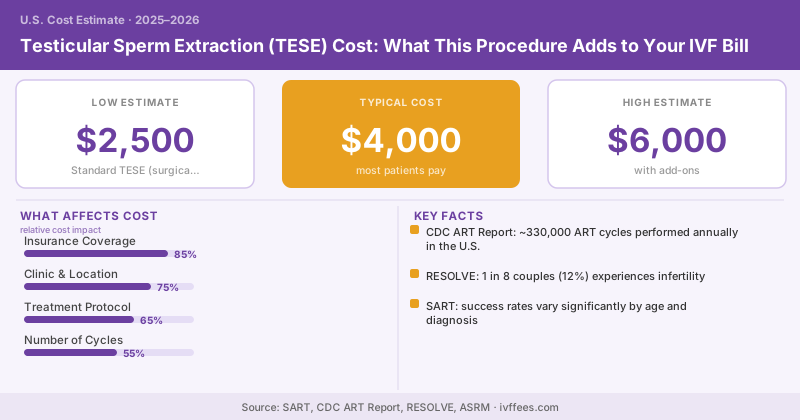
Step one: a urologist retrieves sperm directly from testicular tissue instead of relying on ejaculate. Step two: your IVF bill grows by $3,000 to $8,000 — but for men with no sperm in their ejaculate, it’s often the only path to a genetically related child.
What TESE Adds to Your Total Cost
| Cost Component | Low End | Typical | High End |
|---|---|---|---|
| Standard TESE (surgical retrieval) | $2,500 | $4,000 | $6,000 |
| Micro-TESE (microsurgical) | $4,000 | $6,500 | $9,500 |
| Anesthesia | $500 | $900 | $1,400 |
| ICSI (required to use retrieved sperm) | $1,500 | $2,200 | $3,000 |
TESE is never a standalone treatment — retrieved sperm must be used with ICSI (intracytoplasmic sperm injection) during an IVF cycle, since natural fertilization isn’t possible with the small quantity of sperm typically retrieved this way. Budget for both costs together, not TESE alone.
Who Actually Needs This Procedure
TESE is used specifically for men with azoospermia — no sperm present in their ejaculate — whether due to a blockage somewhere in the reproductive tract (obstructive azoospermia) or a problem with sperm production itself (non-obstructive azoospermia). For obstructive cases, retrieval success rates are generally very high, since sperm production itself is normal and the issue is purely a blocked pathway. Non-obstructive cases are more variable, which is where the choice between standard TESE and micro-TESE becomes more clinically significant.
Why Micro-TESE Costs More — and Why It’s Sometimes Worth It
Micro-TESE uses an operating microscope to visually identify the specific seminiferous tubules most likely to contain sperm production, rather than randomly sampling testicular tissue as in standard TESE. For men with non-obstructive azoospermia, where sperm production is patchy or severely reduced, this targeted approach generally yields meaningfully higher sperm retrieval success rates in published urology outcomes research, which is why many specialists recommend it despite the higher cost for this specific patient group.
If a TESE procedure successfully retrieves sperm, ask your clinic to freeze the maximum possible number of samples rather than just what’s needed for your immediate cycle. A successful retrieval that yields enough for multiple future attempts can spare you a repeat surgical procedure entirely if your first IVF/ICSI cycle doesn’t result in pregnancy.
What Happens If No Sperm Is Found
Even with micro-TESE, sperm retrieval isn’t successful for every patient with severe non-obstructive azoospermia — a real and difficult possibility to prepare for emotionally and financially before the procedure. Discuss with your urologist beforehand what the realistic odds are for your specific diagnosis and any prior test results, and ask whether donor sperm should be part of the conversation as a backup plan before you’re in the recovery room facing that outcome unprepared.
Don’t schedule your partner’s egg retrieval to happen on the same day as an unproven TESE attempt without a clear backup plan discussed in advance. If sperm retrieval is unsuccessful and there’s no frozen donor sperm backup available, retrieved eggs may need to be frozen unfertilized rather than immediately fertilized — an outcome that’s manageable but should be planned for, not discovered in the moment.
Insurance and Cost Considerations
Insurance coverage for TESE varies similarly to other IVF-adjacent procedures — sometimes covered as a surgical urology procedure separate from broader fertility treatment exclusions, sometimes bundled under an infertility exclusion regardless of the specific procedure. Confirm coverage directly with your insurer, and ask your clinic whether TESE and the associated IVF/ICSI cycle can be billed and pre-authorized together or need to be handled as separate claims.
The Bottom Line
Budget $3,000 to $9,500 for TESE or micro-TESE on top of a standard IVF/ICSI cycle cost. For men with azoospermia, it’s often the only route to using their own sperm, and freezing multiple retrieved samples for future use is one of the most practical ways to get long-term value from a single surgical procedure.