Your embryos are perfect. Your hormones look fine. And then the ultrasound shows a lining of 5.5 millimeters — and your transfer gets canceled. A thin uterine lining is one of the most frustrating obstacles in fertility treatment, partly because the fixes are hit-or-miss and partly because every canceled cycle costs real money.
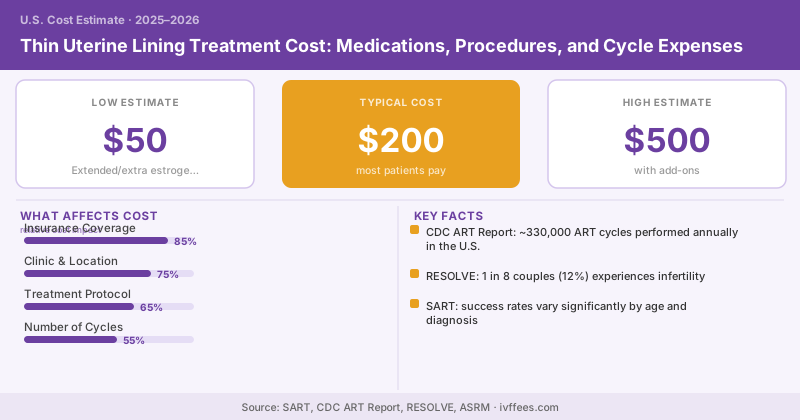
So what does treating a thin lining actually run? Often it’s just an extra $200 in estrogen. Sometimes it spirals into thousands across multiple canceled and re-attempted cycles. Here’s the full range.
What Counts as “Thin” and Why It Matters
The endometrium — your uterine lining — needs to thicken before an embryo can implant. Most clinics want to see at least 7 mm, ideally with a triple-line pattern on ultrasound, before transferring an embryo. Below roughly 7 mm, implantation rates drop, though pregnancies do still happen at thinner measurements.
The cost problem is that a thin lining usually surfaces mid-cycle, after you’ve already paid for medications and monitoring. If the lining won’t cooperate, the transfer is canceled — and that’s money largely spent for nothing.
| Treatment | Low | Typical | High |
|---|---|---|---|
| Extended/extra estrogen (oral, patch, vaginal) | $50 | $200 | $500 |
| Vaginal sildenafil (Viagra) compounded | $100 | $300 | $600 |
| Low-dose aspirin / supplements | $10 | $40 | $100 |
| Hysteroscopy to check for scarring | $2,500 | $5,000 | $10,000 |
| PRP intrauterine infusion (experimental) | $800 | $1,500 | $3,000 |
| Canceled transfer cycle (sunk cost) | $1,500 | $3,000 | $6,000 |
First-Line: More Estrogen
The lining grows in response to estrogen, so the cheapest fix is simply more of it — higher oral doses, adding patches, or vaginal estrogen for better local absorption. This adds maybe $100 to $500 to a cycle. For many women, that’s the whole solution.
If you’re doing a medicated frozen embryo transfer, your clinic controls the estrogen dosing directly, which makes adjusting it straightforward and low-cost.
When Pills Aren’t Enough
If extra estrogen doesn’t do the job, REs reach for second-line options. Vaginal sildenafil (yes, compounded Viagra) is used to improve uterine blood flow; low-dose aspirin and pentoxifylline get tried for the same reason. None of these is a guaranteed fix, and the evidence is mixed — but they’re relatively cheap to attempt.
The pricier, more experimental frontier is platelet-rich plasma (PRP) infused into the uterus, which some clinics offer for $800 to $3,000 per attempt. ASRM considers many of these advanced lining therapies experimental, so insurance rarely covers them and the evidence is still developing.
The first thing to rule out is scarring. A thin lining that won’t respond to estrogen may be hiding intrauterine adhesions (Asherman’s syndrome), which a hysteroscopy can diagnose and treat in one procedure. Spending $5,000 on experimental infusions when the real problem is scar tissue is wasted money — get the structural cause ruled out first.
The Hidden Cost: Canceled Cycles
Here’s where thin lining really hurts the wallet. If your lining won’t reach target, the cycle is canceled. In a medicated FET, you’ve spent on estrogen and monitoring — call it $1,500 to $3,000. In a fresh IVF cycle, a poor lining might force a freeze-all, pushing your transfer (and more cost) into a later cycle.
Repeated cancellations are why some women spend far more than the medication price tags suggest. Each restart resets the clock and the fertility medications bill.
A history of D&C, prior uterine surgery, or pelvic infection raises the odds your thin lining is from scarring rather than hormones. If you’ve had any of these, ask for a hysteroscopy before burning cycles on estrogen tweaks. Treating the wrong cause is the most expensive mistake here.
Does Insurance Help?
Diagnostic procedures like hysteroscopy are often covered under surgical/gynecological benefits, even on plans that exclude fertility. Estrogen medications are inexpensive and commonly covered. The experimental therapies — PRP, compounded sildenafil for this use — are typically out of pocket. If repeated canceled cycles are driving up your spend, it’s worth reviewing IVF financing options to manage the cash-flow hit.
Frequently Asked Questions
What lining thickness is too thin to transfer? Most clinics prefer at least 7 mm, though pregnancies occur below that. Below roughly 6 mm, many REs will delay or cancel the transfer because implantation rates fall.
Can a thin lining be fixed permanently? Sometimes. If the cause is scarring, treating the adhesions can restore lining growth. If the lining is simply estrogen-resistant or thinned by prior damage, you may need to optimize each cycle individually rather than achieve a permanent fix.
Does natural-cycle FET help a thin lining? For some women, yes. A natural or modified-natural cycle relies on your own ovulation and estrogen, which occasionally produces a better lining than a medicated protocol. It also avoids some medication costs.
Bottom Line
Treating a thin uterine lining can cost as little as $200 in extra estrogen or balloon into thousands across canceled cycles and experimental therapies. The key to controlling cost is finding the cause early — rule out scarring with a hysteroscopy, optimize estrogen, and avoid pouring money into unproven infusions until the structural workup is done. Work closely with your RE to adjust each cycle rather than repeating the same failed protocol.