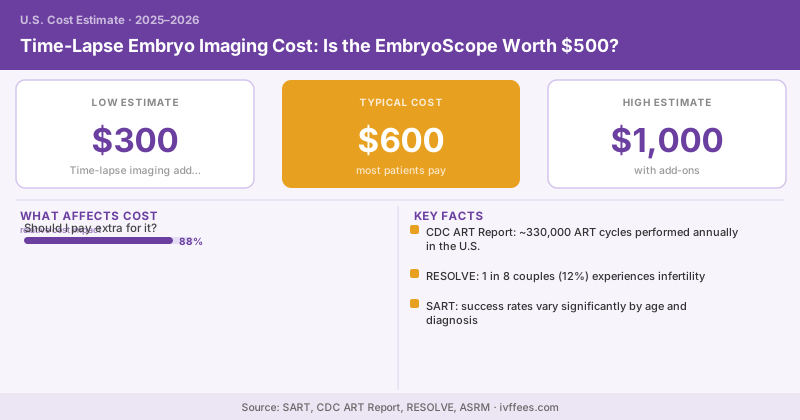
What does $500 buy you in an IVF lab? Sometimes it buys a camera. Time-lapse embryo imaging — often sold under brand names like EmbryoScope or Geri — promises a better view of your developing embryos. Whether that better view actually leads to a baby is a separate question, and one worth asking before you pay.
Here’s what the technology does, what it costs, and what the science says.
How Time-Lapse Imaging Works
In a traditional IVF lab, embryos sit in an incubator and the embryologist removes them once or twice a day to check development under a microscope. Each removal exposes the embryos to temperature and air changes.
Time-lapse systems use an incubator with a built-in camera that photographs each embryo every few minutes. The embryologist watches development on a screen without disturbing the embryos. The system captures the exact timing of cell divisions, which some labs use to help select the best embryo to transfer.
What It Costs
| Time-Lapse Imaging Scenario | Low | Typical | High |
|---|---|---|---|
| Time-lapse imaging add-on (per cycle) | $300 | $600 | $1,000 |
| Bundled into premium IVF package | $0 | $0 | $0 |
| With AI embryo-scoring software | $500 | $900 | $1,500 |
That sits on top of your base IVF cost, which is already substantial for most U.S. patients.
Time-lapse imaging keeps embryos in a stable incubator and records their development continuously. It typically adds $300–$1,000 per cycle. It’s genuinely useful for the lab, but large trials haven’t shown it reliably increases live birth rates.
What the Evidence Actually Shows
This is the part clinics tend to gloss over. A 2019 Cochrane review on time-lapse systems concluded there was insufficient evidence to show that they improve live birth, clinical pregnancy, or miscarriage rates compared with conventional incubation and assessment. The quality of evidence was rated low to very low.
The HFEA’s add-on rating system places time-lapse imaging at amber, meaning the evidence doesn’t yet support a measurable improvement in birth rates for most patients. The ASRM has likewise urged caution about add-ons that are marketed as improving outcomes without strong supporting data.
So the technology is real and the stable incubation is a legitimate benefit. What’s unproven is whether that benefit translates into more babies for the average patient.
Where the Real Value Might Be
Time-lapse imaging may help most when:
- Your lab uses the data as part of a validated selection algorithm
- It’s included at no extra charge as part of the lab’s standard setup
- You have several embryos and selection between them is genuinely difficult
It’s harder to justify when:
- It’s a steep separate charge stacked on other add-ons
- You only have one or two embryos, where selection isn’t the bottleneck
- The clinic implies it will “improve your success rate” without citing data
Decide With the Full Picture
If you’re weighing time-lapse imaging, look at your whole add-on list. Many patients are already paying for ICSI, PGT genetic testing, and assisted hatching — and those extras are a major reason your bill keeps climbing. Knowing what’s included in IVF cost helps you tell core care from optional upsells.
Frequently Asked Questions
Does time-lapse imaging increase IVF success rates? The evidence doesn’t clearly show that it does. A 2019 Cochrane review found insufficient evidence that time-lapse systems improve live birth or pregnancy rates compared with standard incubation. The undisturbed incubation is a real benefit, but it hasn’t been proven to mean more babies.
Is the EmbryoScope the same as time-lapse imaging? EmbryoScope is a popular brand name for a time-lapse incubator. Geri is another. They all combine a stable incubator with a built-in camera that records embryo development continuously, so the embryologist doesn’t have to remove embryos to check them.
Should I pay extra for it? That depends on your clinic and your situation. If it’s included for free, there’s no downside. If it’s a separate charge and you only have one or two embryos, the selection benefit may be limited. Ask your lab how they use the data.
Don’t accept “it improves your success rate” without a source. Ask the clinic for the specific evidence behind their time-lapse claim and whether it’s amber-rated on the HFEA scale.