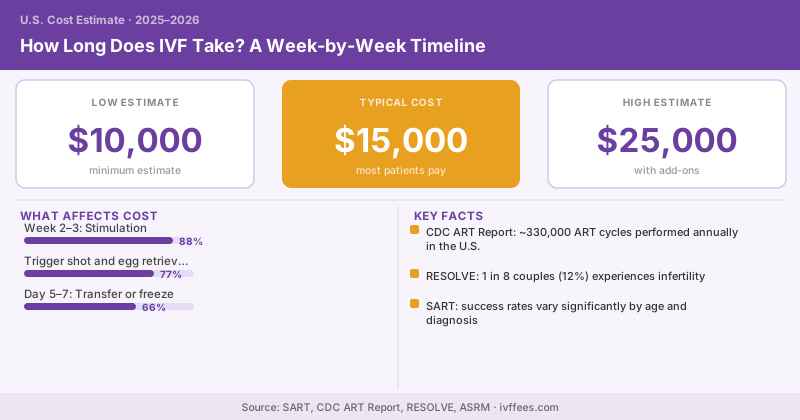
“How long will this take?” is one of the first questions people ask — and clinics often underestimate the honest answer. A single IVF cycle is 4–6 weeks. But from your first consultation to a positive pregnancy test, the real timeline is typically 3 to 6 months for most patients.
Here’s a complete breakdown, week by week, including the pieces that often get skipped in the initial conversation.
Phase 1: Pre-Treatment Testing and Consultation
Before a single injection, you’ll spend time on diagnostics and planning. This phase usually takes 4–8 weeks depending on scheduling, insurance authorization, and test turnaround.
| Step | Typical Timing |
|---|---|
| Initial consultation with RE | 1–2 week wait for appointment |
| Baseline blood work (AMH, FSH, estradiol, TSH) | Same day or next day |
| Antral follicle count (AFC) ultrasound | Cycle day 2–5 |
| Saline infusion sonogram or HSG | Cycle day 5–12 |
| Semen analysis | Any time; results in 1 week |
| Genetic carrier screening (if chosen) | 2–4 weeks for results |
| Financial consultation + consent signing | 1–2 weeks |
Total pre-treatment phase: 4–8 weeks before you even start your first injection.
Phase 2: The Retrieval Cycle (The “Active” IVF Cycle)
This is the phase most people picture when they think of IVF. It spans roughly 4–5 weeks from cycle day 1.
Week 1–2: Birth control or suppression (sometimes) Many protocols start with oral contraceptives (2–4 weeks) or a GnRH agonist to suppress the ovaries before stimulation. Not all protocols require this, but it’s common, especially in antagonist protocols.
Week 2–3: Stimulation Daily injectable hormone medications (FSH, LH) for 8–14 days. You’ll come into the clinic every 1–3 days for monitoring ultrasounds and blood draws to track follicle growth. This phase requires significant schedule flexibility — appointments often happen at 7–8 am.
Trigger shot and egg retrieval About 36 hours after the trigger shot, egg retrieval happens. It’s an outpatient procedure under sedation, typically 20–30 minutes. You’ll need the day off work and someone to drive you.
Days 1–6 after retrieval: Fertilization and embryo development Your embryologist fertilizes the eggs (with ICSI if indicated), then cultures the resulting embryos for 5–6 days to the blastocyst stage. You’ll get daily or every-other-day updates on how many are developing.
Day 5–7: Transfer or freeze Either a fresh embryo transfer happens now (if not doing PGT), or all embryos are frozen (if PGT-A or a freeze-all protocol is used). If PGT-A testing is done, results take 7–14 additional days.
Fresh transfer happens immediately after retrieval — adding only 5–7 days to the cycle. A frozen embryo transfer requires a separate cycle, adding 4–6 more weeks. If your clinic recommends a freeze-all approach (increasingly common for safety and implantation reasons), plan for the longer timeline.
Phase 3: The Frozen Embryo Transfer Cycle
If you’re doing a frozen embryo transfer (FET) — either because PGT-A was done, your fresh transfer was cancelled, or you’re using previously banked embryos — expect another 4–6 weeks:
| FET Step | Duration |
|---|---|
| Waiting for next menstrual cycle to start | 0–4 weeks |
| Endometrial preparation (estrogen) | 2–3 weeks |
| Progesterone supplementation before transfer | 5–7 days |
| Embryo transfer procedure | 1 day |
| Two-week wait (2WW) before pregnancy test | 10–14 days |
The “two-week wait” is exactly what it sounds like — 10–14 days of progesterone support and waiting before a blood pregnancy test (beta hCG) confirms whether implantation occurred. Most patients describe this as the hardest part of the process.
Total Timeline: From Consultation to Pregnancy Test
| Scenario | Approximate Total Time |
|---|---|
| Fresh transfer, successful on first attempt | 8–14 weeks (2–3.5 months) |
| Fresh transfer with PGT-A results before transfer | 12–16 weeks (3–4 months) |
| Freeze-all + one FET, successful | 14–20 weeks (3.5–5 months) |
| One failed cycle, second retrieval + FET | 6–9 months total |
According to SART data, approximately 45% of patients under 35 achieve a live birth in the first retrieval cycle — but many of those require at least one frozen transfer. For patients who need a second retrieval, the calendar typically pushes past 6 months before a confirmed pregnancy.
What Makes It Take Longer
Several things can extend the timeline beyond these estimates:
- Insurance pre-authorization — can add 2–6 weeks if coverage exists and requires documentation
- Uterine abnormality discovery — if a polyp or fibroid is found during pre-testing, it needs surgical removal before IVF proceeds
- Poor embryo quality — no viable embryos after retrieval means starting over with a new cycle
- Clinic scheduling — high-demand clinics may have 4–8 week waits for new patient consultations
- Medication shortage delays — rare but have occurred with specific injectable medications
If your clinic says “you can probably start next month” — get the actual dates in writing. Stimulation monitoring requires appointments timed to your menstrual cycle, and even a one-week delay in starting can shift your entire calendar by 4–6 weeks.
Planning Your Life Around the Timeline
The monitoring phase (injections + daily or every-other-day appointments for 10–14 days) is the most schedule-intensive. Most clinics do early morning monitoring, but you can’t skip appointments or delay them by more than a day during stimulation.
Plan for reduced travel, reduced alcohol, and reduced strenuous exercise during the retrieval and transfer phases. Most patients return to desk work within 1–2 days of egg retrieval, but strenuous activity is restricted for a week or more.
The timeline isn’t short. But knowing it upfront lets you plan your finances, work schedule, and emotional bandwidth more effectively.