Here’s what nobody tells you at the first consult: the headline success rate on a clinic’s website? That’s for one cycle. Most people need more than one.
The honest answer is that the average patient who eventually achieves a live birth does so after 2 to 3 complete IVF cycles. But the real number depends heavily on your age, diagnosis, and how you count “cycles.” Understanding this upfront changes how you plan — financially and emotionally.
What SART Data Actually Shows
The Society for Assisted Reproductive Technology (SART) publishes cumulative live birth rates that track patients across multiple cycles. Their data shows something important: success rates compound.
According to SART’s national data, cumulative live birth rates using a patient’s own eggs look like this after multiple retrievals:
| Age Group | After 1 Cycle | After 2 Cycles | After 3 Cycles |
|---|---|---|---|
| Under 35 | ~45–55% | ~65–75% | ~75–85% |
| 35–37 | ~35–42% | ~55–65% | ~65–72% |
| 38–40 | ~22–30% | ~40–52% | ~50–60% |
| 41–42 | ~10–15% | ~20–28% | ~28–35% |
| Over 42 | ~3–6% | ~7–12% | ~10–15% |
The takeaway: a 37-year-old has roughly a 38% chance per cycle, but if she goes through three cycles, her cumulative odds climb to around 65–70%. Each attempt builds on the last — especially when frozen embryos from earlier retrievals are used.
What Counts as a “Cycle”?
This is where the math gets tricky — and where clinics sometimes talk past patients.
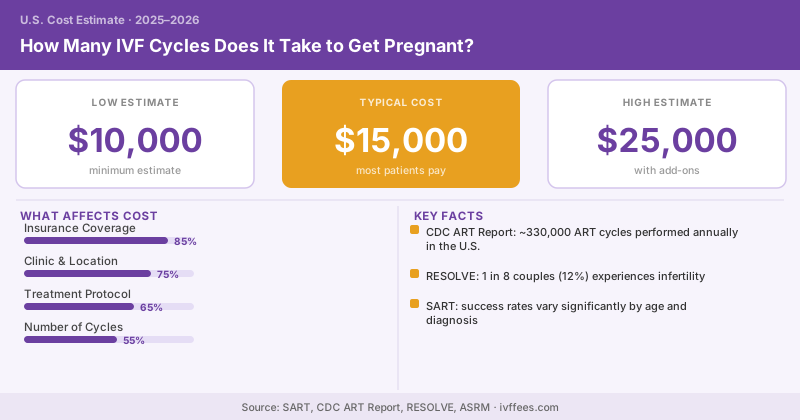
A retrieval cycle is the full stimulation-and-egg-retrieval process. It’s the expensive part ($12,000–$17,000 before medications).
A transfer cycle includes thawing a frozen embryo and transferring it. Much cheaper ($3,000–$5,000) — and many patients do 2–3 transfers from embryos banked in a single retrieval.
So “I did IVF three times” could mean three full retrievals ($45,000+) or one retrieval followed by three transfers ($20,000–$25,000 total). Big difference.
If you’re under 38 and respond well to stimulation, many reproductive endocrinologists recommend completing 1–2 retrieval cycles before any transfers. Banking multiple embryos gives you more transfer attempts — often at a fraction of the cost of additional retrievals.
The Real Cumulative Cost Model
Let’s run the actual numbers for a 36-year-old doing IVF with no insurance coverage:
| Scenario | Cycles | Estimated Cost |
|---|---|---|
| Success on first retrieval + fresh transfer | 1 retrieval, 1 transfer | $18,000–$25,000 |
| Success after retrieval + 2 frozen transfers | 1 retrieval, 2 FETs | $23,000–$31,000 |
| Two full retrievals + 2 transfers | 2 retrievals, 2 FETs | $38,000–$52,000 |
| Three retrievals to achieve live birth | 3 retrievals, 3–4 FETs | $54,000–$75,000 |
A 2024 analysis published in Fertility and Sterility found that among patients who ultimately had a live birth, the median total out-of-pocket spend was approximately $28,000–$33,000 — reflecting that most patients succeeded within two retrieval cycles with additional frozen transfers.
Why Some People Need More Cycles
Not everyone needs three tries. And not everyone succeeds even after three. Several factors push the cycle count higher:
- Age — egg quality declines after 35, more dramatically after 38
- Low ovarian reserve — fewer eggs retrieved means fewer embryos to work with
- Unexplained implantation failure — embryos form but don’t implant; PGT-A genetic testing can help identify chromosomally abnormal embryos
- Male factor infertility — ICSI usually solves this, but severe sperm DNA fragmentation may require additional workup
- Uterine factors — fibroids, polyps, or thin lining can cause transfer failures unrelated to embryo quality
If you’ve had two or more failed transfers of good-quality embryos, ask about a recurrent implantation failure (RIF) workup before spending money on another cycle. The issue may be diagnosable and treatable.
Shared-Risk Programs and Multi-Cycle Pricing
Because multiple cycles are common, many clinics offer multi-cycle packages or shared-risk (refund) programs:
- Multi-cycle discounts — typically 10–20% off when you prepay for 2–3 retrievals upfront
- Shared-risk programs — you pay $25,000–$35,000 for up to 3 cycles; if you don’t achieve a live birth, you get a significant refund (50–100% depending on the program)
These programs aren’t right for everyone — younger patients with good prognoses often pay more upfront than they need to. But for patients with uncertain prognosis, the financial certainty can be worth it. Read the fine print carefully on what qualifies for a refund.
Setting Realistic Expectations
RESOLVE, the national infertility association, consistently reports that the emotional and financial weight of multiple IVF cycles is one of the top stressors patients face. Going in with a clear plan — including a defined number of cycles you’re willing to attempt, a budget ceiling, and agreed criteria for changing course — makes the process more manageable.
The numbers aren’t discouraging. For patients under 40, cumulative success after 3 cycles is genuinely high. The key is knowing that cycle one is rarely the whole story, and planning your finances accordingly from the start.