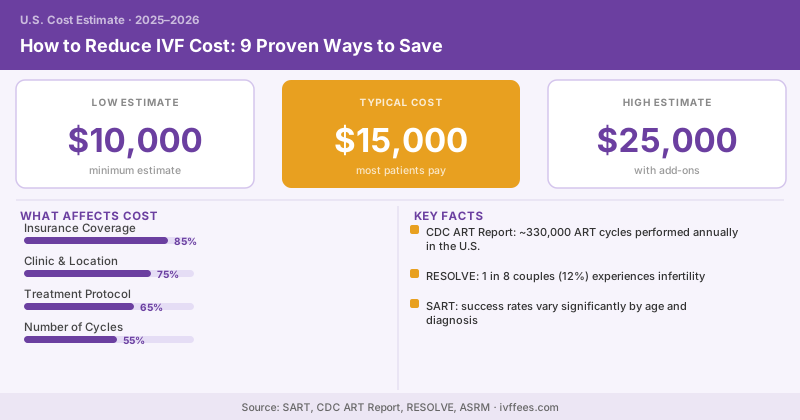
Most people assume IVF costs are fixed. They’re not. With the right strategies, many patients cut their out-of-pocket spend by 20–50% without compromising care. Here’s what actually works.
1. Check Your State’s Insurance Mandates First
Before paying anything out of pocket, find out if you’re covered. Nineteen states currently have some form of fertility insurance mandate — and if you live in one of them, your employer’s health plan may be legally required to cover IVF.
States with comprehensive IVF mandates include Illinois, New Jersey, Massachusetts, Connecticut, Maryland, and New York (mandate effective 2020). Requirements vary: some cover unlimited cycles, others cap at 3–6 lifetime attempts.
According to RESOLVE’s 2023 insurance survey, patients in mandate states who had IVF coverage paid a median of $3,200–$6,800 out of pocket per cycle versus $19,000+ for uninsured patients. That gap is enormous. See the full IVF insurance coverage guide and state-by-state mandate list.
Even in non-mandate states, some large employers (Amazon, Apple, Google, Starbucks, Walmart, Bank of America) offer IVF benefits voluntarily. Check your Summary Plan Description or call your HR benefits line specifically asking about “infertility treatment” and “assisted reproductive technology.”
2. Shop Medications — Don’t Fill at Your Clinic
Fertility medications are the single most negotiable line item in your IVF budget. The same prescription can cost $1,000–$3,000 less depending on where you fill it.
Strategies that work:
- Specialty pharmacies — Freedom Fertility, MDR Pharmacy, Mandell’s, Village Fertility Pharmacy all routinely undercut retail prices by 20–40%
- Manufacturer programs — Merck (Gonal-F), Ferring (Menopur, Bravelle), EMD Serono all have patient assistance programs for patients who qualify by income
- Compassionate care programs — RESOLVE’s donor medication program collects unused, sealed, clinic-certified medications from patients who have leftover doses. These can be obtained at steep discounts or free
- International pharmacy orders — legal for personal use in some circumstances; Canadian and European pharmacies often price 30–50% lower
Most patients who shop medications save $800–$2,500 per cycle versus clinic-dispensed pricing.
3. Shared-Risk (Refund) Programs
Shared-risk programs, offered by several national networks (CNY Fertility, Shady Grove, RMA, CCRM), charge a flat fee — typically $18,000–$35,000 — for up to 3–6 complete IVF cycles. If you don’t achieve a live birth, you receive a partial or full refund (percentage varies by program and protocol).
Who benefits most:
- Patients with uncertain prognosis (age 35–40, one failed cycle already)
- Couples with $30,000+ budgeted and psychological preference for financial certainty
- Patients willing to be locked into a specific clinic network
Who doesn’t benefit:
- Patients with excellent prognosis (likely to succeed in 1–2 cycles) — you’ll overpay for cycles you never use
- Patients who need highly individualized protocols that don’t fit program parameters
Read the fine print carefully. Most programs exclude patients with very low AMH, prior failed cycles above a certain count, or specific diagnoses. Many require you to use PGT-A testing (which adds cost within the program).
4. Mini-IVF (Minimal Stimulation IVF)
Mini-IVF uses lower doses of stimulation medications — or oral medications like Clomid/letrozole — to produce a smaller number of eggs. It’s not right for everyone, but for certain patient profiles, it dramatically reduces costs.
| Protocol | Medication Cost | Eggs Retrieved | Typical Total Cost |
|---|---|---|---|
| Conventional IVF | $3,000–$7,000 | 8–20 eggs | $18,000–$28,000 |
| Mini-IVF | $500–$1,500 | 2–5 eggs | $5,000–$10,000 |
Mini-IVF has lower per-cycle success rates (fewer eggs = fewer embryos = fewer chances), but multiple mini-IVF cycles can be comparable in cumulative cost and outcome to one conventional cycle — particularly for patients who respond poorly to high stimulation anyway.
Best candidates: women with low ovarian reserve who don’t produce many eggs even on high doses, and patients prioritizing cost over speed.
5. Clinical Trials and Research Programs
RESOLVE maintains a database of funded fertility research programs and clinical trials. Participating patients often receive:
- Discounted or free medications
- Reduced-cost monitoring
- Free genetic testing or additional procedures as part of the study protocol
The tradeoff: you may be randomized to a standard (vs. experimental) protocol, and trials have strict eligibility criteria. But for patients who qualify, participation can reduce total costs by $3,000–$10,000 per cycle.
Search clinicaltrials.gov for “IVF” or “in vitro fertilization” or check with your clinic’s research department.
6. Multi-Cycle Discounts
Even without a formal shared-risk program, many clinics offer a 10–20% discount if you prepay for two or three cycles upfront. This is worth negotiating — ask directly.
The math: at 15% off two cycles ($22,000 each), you save $6,600. The risk is that you succeed on cycle one and paid upfront for a cycle you didn’t need. Most clinics will credit unused prepaid cycles toward future care (frozen transfers, other procedures) rather than giving refunds.
7. Consider International IVF
The same IVF procedure costs $3,000–$8,000 in Spain, Czech Republic, Mexico, and Greece versus $15,000–$22,000 in the US. Many of these clinics are ESHRE-accredited, use the same laboratory equipment, and publish outcomes data comparable to top US clinics.
Realistic all-in cost including travel from the US:
- Spain or Czech Republic: $8,000–$14,000 (flights + accommodation + treatment)
- Mexico City or Cancun: $6,000–$10,000 (closer, cheaper travel)
The tradeoffs: legal complexity if anything goes wrong, fewer recourse options, need to re-do diagnostic testing locally for US records, and more logistical coordination. See the full IVF abroad cost guide.
International IVF isn’t right for every patient. If you have a complex diagnosis requiring ongoing monitoring, or need to coordinate with US specialists, a domestic clinic may be worth the premium. Evaluate your specific situation carefully before committing to international care.
8. Use HSA and FSA Funds
IVF is a qualified medical expense under IRS rules. If you have a Health Savings Account (HSA) or Flexible Spending Account (FSA), you can pay for IVF with pre-tax dollars.
The tax savings:
- At 22% federal tax bracket: $22,000 of IVF costs paid from HSA = ~$4,840 in tax savings
- At 24% bracket: the same expenses save ~$5,280
Eligible expenses include egg retrieval, embryo transfer, medications, monitoring, ICSI, embryo storage, and PGT testing. See the complete HSA/FSA fertility expenses guide.
9. Fertility Grants
Multiple organizations fund partial grants for IVF patients who demonstrate medical need and financial hardship. These don’t cover full costs, but can meaningfully reduce the gap.
Active grant programs include:
- Baby Quest Foundation — up to $15,000 per recipient
- Heart for Families Foundation — focus on underserved populations
- RESOLVE’s Hope Award — various grant amounts
- CNY Fertility’s LEAP program — income-based discount structure
- Starbucks Foundation grants (via employer)
Competition is real — these programs receive far more applicants than they can fund. Apply early, apply to multiple programs, and be thorough in applications. See the fertility grants complete guide.
What Combination Works Best?
| Strategy | Potential Savings | Best For |
|---|---|---|
| Insurance coverage | $15,000–$40,000+ | Mandate state employees |
| Medication shopping | $800–$2,500/cycle | Almost everyone |
| Shared-risk program | Varies | Uncertain prognosis, 35–40 age range |
| HSA/FSA pre-tax payment | $2,000–$6,000 | Anyone with payroll deductions available |
| Mini-IVF | $8,000–$15,000/cycle | Poor responders, cost-primary patients |
| International IVF | $8,000–$15,000/cycle | Healthy patients, standard diagnosis |
| Clinical trials | $3,000–$10,000 | Research-eligible patients |
| Grants | $1,000–$15,000 | Income-qualifying patients |
The best plan layers multiple strategies. Shop medications regardless of what else you do. Use HSA funds regardless of what else you do. Then evaluate shared-risk, international, or mini-IVF based on your specific age, diagnosis, and financial situation.