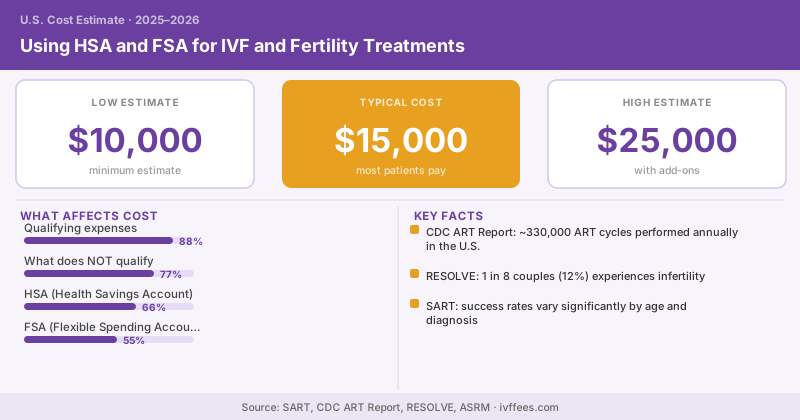
Pay for IVF with pre-tax dollars and you’ve effectively cut your bill by 22–37%, depending on your tax bracket. That’s not a coupon — that’s the IRS telling you fertility treatment is a legitimate medical expense. Most people underuse this benefit, either because they don’t realize how much qualifies or because they don’t max out their contributions before starting a cycle.
Here’s exactly what qualifies, what doesn’t, and how to maximize the tax advantage.
What Qualifies as an HSA/FSA Fertility Expense
IRS Publication 502 (Medical and Dental Expenses) defines what counts as an eligible medical expense. The list of fertility-related expenses is broader than most people realize.
Qualifying expenses:
- IVF (in vitro fertilization) — The entire IVF process qualifies: monitoring appointments, egg retrieval, fertilization, embryo culture, and embryo transfer.
- IUI (intrauterine insemination) — All associated costs qualify.
- Fertility medications — Injectable gonadotropins, oral medications (Clomid, letrozole), progesterone support, trigger shots, and other prescription medications used in fertility treatment are all eligible.
- Fertility diagnostics — Bloodwork, ultrasounds, semen analysis, AMH testing, and other diagnostic procedures related to infertility evaluation.
- Egg freezing (medical necessity) — When egg freezing is done for medical reasons (before cancer treatment, for example), it qualifies.
- Egg storage fees — Annual storage fees for frozen eggs or embryos qualify as medical expenses.
- Sperm freezing and storage — Same rules apply as egg storage.
- Donor sperm — The cost of donor sperm for use in fertility treatment qualifies.
- Surgical procedures — Hysteroscopy, laparoscopy, and other fertility-related surgical procedures qualify.
- Acupuncture — If recommended by a physician as part of fertility treatment, acupuncture costs qualify.
What does NOT qualify:
- Surrogacy fees — The IRS does not consider payment to a surrogate or gestational carrier a medical expense for the intended parent’s taxes.
- Adoption fees — Adoption costs don’t qualify as medical expenses (though a separate adoption tax credit may apply).
- Elective egg freezing — When done for purely social reasons without a medical diagnosis, the IRS has been inconsistent on this. Conservative approach: don’t assume it qualifies without the medical necessity documentation.
- Sperm donor fees paid to a donor directly — This has more ambiguity; sperm bank charges are cleaner.
The authoritative source is IRS Publication 502. For fertility specifically, expenses are deductible “if you are trying to overcome an inability to have children.” The IRS has also issued private letter rulings affirming IVF as a deductible medical expense. Your HSA/FSA administrator should honor these expenses without issues.
2025 Contribution Limits
HSA (Health Savings Account)
To contribute to an HSA, you must be enrolled in a High-Deductible Health Plan (HDHP). The 2025 IRS limits:
- Individual coverage: $4,300 per year
- Family coverage: $8,550 per year
- Catch-up contribution (age 55+): Additional $1,000 per year
These limits are set by the IRS and adjust annually for inflation. For 2024, the limits were $4,150 (individual) and $8,300 (family) — 2025 represents a modest increase.
FSA (Flexible Spending Account)
- Healthcare FSA: $3,300 per year (2025 IRS limit)
- Dependent care FSA: Separate limit, not applicable for fertility
- Use-it-or-lose-it rule: Most FSAs have a December 31 deadline. Some plans offer a 2.5-month grace period or a $640 rollover — check your plan specifics.
Unlike HSAs, FSAs don’t require enrollment in an HDHP. They’re available through most employer-sponsored benefit plans.
The Triple Tax Advantage of HSAs
This is why HSAs are the gold standard for medical savings:
1. Contributions are pre-tax — If you contribute through payroll deduction, the money goes in before federal income tax, FICA (Social Security and Medicare), and state income tax are calculated.
2. Growth is tax-free — HSA funds can be invested in mutual funds and other vehicles. Any growth is tax-free as long as it stays in the account.
3. Withdrawals for qualified expenses are tax-free — When you spend HSA funds on eligible medical expenses like IVF, there’s no tax owed.
The math at a 24% federal tax bracket:
- $8,550 contributed to HSA (family limit)
- Federal tax savings: $8,550 × 24% = $2,052
- State income tax savings (varies): approximately $400–$700 in most states
- FICA savings on payroll contributions: approximately $654
- Total tax savings: roughly $3,100–$3,400 on a fully maxed HSA
If you’re doing a $20,000 IVF cycle and paying with post-tax dollars versus HSA funds, the difference is real money.
| Account Type | 2025 Limit (Individual) | 2025 Limit (Family) | Tax Advantage |
|---|---|---|---|
| HSA | $4,300 | $8,550 | Triple (pre-tax, growth, withdrawal) |
| FSA | $3,300 | $3,300 | Pre-tax contributions only |
| HSA + FSA (limited-purpose FSA) | Up to $7,600 combined | Up to $11,850 combined | Both accounts stacked |
Timing Strategy: Max Before You Start
The single most important HSA/FSA strategy: maximize your contributions before your first cycle, not after. Here’s why:
With an FSA, you get access to the entire annual election amount on January 1 — before you’ve contributed a single dollar. If you elect $3,300 for the year, you can spend all $3,300 in February, even if you’ve only contributed $275 so far. The employer fronts the rest.
With an HSA, you need to build up the balance over time (or have saved prior years). But HSA balances roll over indefinitely, so there’s no penalty for starting early and accumulating over multiple years.
Practical approach: If you know you’ll be doing a cycle in Q1, elect the maximum FSA in the prior November open enrollment. Use those funds for your fertility expenses. For HSAs, keep contributing year-round and let the balance build for when you need it.
Can You Use Both an HSA and FSA?
Generally, no — you can’t have both a regular FSA and an HSA simultaneously. However, there’s an exception: a limited-purpose FSA (LPFSA) is specifically designed to pair with an HSA. LPFSAs typically cover only dental and vision expenses, so they don’t conflict with HSA rules. Some plans allow LPFSAs to convert to general-purpose FSAs once you’ve met your HDHP deductible, which could let you stack both accounts for fertility expenses.
Documentation: Keep Every Receipt
HSA and FSA administrators sometimes require documentation for fertility expenses, especially larger ones. Keep every EOB (Explanation of Benefits), clinic invoice, and pharmacy receipt. For self-pay expenses at fertility clinics, get itemized invoices showing the date of service and what was done.
The IRS can audit HSA withdrawals, and while fertility expenses are clearly legitimate, having documentation on hand protects you.
HSA and FSA contribution limits from IRS Revenue Procedure 2024-25 (2025 limits). Eligible expense guidance from IRS Publication 502 (2024 edition). Consult a tax professional for your specific situation — this is informational, not tax advice.