In 2010, ERA testing barely existed. Today it costs $800 and some REs swear by it. But before ERA, there’s a more fundamental test that’s been around for decades — and your RE may require it before your first transfer.
Hysteroscopy is a procedure that lets a physician look directly inside your uterine cavity using a thin, lighted scope. It’s the gold standard for evaluating the uterine environment before IVF — and it can find things that ultrasound and HSG miss. Here’s what it costs, what it reveals, and when it’s actually worth doing.
How Much Does a Hysteroscopy Cost?
Cost depends heavily on where the procedure is performed: in-office (least expensive), in an outpatient surgical center, or in a hospital operating room (most expensive).
| Setting | Low | Typical | High |
|---|---|---|---|
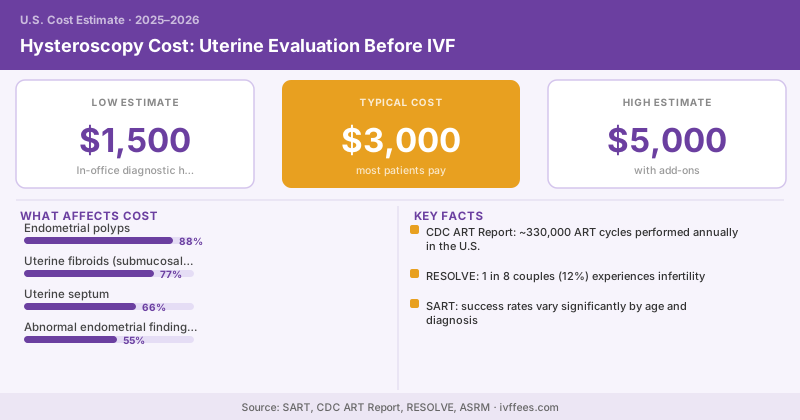
| In-office diagnostic hysteroscopy | $1,500 | $3,000 | $5,000 |
| Outpatient surgical center | $2,000 | $4,000 | $7,000 |
| Hospital-based (general anesthesia) | $3,500 | $6,000 | $12,000 |
| Operative hysteroscopy (with treatment) | $3,000 | $5,500 | $10,000 |
| With anesthesia billed separately | $500 | $1,200 | $3,000 |
Diagnostic vs. Operative Hysteroscopy
A diagnostic hysteroscopy is purely evaluative — the doctor looks, takes notes, possibly biopsies. An operative hysteroscopy combines evaluation with treatment in the same session — removing polyps, dividing a uterine septum, or cutting adhesions.
If you need both, combining them into one procedure is significantly more cost-effective than scheduling two separate procedures. Ask your RE upfront whether they can treat what they find in the same session.
What Hysteroscopy Can Find
This is why it matters before IVF. Hysteroscopy can detect:
Endometrial polyps: Small growths in the uterine lining. Present in approximately 24–32% of infertile women undergoing hysteroscopy, according to a meta-analysis in Fertility and Sterility. Polyps can interfere with embryo implantation and are easily removed during an operative hysteroscopy.
Uterine fibroids (submucosal): Fibroids that protrude into the uterine cavity. Even small submucosal fibroids can reduce IVF success rates by 30–50% if left untreated.
Uterine septum: A band of tissue dividing the uterine cavity. Associated with increased miscarriage risk and can often be resected during the same procedure.
Intrauterine adhesions (Asherman’s syndrome): Scar tissue bands inside the uterus. Rare but significant — causes recurrent implantation failure and can usually be treated surgically.
Abnormal endometrial findings: Including hyperplasia or suspicious lesions that warrant biopsy before proceeding with IVF.
Not necessarily. ASRM doesn’t mandate routine hysteroscopy before every IVF cycle. However, most REs recommend it if: prior IVF cycles have failed without explanation, a sonohysterogram (SHG) showed an abnormality, you’ve had prior uterine surgery, or you have risk factors for intrauterine pathology. Ask your RE for their specific recommendation and rationale.
Hysteroscopy vs. Sonohysterogram (SHG)
Many fertility clinics start with a sonohysterogram — a less invasive procedure where saline is infused into the uterus while ultrasound imaging is done. SHGs cost $300–$700 and can identify many of the same problems.
If the SHG is normal, hysteroscopy may not be needed. If the SHG shows an abnormality, hysteroscopy is usually the next step (and often combines diagnosis with treatment). Think of SHG as the screening test and hysteroscopy as the confirmatory, therapeutic procedure.
Insurance Coverage
Hysteroscopy is often covered by insurance when performed for diagnostic indications — uterine abnormality, abnormal bleeding, suspected pathology. The key is medical necessity documentation.
If your RE orders it specifically as “IVF preparation,” it may be categorized as a fertility procedure and denied. If it’s ordered for “evaluation of uterine abnormality found on prior imaging” or “abnormal uterine bleeding,” it’s more likely to be covered under general gynecological benefits.
Work with your RE’s billing coordinator to ensure the indication is coded properly. This alone can mean the difference between a $300 copay and a $4,000 bill.
If you’re quoted a price for hysteroscopy, ask whether that includes anesthesia, facility fees, and the pathology fees for any biopsies. These are frequently billed separately and can double the sticker price. Request an itemized estimate — not just the procedure code price — before your appointment.
Recovery and Timing
A diagnostic hysteroscopy done in office typically takes 15–20 minutes and requires no anesthesia or just local numbing. Most patients return to normal activity the same day with minor cramping.
An operative hysteroscopy may require light sedation or general anesthesia and a 1–2 day recovery. Timing-wise, you’ll typically need to wait 1–2 menstrual cycles after an operative procedure before starting an IVF cycle — so factor that into your treatment timeline if you need it.
The Bottom Line
A hysteroscopy before IVF isn’t always required, but it’s often one of the best investments you can make before spending $15,000–$25,000 on a retrieval cycle. Finding and fixing a polyp or adhesion before transfer can dramatically improve your chances. The key is getting the coding right for insurance and combining diagnostic and operative work whenever possible to minimize costs.