42% of all IVF cycles in the United States now use ICSI — even when there’s no male factor infertility. That number, reported in the CDC’s 2021 ART Surveillance Report, has sparked a significant debate in reproductive medicine: is ICSI being overused as a revenue driver?
Here’s what ICSI actually is, what it costs, and how to know whether you’re getting a necessary procedure or an expensive add-on you don’t need.
What ICSI Is
Intracytoplasmic sperm injection (ICSI) is a fertilization technique where a single sperm is injected directly into a mature egg using a microscopic needle. It was developed in the early 1990s as a treatment for severe male factor infertility — men with very low sperm counts, poor motility, or morphology issues that would prevent conventional fertilization.
In conventional IVF fertilization, tens of thousands of sperm are placed around each egg, and one naturally penetrates. ICSI bypasses that entire process.
When ICSI Is Medically Indicated
According to ASRM guidelines, ICSI is clearly indicated for:
- Severe oligospermia (very low sperm count)
- Severe asthenospermia (very low motility)
- Severe teratospermia (very abnormal morphology)
- Surgically retrieved sperm (TESA/PESA for azoospermia)
- Prior complete fertilization failure with conventional IVF
- Frozen sperm with limited sample size
- Frozen/thawed eggs (oocyte vitrification)
It’s not indicated in most cases of unexplained infertility, for routine use in donor egg cycles with a normal semen analysis, or “just in case.”
| ICSI Scenario | Low | Typical | High |
|---|---|---|---|
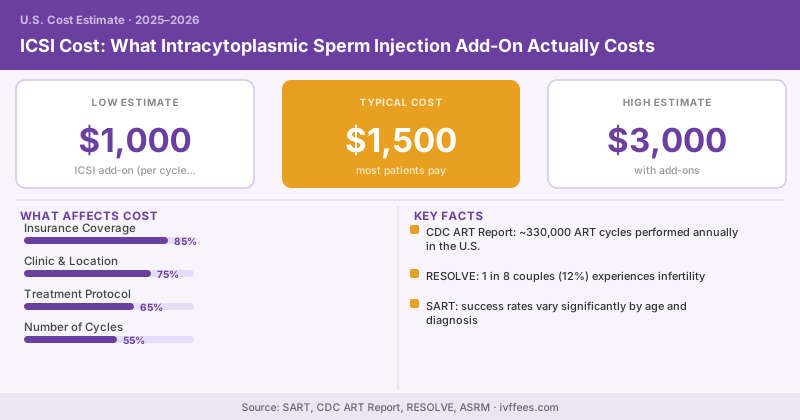
| ICSI add-on (per cycle) | $1,000 | $1,500 | $3,000 |
| ICSI for azoospermia with surgical sperm | $1,200 | $2,000 | $3,500 |
| Included in bundled IVF package | $0 | $0 | $0 |
| Split insemination (half ICSI, half conventional) | $500 | $1,000 | $1,800 |
Why It’s Being Used So Widely
The CDC’s ART data shows ICSI use has grown from 11% of IVF cycles in 1996 to over 40% today — with much of that growth coming from cases with no documented male factor. Studies from Stanford and ASRM have questioned whether this pattern reflects clinical need or financial incentive.
ICSI typically adds $1,000 to $2,000 to the cost of an IVF cycle. For a clinic performing 200 retrievals per year, adding ICSI to every cycle regardless of indication represents significant additional revenue.
A 2020 meta-analysis in Human Reproduction found no improvement in live birth rates when ICSI was used in non-male-factor IVF cases compared to conventional insemination. In other words: if your semen analysis is normal, ICSI may not help you — and it costs you more.
Before agreeing to ICSI, ask your RE directly: “Based on our semen analysis results, is ICSI medically indicated for us — or is this a routine add-on?” If the answer is “we recommend it for everyone,” that’s a yellow flag worth exploring further, especially if your semen analysis is normal.
ICSI and Frozen Eggs
If you’re using previously frozen eggs — either your own or from a donor egg bank — ICSI is widely recommended because the zona pellucida (outer shell of the egg) can harden during the freezing and thawing process, making conventional fertilization less reliable. In this context, ICSI has clearer clinical justification.
Split Insemination: A Middle Ground
Some clinics offer “split insemination” — half the mature eggs are inseminated conventionally, half via ICSI. This is a reasonable approach when the semen analysis is borderline or when there’s no prior fertilization data. It costs less than full ICSI and provides fertilization outcome data that can inform future cycles.
Does Insurance Cover ICSI?
In states with IVF insurance mandates, ICSI is typically covered when medically indicated — meaning when male factor infertility is documented. For routine ICSI without a documented indication, some insurers decline to cover the add-on. Always check your plan’s prior authorization requirements for ICSI specifically.
If you’re getting ICSI without a documented male factor diagnosis in your records, and you’re paying for it out-of-pocket, it’s fair to ask for the clinical rationale in writing. This isn’t confrontational — it’s informed consent.
Bottom Line
ICSI costs $1,000 to $3,000 as an add-on to IVF. It’s one of the most effective tools available when male factor infertility is present — and one of the most debated add-ons when it isn’t. If you’re paying for it, make sure it’s being used for a reason that applies to your specific case.