Here’s a truth that reproductive immunologists and mainstream RE practices don’t always agree on: the evidence base for immune testing in IVF is thin, the costs are high, and the treatments that follow testing are largely unproven in rigorous clinical trials.
That doesn’t mean immune testing is useless for every patient. It means you should go in with clear eyes about what you’re paying for — and why.
What Reproductive Immune Testing Covers
“Immune testing for IVF” is an umbrella term for a variety of tests that attempt to identify immune abnormalities that might be preventing embryo implantation. The tests ordered vary widely by practice.
Natural killer (NK) cell testing is the most commonly ordered. NK cells are part of the innate immune system and are found in the uterine lining (endometrium). The theory: elevated NK cell activity might “attack” the implanting embryo. Blood NK cells (measured from a blood draw) and uterine NK cells (measured via endometrial biopsy) are different tests that measure different things.
Th1/Th2 cytokine ratios. These blood tests measure inflammatory signaling molecules that theoretically reflect the immune environment during implantation. Elevated Th1 cytokines (pro-inflammatory) relative to Th2 cytokines are hypothesized to impair implantation.
HLA (human leukocyte antigen) typing. Some theories suggest that excessive HLA similarity between partners may impair implantation, though this has largely been discredited by larger studies.
Antiphospholipid and thrombophilia panels. Antiphospholipid syndrome testing (lupus anticoagulant, anticardiolipin antibodies) is guideline-recommended for RPL and is distinct from the speculative immune tests above.
| Immune Test | Low | Typical | High |
|---|---|---|---|
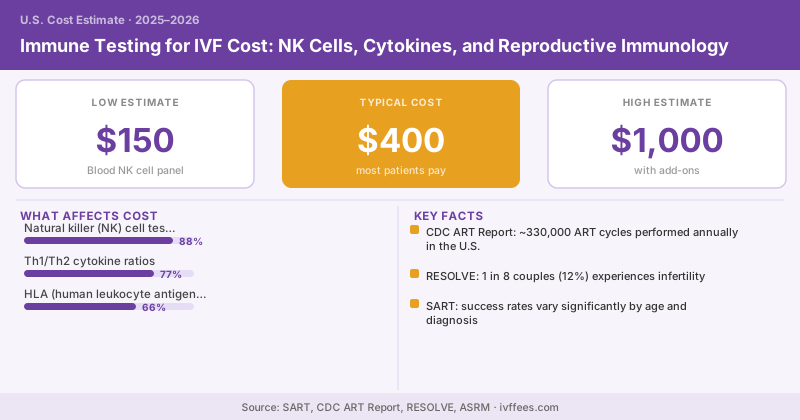
| Blood NK cell panel | $150 | $400 | $1,000 |
| Uterine NK cell biopsy + analysis | $500 | $1,200 | $3,000 |
| Th1/Th2 cytokine ratio | $200 | $500 | $1,000 |
| Full reproductive immunology panel | $500 | $2,000 | $6,000 |
| Antiphospholipid syndrome testing | $100 | $300 | $800 |
The Evidence Problem
ASRM’s Practice Committee has explicitly stated that immune testing panels (NK cell testing, cytokine profiling, HLA typing) are not recommended for routine IVF evaluation or for patients with recurrent implantation failure. The reasons:
- No validated reference ranges. There’s no consensus on what level of NK cells is “abnormal” or clinically meaningful for implantation.
- No proven treatments. The treatments that follow positive immune tests — steroids, IVIG (intravenous immunoglobulin), intralipid infusions, TNF-alpha blockers — have not been shown to improve live birth rates in well-designed randomized controlled trials.
- Significant variation between labs. Results from the same blood sample can differ meaningfully between testing laboratories, making results unreliable.
A 2021 systematic review in Fertility and Sterility concluded that immune testing panels in IVF patients with recurrent implantation failure or RPL lacked the evidence base to guide treatment decisions.
Reproductive immunology practices and some private IVF clinics offer immune testing. Mainstream academic reproductive medicine centers are generally more conservative. If your RE recommends a full immune panel on your first IVF consultation without a history of multiple failed cycles, ask for the clinical rationale and the evidence behind the recommended treatments.
The Intralipid / IVIG Question
If you test positive on NK cell or cytokine tests, the typical treatment recommendation is intravenous intralipid infusions or IVIG — both expensive (IVIG can run $2,000 to $5,000 per infusion) and neither with strong RCT evidence for improving IVF outcomes.
IVIG is FDA-approved for immune deficiency conditions — it’s an off-label use for IVF. Some insurance plans will not cover it for this indication.
When Immune Evaluation May Be Worth Exploring
Despite the weak evidence base, some patients and their REs reasonably consider immune evaluation in:
- Multiple failed IVF cycles with euploid embryos. If you’ve transferred 3+ chromosomally normal embryos without implantation, you’re in a category where the standard explanations don’t apply. It’s reasonable to look further, even if the evidence is thin.
- Documented autoimmune conditions. Patients with lupus, rheumatoid arthritis, or other autoimmune conditions may have relevant immune considerations that standard REs aren’t equipped to manage — a reproductive immunologist consultation may add value.
- Antiphospholipid syndrome. This is the one immune condition with clear treatment guidance (low-dose aspirin plus heparin) — and it should be tested in any patient with RPL or failed transfers.
Be cautious of clinics that recommend a full immune panel as part of their standard workup for all IVF patients, or that recommend it after only one failed cycle. The costs are high and the evidence doesn’t support routine use.
Bottom Line
Reproductive immune testing costs $500 to $6,000 for a full panel. The evidence for most of this testing — particularly NK cell assays, cytokine panels, and HLA typing — is weak, and the treatments that follow are not supported by rigorous clinical trial data. The exception is antiphospholipid syndrome testing, which is evidence-based and has clear treatment implications. If you’re considering immune testing after multiple failed IVF cycles, get a second opinion from a mainstream academic RE before committing to expensive panels with uncertain clinical value.