Standard ICSI uses 200–400x magnification to select the single sperm injected into each egg. IMSI — Intracytoplasmic Morphologically Selected Sperm Injection — uses 6,000x or higher. At that level of magnification, embryologists can see nuclear vacuoles and other structural abnormalities invisible at standard ICSI magnification.
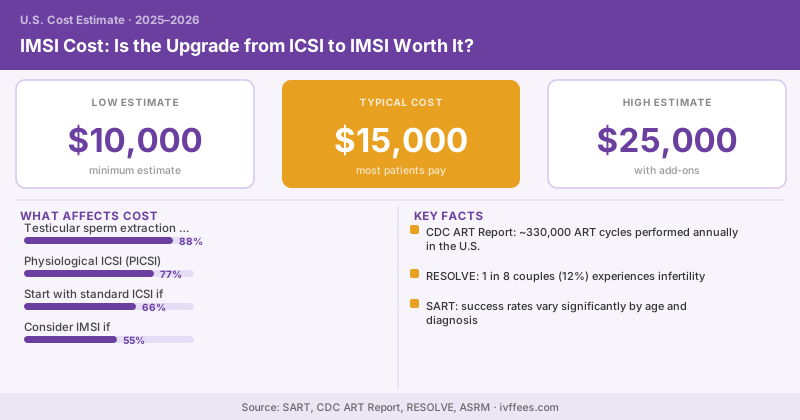
The question isn’t whether IMSI shows more. It does. The question is whether what it shows predicts outcomes well enough to justify $500–$2,500 in additional cost per cycle.
What IMSI Actually Does Differently
In standard ICSI, sperm are selected using a microscope at 200–400x magnification. The embryologist looks for normal morphology by standard criteria and chooses sperm with good shape and motility. The whole selection process takes a few minutes per sperm.
IMSI adds a step: before injection, each candidate sperm is examined at 6,000–10,000x magnification (using Nomarski differential interference contrast optics) specifically to evaluate the sperm nucleus. The main target is nuclear vacuoles — large dark spots in the sperm head that indicate chromatin packaging abnormalities.
Research has linked large nuclear vacuoles to higher rates of DNA fragmentation and poorer embryo development. The theory behind IMSI is that eliminating vacuolated sperm from selection should improve embryo quality and pregnancy rates.
What the Evidence Actually Shows
This is where it gets complicated. The early studies on IMSI (2006–2012) were promising, suggesting improved fertilization rates and pregnancy rates, particularly in men with severe morphology issues. But more recent and better-designed randomized controlled trials have muddied the picture.
A 2018 meta-analysis in Reproductive BioMedicine Online (Teixeira et al.) found that IMSI improved clinical pregnancy rates in patients with prior failed ICSI cycles or severe teratospermia, but showed no significant benefit over standard ICSI in unselected populations.
The ASRM practice committee notes that evidence for IMSI remains insufficient to recommend it as routine — but does not discourage it in selected cases.
The WHO’s global analysis of male infertility data (2021) reinforced that morphology abnormalities affect roughly 50% of infertile men, but morphology alone is a poor predictor of IVF outcome.
Most fertility specialists agree IMSI has the strongest argument in these specific situations:
- Prior failed ICSI cycles with good-quality eggs but poor fertilization or embryo development
- Severe teratospermia (very high percentage of abnormal morphology by strict Kruger criteria)
- Elevated sperm DNA fragmentation combined with poor past ICSI results
- Couples with recurrent miscarriage after ICSI-generated embryos
For a first cycle with moderate male factor, standard ICSI is typically the starting point.
Cost Comparison: ICSI vs. IMSI
| Procedure | Typical Add-On Cost | Base IVF Required |
|---|---|---|
| Standard ICSI | $1,000 – $3,000 | Yes |
| IMSI | $1,500 – $5,500 | Yes |
| IMSI premium over ICSI | $500 – $2,500 | — |
The premium varies by clinic. Some clinics charge IMSI as a flat fee above ICSI; others bundle it with a “male factor package.” The extra cost primarily reflects the embryologist’s time — IMSI selection is significantly more time-intensive than standard ICSI, taking 2–4x longer per sperm. That lab time costs money.
What’s the Alternative?
If elevated DNA fragmentation is the underlying concern (which overlaps significantly with the rationale for IMSI), alternatives include:
Testicular sperm extraction for ICSI: Testicular sperm typically has lower DNA fragmentation than ejaculated sperm. A TESA procedure costs $1,000–$3,500 and may be more clinically targeted than IMSI for men with high DNA fragmentation.
Physiological ICSI (PICSI): A different sperm selection method that uses hyaluronic acid binding to identify more mature sperm with less DNA damage. Typically costs $300–$800 more than standard ICSI. A 2019 RCT (HABSelect trial, published in The Lancet) found PICSI didn’t improve live birth rates overall, but did reduce miscarriage in a subgroup analysis.
Magnetic-activated cell sorting (MACS): Separates apoptotic (dying) sperm using magnetic beads. Add-on cost: $300–$800. Limited evidence base.
IMSI is not available at every IVF clinic. It requires specialized optical equipment and trained embryologists. Before assuming your clinic offers it, ask specifically whether they perform IMSI routinely or only on request — and whether they’ve published or tracked outcomes data for it. Lab volume and embryologist experience matter as much as the technique itself.
How to Decide
A straightforward decision framework:
Start with standard ICSI if:
- First IVF cycle
- Male factor is moderate (count/motility below normal but not severe)
- No prior failed cycles
- Sperm DNA fragmentation not tested or normal
Consider IMSI if:
- One or more failed ICSI cycles with unexplained poor fertilization or embryo arrest
- Severe teratospermia (less than 1–2% normal morphology on strict Kruger)
- Elevated DNA fragmentation index AND prior poor ICSI outcomes
- The clinic has documented IMSI experience and tracks outcomes
Consider testicular sperm retrieval instead if:
- DNA fragmentation is very high (DFI above 30–40%)
- Prior fertilization failure with ejaculated sperm despite good egg quality
- Elevated fragmentation with otherwise adequate sperm counts
The full IVF cost breakdown puts these add-on decisions in perspective — IMSI adds 3–15% to total cycle cost. For a couple already spending $15,000–$20,000 on IVF, the IMSI upgrade represents a meaningful but not prohibitive additional investment if the clinical rationale is there. The key is making sure the indication actually fits before adding the cost.