“Our local clinic quoted $25,000. Our Prague clinic charged $4,800 for the same protocol with the same lab success rates.” That’s a real comment from a patient on a major fertility forum — and it represents thousands of Americans’ experiences with international IVF.
Medical tourism for fertility treatment is more common than most people realize. Tens of thousands of American couples travel abroad for IVF each year, driven primarily by cost — and often finding clinical quality that matches or exceeds what they’d get at home. But it’s not without real risks and tradeoffs. Here’s what you actually need to know.
IVF Cost Abroad vs. United States
| Country | Base IVF Cost | With Medications | Total All-In (est.) |
|---|---|---|---|
| United States | $12,000–$18,000 | $15,000–$25,000 | $18,000–$35,000 |
| Mexico (TJ, CDMX) | $3,500–$6,000 | $5,000–$9,000 | $6,000–$12,000 |
| Czech Republic | $2,500–$4,500 | $4,000–$7,000 | $5,000–$10,000 |
| Spain | $4,000–$7,000 | $6,000–$10,000 | $7,500–$14,000 |
| Greece | $3,000–$5,500 | $4,500–$8,000 | $6,000–$12,000 |
| Colombia | $3,000–$5,000 | $4,000–$7,500 | $5,500–$10,000 |
Travel and accommodation add $1,500–$4,000 per trip. Most IVF cycles require 2–3 visits (initial consult, monitoring/retrieval, transfer).
Why Is IVF So Much Cheaper Abroad?
Lower overall IVF costs in popular medical tourism destinations come from several factors:
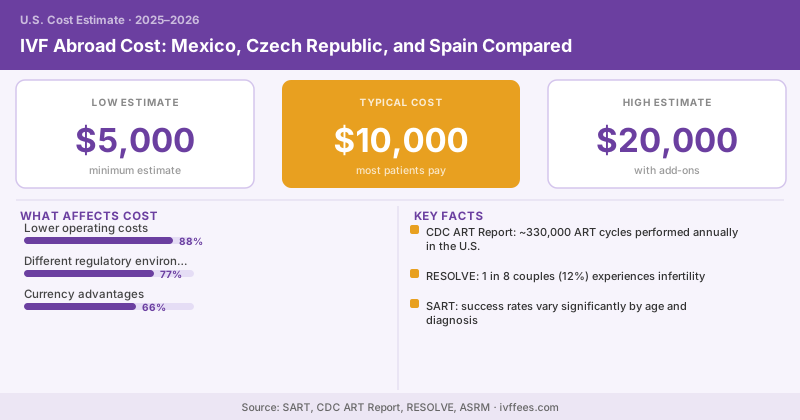
Lower operating costs: Staff salaries, real estate, malpractice insurance, and administrative overhead are dramatically lower in Eastern Europe and Latin America than in the United States.
Different regulatory environment: In some countries, there’s less litigation risk and lower regulatory compliance cost. This isn’t always good (less oversight), but it does reduce costs.
Currency advantages: For Americans paying in dollars, favorable exchange rates with the Czech koruna or Mexican peso amplify savings.
Competition for international patients: Countries like Spain and Czech Republic actively market to fertility tourists and compete on both price and quality.
Czech Republic: The IVF Capital of Europe
Prague and Brno are two of the most popular IVF destinations for American patients. The Czech Republic has:
- Highly regulated, EU-supervised fertility clinics
- A high density of experienced embryologists trained in top EU programs
- Published success rates that are independently audited (European IVF Monitoring data)
- Lower costs than almost anywhere in Western Europe
Major Czech clinics that American patients commonly use include GENNET (Prague), Reprofit International (Brno), and FertilityClinic (Prague). These clinics have English-speaking staff specifically for international patients and extensive telemedicine infrastructure.
A complete Czech IVF cycle — monitoring, retrieval, lab work, and fresh transfer — runs €2,200–€4,000 (approximately $2,400–$4,400 at current rates). Add €1,200–€2,000 for medications purchased locally. Add $2,000–$3,500 for two round-trip flights and a week’s accommodation.
Total: often under $10,000 for an IVF cycle that would cost $25,000–$30,000+ in New York or San Francisco.
Spain: Donor Egg IVF Hub
Spain is particularly popular for donor egg IVF. Spanish law allows anonymous egg donation, and Spain has one of the largest and most diverse donor egg banks in Europe. The quality of egg donors is regulated by the national bioethics committee, and clinics must meet strict standards.
IVF with donor eggs in Spain typically runs €4,000–€8,000 — compared to $35,000–$55,000 in the United States (where donor egg IVF includes significant donor compensation and agency fees). Spanish donors receive compensation capped by national regulations at €1,000 (far below the $20,000–$50,000 an American egg donor might receive), which is one reason costs are so dramatically different.
Major Spanish clinics serving international patients: IVF Spain (Alicante), Institut Marquès (Barcelona), Clínica Rinomédica (Valencia).
In Spain, egg donors are anonymous by law — you won’t have access to donor identity information. In the U.S., donor-conceived children have legal rights to donor information in some states, and open-ID donation is common. This is a significant ethical and practical difference. Consider whether anonymity vs. access matters for your family before choosing an international program.
Mexico: The Closest Option for American Patients
For Americans in Southern California, Texas, Arizona, and the Southwest, Mexico — particularly Tijuana, Guadalajara, and Mexico City — offers IVF at dramatically lower cost with minimal travel time.
Tijuana is 30 minutes from San Diego. Several respected fertility clinics there operate with U.S.-trained physicians and offer IVF packages at $3,500–$6,000. For many San Diego or LA residents, this is the most practical international option.
Quality varies more in Mexico than in the Czech Republic or Spain, so research is critical. Look for clinics with:
- COFEPRIS (Mexican health agency) accreditation
- Published SART-equivalent success rate data
- Active online communities with verifiable patient testimonials
What to Investigate Before Traveling for IVF
Success rate data: Ask for the clinic’s live birth rate per embryo transfer, broken down by patient age and diagnosis. Be skeptical of any clinic that can’t provide this.
Lab accreditation: Is the embryology lab accredited by ESHRE (European Society of Human Reproduction and Embryology) or an equivalent body? Unaccredited labs vary enormously in quality.
Communication infrastructure: How will monitoring be managed? Will you do some blood work and ultrasounds locally and send results? What’s the telemedicine protocol?
Legal rights: In case of a dispute, what legal recourse do you have? Medical malpractice claims in foreign countries are difficult to pursue. Make sure you understand this going in.
Medication logistics: Can you bring medications from the U.S. if you have U.S. prescriptions? Or do you purchase locally? Some countries’ medications are perfectly fine; others may require U.S. sourcing.
Never choose an international IVF clinic based primarily on price. A clinic charging $2,000 less than a reputable Czech facility but with poor lab outcomes or no published success data is not saving you money — it’s increasing your risk of treatment failure and repeat cycles. Price is one data point; clinical outcomes and accreditation matter more.
The Hidden Costs of IVF Abroad
Sticker price comparisons don’t capture everything:
- Flight costs: 2–3 international round trips at $500–$1,500 each
- Accommodation: 1–2 weeks per trip at $80–$200/night
- Time off work: Significant, especially for retrieval cycles
- Communication challenges: Not all international clinics have seamless English-language care
- Canceled cycles: If a cycle is cancelled after you’ve traveled, you’ve still spent money on travel
- Frozen transfer logistics: If embryos are created abroad, transferring them back to the U.S. requires shipping, which is expensive and has some technical risk
Realistic all-in cost for international IVF with two trips: add $3,000–$7,000 to the sticker clinic price.
The Bottom Line
IVF abroad is a legitimate option that saves thousands of American patients significant money each year. The Czech Republic and Spain offer particularly strong clinical quality at dramatically lower prices than U.S. clinics. Mexico offers the advantage of proximity for patients in the Southwest. The key is doing thorough research on clinical outcomes — not just prices — and understanding the legal and logistical tradeoffs. For self-paying patients facing $25,000–$35,000 U.S. treatment costs, international IVF at $8,000–$15,000 all-in is often worth serious consideration.