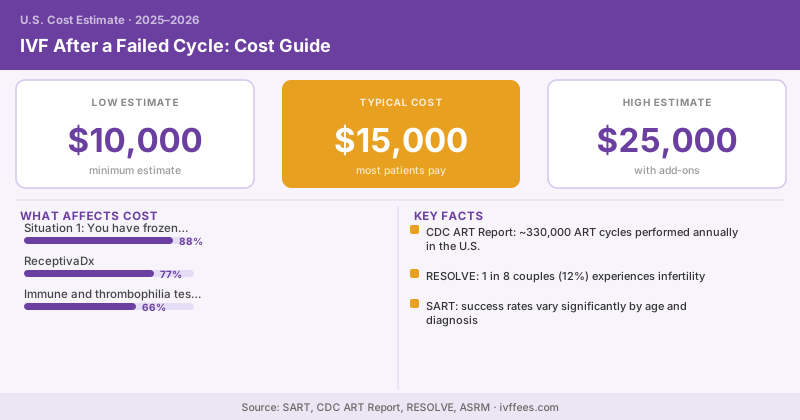
42% of women under 35 who do IVF don’t get pregnant on the first cycle. That’s not a failure of your body — it’s the statistical reality of the procedure. And it raises an immediate, painful question: what does the next attempt cost?
The answer is more complicated than “pay full price again.” Your options after a failed cycle depend heavily on whether you have frozen embryos waiting, what your clinic’s protocol looks like, and whether you want to investigate what went wrong. Here’s the full breakdown.
Your Options After a Failed IVF Cycle
Not every failed cycle is the same. There are two fundamentally different situations:
Situation 1: You have frozen embryos. Your retrieval worked — you have blastocysts in storage. The cycle failed at the transfer stage. A frozen embryo transfer (FET) is your next step, at a fraction of fresh cycle cost.
Situation 2: You have no frozen embryos. Either the retrieval produced no viable embryos, or all embryos were transferred or lost. You’ll need a new stimulation cycle — full price.
| Path Forward | Estimated Cost |
|---|---|
| Frozen embryo transfer (FET) from prior cycle | $3,000–$6,000 |
| Full fresh IVF cycle (new stimulation + retrieval) | $12,000–$20,000 |
| Medications for FET (hormone prep) | $300–$1,500 |
| Medications for fresh cycle | $3,000–$7,000 |
| Shared-risk / multi-cycle program | $20,000–$30,000 total |
| Additional diagnostic testing after failure | $500–$2,000 |
If you have frozen embryos, the FET path is almost always the right next step. You’re not repeating the hard, expensive part — the retrieval. You’re just preparing your uterus to receive an embryo you already have. Most clinics charge $3,000–$6,000 for a FET cycle including monitoring and the transfer procedure.
What a Second Fresh IVF Cycle Costs
If you need a new retrieval, you’re looking at a full repeat of your first IVF cycle. Clinics rarely discount for repeat patients — the lab costs, physician time, and medications are the same regardless of your history. Budget $12,000–$20,000 depending on your clinic’s location and pricing structure.
Medications are typically $3,000–$7,000 on top of the clinic fee. If your first cycle showed that you respond well to stimulation, your protocol may stay similar. If you responded poorly — few eggs retrieved, poor quality — your RE may adjust to a higher dose or a different protocol (antagonist vs. long lupron), which might change the medication cost modestly.
Shared-Risk and Multi-Cycle Programs
Many clinics offer “shared-risk” or “refund guarantee” programs that bundle multiple cycles into a single upfront payment with a partial refund if you don’t achieve a live birth. These programs typically cost $20,000–$30,000 and cover 2–3 fresh cycles and their associated FETs.
They’re financially smart for some patients and wasteful for others. The math works in your favor if:
- You’re under 38 with a good prognosis who needed more than one cycle
- You were declined from the program on your first try but can now re-qualify (programs often screen applicants)
- You have the cash flow to pay the lump sum upfront
The math works against you if your clinic’s per-cycle success rates are high enough that you’d have been better off paying à la carte.
Read the exclusion clauses carefully before signing. Most programs require you to complete all included cycles before receiving a refund — you can’t opt out after cycle two if you’re pregnant but miscarried. Some exclude genetic testing (PGT-A) from the package, meaning your out-of-pocket costs are still significant even within a “bundled” program. Ask specifically: what counts as a qualifying transfer? Is a biochemical pregnancy (positive test, early loss) considered a live birth attempt?
Investigating What Went Wrong: Diagnostic Costs
After a failed cycle — especially a failed FET with a chromosomally normal embryo — many REs recommend additional testing before the next attempt. This is sometimes called a “failed implantation workup” and typically adds $500–$2,000 to your total costs.
Common tests after failed cycles:
ERA (Endometrial Receptivity Analysis): A biopsy-based test that identifies your personal “window of implantation” — the optimal timing for transfer. Costs $650–$900 and requires a mock transfer cycle, adding roughly $1,000–$2,000 to your prep costs.
ReceptivaDx: Tests for endometrial BCL6 expression, a marker associated with endometriosis and implantation failure. Costs $650–$800 and is done via endometrial biopsy.
Immune and thrombophilia testing: Panels looking at natural killer cell activity, antiphospholipid antibodies, and clotting factors. Costs $200–$800 depending on how many markers are tested.
These tests are not universally recommended after a first failed cycle. ASRM guidelines note there’s insufficient evidence to recommend routine immune testing for implantation failure. But after two or more failed transfers with normal embryos, the diagnostic workup becomes more justified.
What the Statistics Say About Your Next Attempt
Here’s the data that matters most when you’re deciding whether to keep going.
CDC ART Success Rates data consistently shows that cumulative live birth rates improve substantially with additional cycles. For women under 35 using their own eggs, CDC data indicates approximately 65% achieve a live birth within three complete IVF cycles — meaning most patients who persist through a first failure do eventually succeed.
SART’s 2022 national summary data showed that for patients who returned for a second cycle after an unsuccessful first attempt, clinical pregnancy rates were comparable to — and in some age groups slightly higher than — first-cycle rates, likely because protocols were adjusted based on the first cycle’s information.
A failed cycle is not a prediction of future failure. An embryo that doesn’t implant tells you something happened at the implantation stage — it doesn’t tell you whether the next embryo will behave the same way. Chromosomally normal embryos from PGT-A testing fail to implant 20–30% of the time even in ideal uterine environments. That’s a known limitation of the technology, not a sign that you can’t carry a pregnancy.
Financing a Second Cycle
Most fertility clinics offer payment plans, and a second cycle is often where patients first access outside financing. Options include:
- Clinic payment plans: Many clinics split the balance into 3–6 month installments, sometimes interest-free
- CareCredit: 0% promotional financing for 12–18 months on approved amounts; standard for fertility financing
- CapexMD / Future Family: Fertility-specific loan products with rates typically 10–18% APR
- HSA/FSA funds: If you have remaining funds, apply them to FET or diagnostic costs first — they won’t last forever
If you used your insurance’s IVF coverage on your first cycle and are now out of benefit, a second cycle will likely be fully out-of-pocket. Confirm your benefits remaining before your next appointment.
The Bottom Line
A frozen embryo transfer after a failed cycle costs $3,000–$6,000. A full second fresh cycle costs $12,000–$20,000. Before you default to either, have an honest conversation with your RE about what they think went wrong — and whether additional diagnostic testing changes the plan. Most couples who continue treatment after a first failed cycle do eventually have a baby. The path is harder and more expensive than anyone hopes, but the statistics are on your side if you can keep going.