Nobody starts IVF expecting to do it more than once. The reality is different. According to SART’s national data, the cumulative live birth rate for a single IVF cycle in women under 35 is approximately 40–45% — meaning more than half of those patients don’t succeed on the first try and face the decision of what to do next.
If you’re planning a second, third, or fourth cycle, here’s how the financial math changes — and what protocol adjustments cost.
Why Repeat Cycles Cost Different Amounts
Not every IVF cycle is the same. Your second cycle might cost more, less, or the same as your first depending on what your RE recommends changing.
Protocol modifications that can increase cost:
- Adding PGT-A testing after a first cycle without it: +$2,000 to $4,000
- Adding ERA testing to identify a displaced implantation window: +$800 to $2,000
- Adding ICSI if fertilization was suboptimal: +$1,000 to $2,000
- Switching to a freeze-all strategy: +$3,000 to $5,000 (FET cycle added)
- Adding immune testing or treatments: +$500 to $3,000
Protocol changes that can decrease cost:
- Switching from fresh to frozen transfer (if fresh was expensive and failed)
- Using banked embryos from a prior cycle (no new retrieval needed): $3,000 to $5,000 for FET only
- Reducing medication doses if OHSS was a concern in the prior cycle
- Trying mini-IVF if high-dose stimulation yielded poor embryo quality
| Repeat IVF Scenario | Low | Typical | High |
|---|---|---|---|
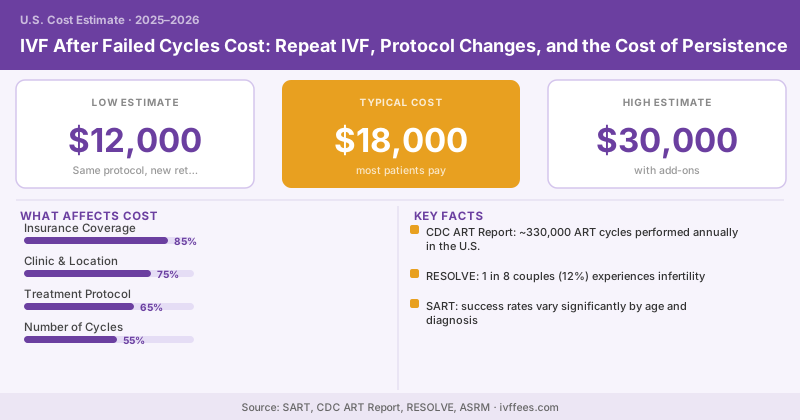
| Same protocol, new retrieval | $12,000 | $18,000 | $30,000 |
| New retrieval + protocol modification | $13,000 | $20,000 | $35,000 |
| FET only (using banked embryos) | $3,000 | $5,000 | $8,000 |
| New retrieval + PGT-A added | $15,000 | $22,000 | $38,000 |
| Cumulative after 3 own-egg retrievals | $35,000 | $55,000 | $100,000+ |
The Protocol Change Question: What Should Be Different?
After a failed cycle, one of the most important conversations is: what, if anything, should change? The right answer depends on why the cycle failed.
Failed at fertilization or early embryo development:
- Was ICSI used? If not, should it be?
- Sperm DNA fragmentation testing warranted
- Consider different culture conditions or media
Poor response to stimulation:
- Protocol change: flare, estrogen priming, different gonadotropin brand
- Consider DHEA supplementation before next cycle
- Consider mini-IVF if high-dose protocols yielded poor quality
Failed implantation with good embryos:
- ERA testing to assess endometrial receptivity timing
- Uterine re-evaluation (repeat SIS or hysteroscopy)
- Thrombophilia testing if not done
- Thyroid function re-check
Failed implantation with chromosomally normal (euploid) embryos:
- This is the hardest scenario. A euploid embryo transfer failing suggests uterine factors or immune factors
- Endometrial receptivity testing (ERA)
- Careful review of progesterone levels during FET prep
- Consideration of reproductive immunology consultation
Keep your own records of every cycle: medication doses, monitoring results (follicle sizes and counts, estradiol levels), retrieval outcomes, fertilization and blastocyst development, and embryo grades. When you change protocols or change clinics, this information is essential. Don’t rely solely on your clinic to track it.
When to Consider Changing Clinics
Changing clinics is emotionally difficult but financially can be worthwhile. Consider it when:
- You’ve had 2+ failed cycles with no meaningful protocol change recommendations
- Your clinic’s SART-reported success rates are below national average for your age group
- The financial package at another clinic offers better terms for multi-cycle patients
- You want a subspecialist for a complex diagnosis (endometriosis, DOR, recurrent implantation failure)
Clinic changes typically require re-evaluation costs ($300 to $800 for a new consultation and records review), but this is usually worthwhile if it means a fundamentally different clinical approach.
Multi-Cycle Packages and Shared-Risk Programs
Many clinics offer multi-cycle packages at a discount if you purchase 2–3 cycles upfront. A typical two-cycle package saves $3,000 to $8,000 compared to paying for cycles individually.
Shared-risk (refund) programs cover multiple IVF cycles for a fixed fee — often $20,000 to $35,000 — with a partial refund if no live birth results. These programs are only available to patients who meet specific criteria (usually under 40, good ovarian reserve, no previous failed IVF). If you qualify, they offer a financial safety net for repeat cycling.
One important caveat: shared-risk programs are structured so the clinic makes money on average. They’re good deals for patients who end up doing many cycles and don’t succeed; they’re less good for patients who succeed on the first or second try (you overpaid for insurance you didn’t need).
The Cumulative Emotional and Financial Cost
After three failed IVF cycles, the cumulative financial and emotional burden is significant. RESOLVE: The National Infertility Association reports that financial stress is the most commonly cited barrier to continuing infertility treatment — more frequently cited than the physical or emotional demands of treatment itself.
If you’ve done three or more cycles and haven’t succeeded, consider requesting a comprehensive review that includes:
- Fresh eyes from a second RE
- Assessment of whether donor eggs should be discussed (if not already)
- Discussion of alternative paths (embryo adoption, gestational carrier, domestic adoption)
- A frank conversation about cumulative costs vs. probability of success for further cycles
This isn’t giving up — it’s strategic planning with accurate information.
There is no universal answer to “how many cycles should I try?” The decision depends on your age, ovarian reserve, diagnosis, whether you have banked euploid embryos, and your financial and emotional capacity. What there is: a right to ask your RE exactly what the evidence shows for your specific situation, not a generic “keep trying” or “give up” recommendation.
The Math: Cumulative Spending vs. Success Probability
Here’s a framework that some couples find useful:
For a 38-year-old woman with normal ovarian reserve and no identified diagnosis:
- Cycle 1: ~35% success rate, ~$20,000
- Cycle 2 (after 1 failure): ~30% success rate (cumulative ~55%), ~$20,000
- Cycle 3 (after 2 failures): ~25% success rate (cumulative ~66%), ~$20,000
- Total after 3 cycles: ~$60,000 spent, ~66% cumulative probability of success
Compare to donor egg IVF: ~45–50% success rate per transfer, ~$35,000 to $45,000.
Neither path is objectively right. But seeing the numbers explicitly helps couples make a decision that’s theirs — not just a default continuation of whatever they’ve been doing.
Bottom Line
Repeat IVF after failed cycles costs $10,000 to $35,000 per attempt depending on what protocol changes are made. Cumulative costs after three to four cycles frequently reach $50,000 to $100,000. The key financial decision points are: whether to do another own-egg retrieval, whether to try frozen embryo transfer from existing banked embryos, and when to seriously evaluate alternative paths including donor eggs.