You injected medications for eight days, went in for monitoring five times, and then your RE called with the news: the cycle is cancelled. You didn’t get a retrieval. You didn’t get any embryos.
And you still owe money.
Cycle cancellation is one of the most financially disorienting things that can happen during IVF. Many patients are blindsided by the bill because their clinic contract covered “the cycle” — but cancellation fees were buried in the fine print. Here’s what you actually owe and why.
Why Cycles Get Cancelled
Before getting to costs, it helps to understand why a cycle might stop before retrieval:
- Poor response to stimulation — fewer than 2–3 follicles developing (most common reason)
- Premature ovulation — the LH surge happens before the retrieval can be scheduled
- Ovarian hyperstimulation syndrome (OHSS) risk — too many follicles developing, unsafe to proceed
- Illness or emergency — patient-side issues unrelated to the cycle itself
- Lab or clinic issues — rare, but it happens
According to the CDC’s ART report, approximately 10–15% of IVF cycles in the U.S. are cancelled before egg retrieval in any given year. That’s not a small number.
| Cost Category | Low | Typical | High |
|---|---|---|---|
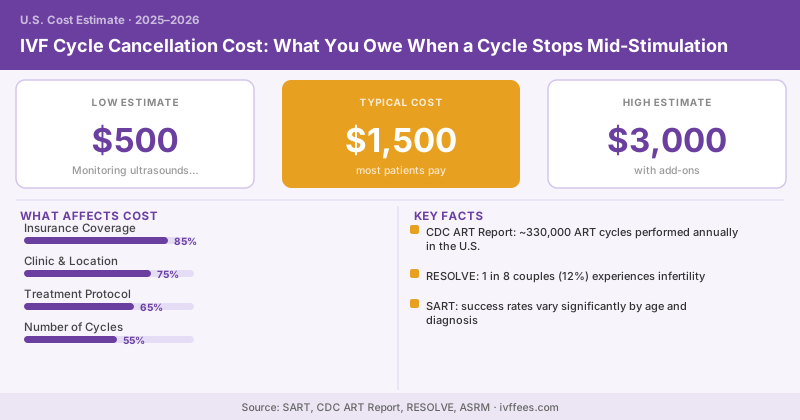
| Monitoring ultrasounds (5–8 visits) | $500 | $1,500 | $3,000 |
| Blood hormone tests during stim | $200 | $600 | $1,200 |
| Fertility medications already used | $500 | $2,500 | $6,000 |
| RE consultation/cancellation review | $0 | $200 | $500 |
| Total out-of-pocket after cancellation | $1,000 | $4,000 | $10,000 |
What You’re Typically Charged For
When a cycle is cancelled, you’re billed for services already rendered — not for services that would have been delivered. Here’s how it usually breaks down:
Medications (non-refundable in most cases). If you injected nine days of stimulation medications and the cycle is cancelled on day nine, you’ve used those drugs. Most fertility pharmacies don’t accept returns on opened medications. Unused, sealed injectable medications in original packaging may be returnable or tradeable — check with your pharmacy and connect with patient communities that facilitate medication sharing.
Monitoring appointments. Every ultrasound and blood draw during stimulation is billed individually. These are separate from the “base cycle” fee at most clinics. If you had six monitoring visits at $200 to $350 each, that’s $1,200 to $2,100 in monitoring charges alone.
Lab processing fees. Some clinics charge for early-cycle blood panels, semen analysis during the cycle, or other lab work done in preparation for retrieval — even if retrieval never happens.
Ask specifically: “What are the charges if my cycle is cancelled before retrieval?” Get the answer in writing. Some clinics offer partial refunds or credit toward a future cycle; most do not. This matters more than you think if you’re in a financial risk category for poor response.
Refund Programs and What They Don’t Cover
Multi-cycle refund programs (shared-risk programs) typically have specific language about what “counts” as a completed cycle for refund purposes. Many require that a retrieval was attempted. A cycle cancelled before retrieval is often excluded from the program entirely — meaning you still pay for the cancelled cycle out-of-pocket, and it doesn’t count toward your refund eligibility.
Read the fine print on any refund program before enrolling.
The Frozen Medications Problem
One of the most frustrating scenarios: you’ve already received a $4,000 medication shipment, started injections, and the cycle gets cancelled on day six. You have 10+ days of unused, unopened medication in your refrigerator.
Your options:
- Request a pharmacy return. Some specialty pharmacies (Freedom Fertility, MDR) will accept sealed, unopened vials within a specific timeframe. Ask immediately.
- Transfer to another patient. Patient communities like Fertility Friends or IVF Connections have medication exchange programs. It’s technically a donation in most states, not a sale.
- Save for your next cycle. If you’re planning another cycle with the same clinic and protocol, your RE may authorize using leftover medications — though storage requirements matter.
Your Financial Rights After a Cancellation
You have the right to:
- An itemized bill explaining every charge
- A clear accounting of what “credit” (if any) applies to a future cycle
- Your complete medical records, including all cycle monitoring results
- An explanation of why the cycle was cancelled and what protocol changes are recommended
ASRM guidelines state that patients should receive a clear explanation of cycle outcomes and recommendations for future treatment. If your clinic isn’t providing this proactively, ask for a post-cancellation consultation.
Don’t pay a cancellation bill before requesting an itemized breakdown. Billing errors after cancellations are more common than they should be — you may be charged for services that were scheduled but never performed.
Does Insurance Cover a Cancelled Cycle?
If you have insurance coverage for IVF, a cancelled cycle’s coverage depends on how your policy defines an “attempt” or “cycle.” Some policies cover monitoring and medications regardless of whether retrieval occurs. Others require a retrieval to have taken place before covering any costs.
Check your Explanation of Benefits (EOB) carefully after a cancelled cycle — and if something seems wrong, call your insurance company’s member services line before paying the clinic directly.
Planning Ahead for Cancellation Risk
If you have low ovarian reserve, prior poor response history, or are over 40, your cancellation risk is meaningfully higher than average. Here’s what to do before starting a cycle:
- Ask your RE directly: “What are the chances this cycle gets cancelled before retrieval, given my AMH and AFC?”
- Get a clear picture of what the financial exposure is if the cycle doesn’t make it to retrieval
- Consider whether a mini-IVF protocol might reduce cancellation risk while also reducing up-front medication costs
- Build a “cancelled cycle” line into your IVF budget — $2,000 to $5,000 for monitoring plus meds already used
Cancellations aren’t failures. They’re clinical decisions made in your best interest. But going in financially prepared makes the outcome a lot easier to handle.