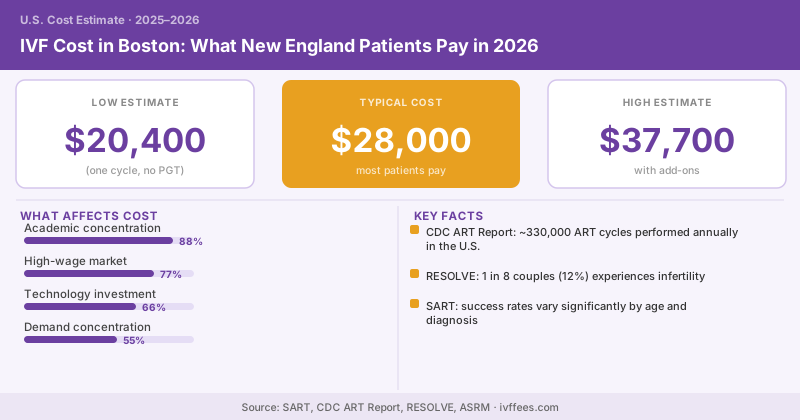
In 2010, IVF in Boston cost around $12,000 per cycle. Today it runs $18,000–$24,000 — a 50–100% increase in 15 years, while the national average rose more slowly. Boston’s premium pricing reflects something real: this city has some of the most technically advanced, research-driven fertility programs in the world. But it also means you’re paying Boston prices, which are among the highest in the country.
The offsetting factor: Massachusetts has a strong fertility insurance mandate. Many Boston-area patients with qualifying employer coverage pay $3,000–$7,000 out of pocket per cycle rather than the full sticker price.
What IVF Costs in Boston
Boston-area clinic fees for a base IVF retrieval run $16,000 to $24,000 — near Manhattan levels, above LA, and well above Midwestern markets. Medications add $4,000–$7,500. An all-in first cycle typically runs $21,000 to $32,000 for uninsured patients.
| Cost Component | Low End | Typical | High End |
|---|---|---|---|
| Base IVF procedure (Boston metro) | $15,000 | $19,500 | $25,000 |
| Fertility medications | $3,500 | $5,500 | $8,000 |
| Monitoring & labs | $1,200 | $1,900 | $3,000 |
| Anesthesia | $700 | $1,100 | $1,700 |
| PGT-A genetic testing (optional) | $3,500 | $5,000 | $7,500 |
| Frozen embryo transfer (if needed) | $4,000 | $5,500 | $7,500 |
| Total (one cycle, no PGT) | $20,400 | $28,000 | $37,700 |
Massachusetts’ Fertility Insurance Mandate
Massachusetts has one of the strongest fertility insurance mandates in the United States. The state requires fully-insured group health plans to cover diagnosis and treatment of infertility, including IVF.
Key provisions of the Massachusetts mandate:
- Coverage required for medically necessary IVF cycles
- No lifetime cycle cap written into the basic mandate (though individual plans may have benefit limits)
- Applies to employers with 6+ employees using Massachusetts-registered insurers
- Includes monitoring — ultrasounds, blood draws, and related diagnostic services
According to RESOLVE, Massachusetts’ mandate is frequently cited as one of the models for other states considering fertility coverage legislation. The lack of a statutory cycle cap is notable — many mandated states cap coverage at 3–4 cycles, while Massachusetts patients on qualifying plans can often access coverage for additional cycles if medically justified.
What the mandate doesn’t cover automatically:
- Self-funded employer plans — still exempt under ERISA, as in every state
- Small group plans with fewer than 6 employees
- Individual market plans (though many Massachusetts ACA marketplace plans voluntarily include fertility benefits given state culture around coverage)
Boston is a hub for biotech, finance, and education — sectors that often run self-funded benefits plans at large employers. Harvard, MIT, major hospitals, and many biotech firms use self-funded plans governed by federal ERISA law, not the Massachusetts mandate. Always confirm with HR whether your plan is fully-insured or self-funded before treatment planning.
Why Boston IVF Costs More
Academic concentration. Boston has more research-hospital-affiliated fertility programs per capita than almost any U.S. city. MGH, Brigham and Women’s, Beth Israel, Boston Medical Center — these programs carry the overhead of academic medicine: research programs, fellowships, cutting-edge equipment. Patients benefit from exceptional expertise but pay the associated premium.
High-wage market. Boston’s cost of living and professional wages are among the highest in the country. An embryologist or reproductive endocrinologist in Boston commands more than their counterpart in Indianapolis.
Technology investment. Boston programs are early adopters of emerging embryology technologies — time-lapse monitoring systems, AI-assisted embryo grading, advanced genetic testing platforms. These tools cost money to deploy and maintain.
Demand concentration. Greater Boston has a high density of college-educated professionals who delay childbearing into their mid-to-late 30s. That demographic profile creates sustained demand for fertility services.
Top IVF Clinics in the Boston Area
Boston’s fertility ecosystem is anchored by world-class programs:
- Boston IVF — one of the country’s largest and most recognized fertility programs; multiple Massachusetts locations; strong SART-reported success rates; known for research contributions
- Massachusetts General Hospital Fertility Center — academic medical center at one of the top-ranked hospitals in the world; excellent for complex diagnoses
- Brigham and Women’s Hospital Center for Infertility and Reproductive Surgery — another elite academic program with strong endometriosis and surgical fertility expertise
- Boston Medical Center Fertility and Reproductive Surgery — safety-net hospital with a focus on access and equity; often more accessible for underserved populations
- Tufts Medical Center Fertility Center — academic medical center with broad service range
- CCRM Boston — national network with Boston presence; strong genetic testing programs
- Shady Grove Fertility Boston — national network with Newton location; competitive pricing
For patients in Rhode Island, Providence has RMA of Connecticut (Newport location) and Women and Infants Hospital, often slightly cheaper than Boston proper.
Reducing IVF Costs in Boston
Understand your full benefit. Massachusetts mandate patients often don’t know the extent of their coverage until they request a detailed benefits explanation. Some plans cover not just the procedure but also medications, making the total out-of-pocket dramatically lower. Get the full picture in writing.
Compare Boston vs. Providence vs. Hartford. Rhode Island (WIC’s fertility program) and Connecticut (Shady Grove, RMA) both have fertility programs 1–2 hours from Boston that charge $2,000–$5,000 less per cycle. If you’re uninsured or have a cap on your Massachusetts benefit, this comparison is worth making.
Specialty pharmacy for medications. Even with procedure coverage, medications are often only partially covered. Boston patients can save $1,500–$3,000 per cycle using specialty pharmacies versus retail pharmacy prices.
Time your benefit year. If your employer’s benefits reset January 1, January starts are optimal. A cycle started in November may bleed into the next calendar year, potentially splitting expenses across two benefit years in a way that reduces coverage.
Research hospital programs for complex cases. If you have a complex diagnosis — recurrent pregnancy loss, poor ovarian reserve, advanced endometriosis — the MGH, Brigham, or Boston Medical programs may offer both better outcomes and more insurance-navigable billing than private practices.
SART 2022 data shows that several Boston-area clinics report live birth rates per retrieval that are above the national average for most age groups — reflecting the academic and high-volume nature of these programs. But national-average rates for women over 40 are still only 15–20%, regardless of clinic quality. Age-specific expectations matter as much as clinic selection.
New Hampshire, Maine, and Vermont Patients: Come to Boston
Vermont, New Hampshire, and Maine have limited or no fertility insurance mandates. Patients in northern New England often travel to Boston for IVF — not just because of better coverage access, but because the clinical programs available in Boston’s academic centers are simply more comprehensive.
If you live in New Hampshire or southern Maine, Boston is realistically 1–3 hours away. Boston IVF has satellite monitoring locations in New Hampshire (Londonderry) specifically to serve patients who do their monitoring locally and travel to Boston for retrieval and transfer.
The Bottom Line for Boston Patients
Boston has some of the best fertility programs in the world — and you’ll pay world-class prices for them. Uninsured cost: $21,000–$32,000 per cycle. With Massachusetts mandate coverage: $3,000–$8,000 per cycle out of pocket. If you’re on a qualifying plan, Boston may be the best value in the country for elite fertility care. If you’re uninsured, comparison-shopping against Providence and Hartford is worthwhile.
Cost data based on Boston-area clinic fee schedules, Massachusetts mandate documentation, SART 2022 data, and RESOLVE analysis. Individual costs vary by clinic, insurance plan, and treatment protocol.