Illinois has one of the oldest and most comprehensive fertility insurance mandates in the country. For many Chicagoans, that single fact changes IVF from a $20,000 expense into something far more manageable. For others — on the wrong type of plan — nothing changes at all.
Here’s the real picture of what IVF costs in Chicago, what Illinois law actually requires, and how patients are navigating it.
IVF Cost Ranges in Chicago
Chicago-area clinics run $13,000 to $20,000 for the base IVF procedure — noticeably lower than coastal cities and closer to the national midrange. Add medications ($3,500–$6,500) and you’re typically looking at $17,000 to $26,000 out of pocket for a fully uninsured cycle.
Compared to Manhattan or LA, that’s a meaningful discount. Midwest overhead costs — real estate, staffing, utilities — are lower, and that filters through to patient pricing.
| Cost Component | Low End | Typical | High End |
|---|---|---|---|
| Base IVF procedure (Chicago metro) | $12,000 | $15,500 | $21,000 |
| Fertility medications | $3,000 | $5,000 | $7,500 |
| Monitoring & labs | $1,000 | $1,600 | $2,500 |
| Anesthesia | $600 | $950 | $1,500 |
| PGT-A genetic testing (optional) | $3,000 | $4,500 | $7,000 |
| Frozen embryo transfer (if needed) | $3,000 | $4,500 | $6,500 |
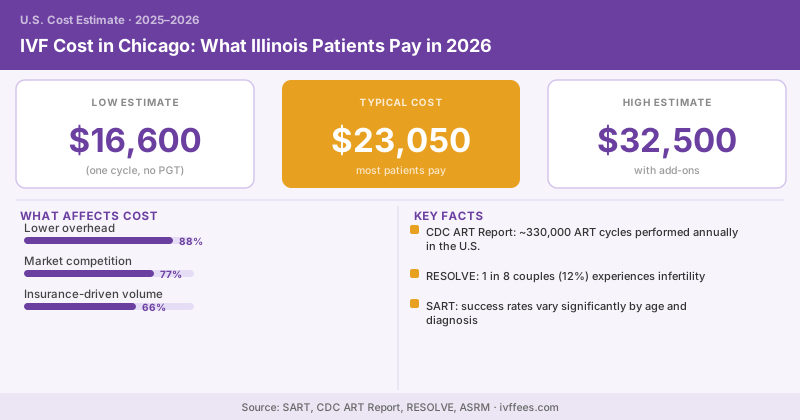
| Total (one cycle, no PGT) | $16,600 | $23,050 | $32,500 |
Illinois’ Fertility Insurance Mandate: One of the Best in the Country
Illinois enacted its fertility insurance mandate back in 1991 — making it one of the earliest states to require coverage. The law has been updated and strengthened since, and today it’s among the most patient-favorable in the U.S.
Under Illinois law, fully-insured group health plans must cover:
- IVF (up to four egg retrieval cycles)
- Monitoring, lab work, and embryo transfer
- Fertility preservation for patients facing medically-indicated infertility risk
According to RESOLVE: The National Infertility Association, Illinois’ four-cycle mandate is one of the most generous in the country — only a handful of states match or exceed it. For patients on qualifying plans, out-of-pocket costs often fall to $1,500–$5,000 per cycle after insurance picks up the bulk of procedure and monitoring fees.
The persistent caveat: self-funded employer plans are not subject to the Illinois mandate. Many large Chicago employers — financial firms, tech companies, major corporations — run self-funded plans that escape state regulation. If you’re at a large employer, verify your plan type before assuming coverage.
Ask your HR department: “Is our health plan fully-insured under Illinois law?” and “Does it comply with Illinois’ infertility coverage mandate?” If the answer to the first question is yes, you should have meaningful IVF coverage. Get the specifics in writing — maximum cycles, lifetime benefit cap, and any prior authorization requirements.
Why Chicago IVF Is Cheaper Than Coastal Cities
Lower overhead. Office space in the Loop or Lincoln Park costs a fraction of comparable Manhattan or Beverly Hills real estate. Staff salaries, while competitive, don’t reach the extremes of gateway cities.
Market competition. Chicago has a mature, competitive fertility market with multiple well-established programs. Competition keeps pricing more disciplined than in lower-density markets where one or two clinics dominate.
Insurance-driven volume. Because Illinois’ mandate drives a higher proportion of insured patients, clinics can operate with more predictable revenue than markets where most patients pay cash. That stability moderates pricing.
Top IVF Clinics in the Chicago Area
Chicago has a robust concentration of fertility programs, including some of the most recognized in the Midwest:
- Fertility Centers of Illinois (FCI) — the largest fertility network in Illinois, with 10+ locations across the metro area; strong success rates and broad service offering
- Northwestern Medicine Fertility & Reproductive Medicine — academic medical center program affiliated with one of the country’s top research hospitals
- University of Chicago Medicine Fertility Clinic — academic affiliation with strong research and complex-case capabilities
- CCRM Chicago — national network presence with comprehensive genetic testing programs
- Midwest Reproductive Center — Overland Park, KS (accessible for far-south Chicago suburbs)
- Shady Grove Fertility Chicago — part of the large national Shady Grove network, often competitive on pricing
Suburban options matter. Clinics in Naperville, Downers Grove, and Schaumburg run slightly cheaper than Chicago proper and are far easier to reach for patients in the western suburbs.
Cost-Reduction Strategies for Chicago Patients
Maximize your Illinois mandate coverage. If you’re on a qualifying plan, you may have up to four covered retrievals. Use them. Don’t self-limit to one or two cycles out of cost anxiety before understanding your full benefit.
Use specialty pharmacies. Even with insurance covering the procedure, many plans don’t fully cover medications. Specialty pharmacies like MDR, Village Pharmacy, and Koala Meds offer significant discounts off retail. Always compare.
Consider the suburbs. A clinic in Naperville that’s 30 minutes from downtown charges $2,000–$4,000 less per cycle than equivalent care at a Chicago proper location. If you’re making 10 monitoring appointments over a stimulation cycle, the commute may be worth it.
Coordinate with your benefits cycle. If your employer’s fertility benefits reset January 1, plan your retrieval cycle to start early in the calendar year. Misaligning a cycle start in November with a December reset can cost you an entire benefit year.
Ask about financing for uncovered costs. Even with strong insurance, out-of-pocket costs for medications, co-pays, and any cycle beyond your covered maximum can add up. Clinics often partner with lenders for 12–24 month 0% financing for qualified patients.
CDC ART Report data consistently shows that age is the strongest predictor of IVF success. For women under 35 in Illinois clinics, live birth rates per retrieval are typically 45–55%. For women 38–40, expect 25–35%. Budget and timeline planning should account for the realistic probability of needing multiple cycles — even with excellent insurance coverage.
Chicago vs. Other Midwest Markets
For patients in adjacent states without strong mandates, Chicago is sometimes worth the travel:
- Milwaukee: ~$11,000–$17,000 base; no Wisconsin IVF mandate
- Indianapolis: ~$10,000–$15,000 base; no Indiana IVF mandate
- Minneapolis: ~$12,000–$18,000 base; Minnesota has a limited infertility mandate
- St. Louis: ~$10,000–$15,000 base; Missouri has no IVF mandate
Wisconsin, Indiana, and Missouri residents who work for Illinois-registered employers with qualifying plans can sometimes access Illinois mandate benefits — worth exploring with your HR department if you’re in a border area.
The Bottom Line for Chicago Patients
For patients on qualifying Illinois plans: IVF in Chicago may be the best-covered fertility care anywhere in the country. Four covered retrievals at out-of-pocket costs of $2,000–$5,000 each is an extraordinary benefit.
For self-funded plan patients and uninsured patients: Chicago’s base IVF costs of $17,000–$26,000 per cycle are lower than coastal markets, and the competitive clinic landscape gives you leverage to negotiate and compare.
Cost data based on Chicago-area clinic fee schedules, Illinois Department of Insurance mandate data, SART 2023 reporting, and RESOLVE state-by-state mandate analysis. Individual costs vary by clinic, protocol, and plan.