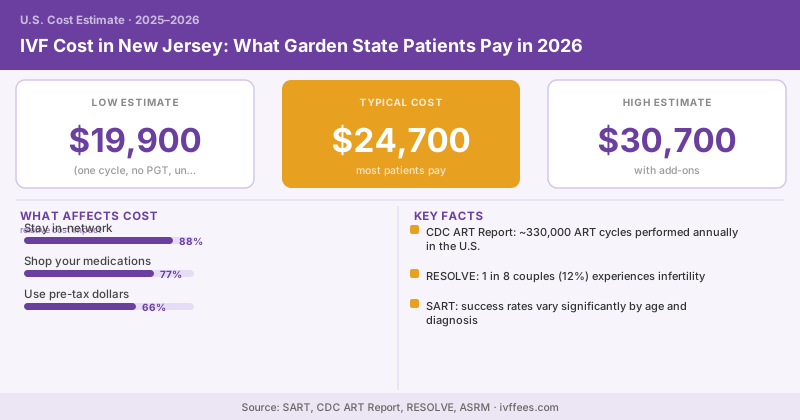
If you’re going to need IVF, New Jersey is one of the better states in the country to need it in. The Garden State is one of a small group that actually mandates IVF coverage — meaning a lot of New Jersey residents pay a fraction of the full sticker price. That sticker price isn’t low (base IVF runs $14,000 to $19,000 before medications), but the mandate changes the out-of-pocket math dramatically for those who qualify.
Here’s how it works.
What IVF Actually Costs in New Jersey
Base IVF procedure fees across New Jersey run $14,000 to $19,000. Add medications, monitoring, and optional genetic testing, and a fully uninsured first cycle would total $19,000 to $27,000. But thanks to the state mandate, many residents never see that full bill.
| Cost Component | Low End | Typical | High End |
|---|---|---|---|
| Base IVF procedure (New Jersey) | $14,000 | $16,500 | $19,000 |
| Fertility medications | $4,000 | $5,500 | $7,500 |
| Monitoring & labs | $1,200 | $1,700 | $2,700 |
| Anesthesia | $700 | $1,000 | $1,500 |
| PGT-A genetic testing (optional) | $4,000 | $5,500 | $8,000 |
| Frozen embryo transfer (if needed) | $3,500 | $5,000 | $7,000 |
| Total (one cycle, no PGT, uninsured) | $19,900 | $24,700 | $30,700 |
New Jersey’s high cost of living — among the steepest in the nation — pushes base procedure fees into the upper-middle of the national range. But the mandate is what really determines what most insured residents actually pay.
New Jersey Mandates IVF Coverage
This is the headline. New Jersey is one of the relatively few states that requires certain health insurance plans to cover IVF, subject to eligibility conditions like a qualifying infertility diagnosis and, in some cases, age or prior-treatment requirements. The mandate has historically applied to certain fully insured group plans regulated by the state.
That’s a world apart from no-mandate states like Texas, Florida, and Georgia, where patients pay essentially everything out of pocket. For the full state-by-state landscape — and to see which other states join New Jersey in mandating coverage — the IVF insurance mandate by state breakdown is the place to start.
The catch every New Jersey patient must understand: the mandate generally does not reach self-funded employer plans, which are governed by federal law rather than state insurance regulation. So whether the mandate helps you depends on the type of plan you have. A New Jersey resident on a self-funded plan may have no more coverage than a Texan, while a coworker on a state-regulated fully insured plan could have robust IVF benefits.
New Jersey mandates IVF coverage for certain state-regulated plans — a major advantage over no-mandate states. But self-funded employer plans are exempt, so the first thing to check is whether your plan is ‘fully insured’ (likely covered) or ‘self-funded’ (likely not). Your HR or benefits administrator can tell you which you have.
New Jersey’s Clinic Market
New Jersey has a deep, sophisticated fertility market, reinforced by its dense population and proximity to both New York City and Philadelphia. Clinics are spread across the northern, central, and southern parts of the state, including large multi-location practices and academic-affiliated programs.
Because the mandate drives strong demand, New Jersey clinics handle high cycle volume and are experienced at processing insurance-covered treatment — a meaningful convenience compared to clinics in cash-pay states. Patients near the borders sometimes treat in New York or Philadelphia, but for those benefiting from the New Jersey mandate, staying in-state with an in-network clinic is usually the smarter financial move.
How to Keep New Jersey IVF Costs Down
Determine your plan type — this is everything. Fully insured, state-regulated plans likely fall under the mandate; self-funded plans likely don’t. This single fact can mean a difference of $20,000.
Stay in-network. If your plan is covered, using an in-network New Jersey clinic maximizes your benefit and minimizes balance billing.
Shop your medications. Even with procedure coverage, drug benefits vary. At $4,000–$7,500, comparing fertility medication costs across specialty pharmacies still pays off.
Use pre-tax dollars. New Jersey has a state income tax, so HSA and FSA contributions cut both federal and state tax — useful for any out-of-pocket portion.
If you’re on a self-funded plan and uncovered, New Jersey clinics widely offer IVF financing options.
Per SART national data, the live birth rate per egg retrieval for women under 35 is around 49% and declines with age. Even with mandated coverage, plans often cap the number of covered cycles, so understand your limits. Ask your New Jersey clinic for age- and diagnosis-specific success rates before you begin.
Frequently Asked Questions
Does New Jersey require insurance to cover IVF? Yes, for certain state-regulated plans, subject to eligibility conditions. This makes New Jersey one of the more favorable states for IVF coverage. However, self-funded employer plans are exempt — confirm your IVF coverage for 2025 with your plan administrator.
Why doesn’t the New Jersey mandate cover everyone? The mandate applies to fully insured, state-regulated plans, not self-funded employer plans governed by federal law. Many large employers use self-funded plans, so not all New Jersey residents benefit.
How can I lower my New Jersey IVF costs? First confirm your plan type, stay in-network if covered, shop medications, and use HSA dollars. See how to reduce IVF cost.
Cost data based on New Jersey clinic fee schedules, SART national data, RESOLVE analysis, and New Jersey insurance mandate status. Individual costs vary by clinic, protocol, plan type, and coverage eligibility.