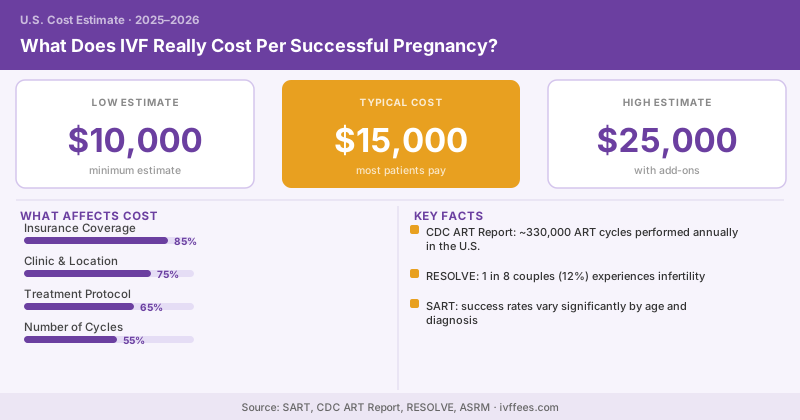
The $15,000 sticker price on one IVF cycle hides a more honest number: what do you actually spend, on average, to bring home a baby?
The answer depends almost entirely on your age — and it’s significantly higher than the per-cycle cost suggests. Here’s how to run the real math, using SART live birth data and realistic all-in cost estimates.
Why “Cost Per Cycle” Understates the Real Number
A single IVF cycle doesn’t guarantee a baby. For patients who ultimately succeed, most go through more than one cycle. The relevant financial metric isn’t cost per cycle — it’s cost per live birth.
That number is calculated simply:
Cost per live birth = (Average all-in cost per cycle) ÷ (Live birth rate per cycle)
As age increases, the live birth rate drops while the cost per cycle stays roughly the same. The result: dramatically higher effective cost per successful pregnancy for older patients.
SART Live Birth Rates by Age (2021–2022 National Data)
According to SART’s national summary report, live birth rates per intended egg retrieval using a patient’s own eggs were:
| Age Group | Live Birth Rate Per Retrieval | Approximate Live Births Per 100 Attempts |
|---|---|---|
| Under 35 | 45–55% | 45–55 out of 100 |
| 35–37 | 35–42% | 35–42 out of 100 |
| 38–40 | 22–30% | 22–30 out of 100 |
| 41–42 | 10–16% | 10–16 out of 100 |
| Over 42 | 3–6% | 3–6 out of 100 |
These are per-retrieval rates — meaning one egg retrieval attempt (which may include multiple embryo transfers from that retrieval). They’re national averages; individual clinic results vary.
All-In Cost Per Cycle: A Realistic Estimate
A single complete IVF cycle — including medications, ICSI if needed, one transfer (fresh or frozen), and baseline testing — typically costs:
- Under 38, no PGT: $18,000–$25,000
- 38+, with PGT-A: $24,000–$35,000
For this model, we’ll use $22,000 as a base (mid-range, one cycle with medications, ICSI, and one FET) for patients under 38, and $28,000 for patients 38+ (adding PGT-A costs).
The Real Cost Per Live Birth by Age
| Age | Live Birth Rate | All-In Cost Per Cycle | Cost Per Live Birth |
|---|---|---|---|
| Under 35 | 50% | $22,000 | ~$44,000 |
| 35–37 | 38% | $22,000 | ~$58,000 |
| 38–40 | 26% | $28,000 | ~$108,000 |
| 41–42 | 13% | $28,000 | ~$215,000 |
| Over 42 | 5% | $28,000 | ~$560,000+ |
These are single-cycle cost-per-birth figures. Patients who try multiple cycles before succeeding shift these numbers lower on a cumulative basis — because cumulative success rates rise with each attempt while some costs (like pre-cycle testing) aren’t repeated.
A 39-year-old who does three cycles and succeeds on the third has a real cost around $84,000 for three cycles combined — not $108,000 × 3. Shared-risk programs and cumulative success rates both improve the per-birth economics for patients willing to persist.
Cumulative Cost-Per-Birth: A More Honest Picture
A 2023 analysis in Fertility and Sterility examined cumulative costs and outcomes across multiple IVF cycles. Their finding: for patients who ultimately achieved a live birth (regardless of how many cycles it took), the median total out-of-pocket spend was $28,000–$35,000 for patients under 38 and $45,000–$65,000 for patients 38–42.
The gap between the single-cycle calculation and the cumulative median exists because:
- Many patients succeed on the first or second cycle
- Frozen embryo transfers (from a single retrieval) are far cheaper than additional retrievals
- Some patients switch to donor eggs after failed cycles with own eggs, which dramatically improves success rates
Donor Eggs Change the Equation Dramatically
For patients over 40 or with poor ovarian reserve, using donor eggs fundamentally changes the cost-per-birth calculation:
- Donor IVF live birth rate (all ages): ~45–55% per transfer (SART 2022 data)
- Total cost of donor IVF: $30,000–$50,000 including donor compensation and agency fees
Cost per live birth using donor eggs at age 43: approximately $60,000–$110,000 — substantially better than own-egg IVF at that age, despite the higher up-front cost per cycle.
| Approach | Age 43 Live Birth Rate | All-In Cost | Cost Per Live Birth |
|---|---|---|---|
| Own eggs | ~5% | $28,000 | ~$560,000 |
| Donor eggs | ~48% | $40,000 | ~$83,000 |
That comparison is stark — and it’s why reproductive endocrinologists often discuss donor egg options earlier than patients expect.
What These Numbers Mean for Your Decision
These aren’t meant to be discouraging. For patients under 37, the per-birth cost of IVF — especially cumulative across multiple cycles — is genuinely reasonable relative to the outcome. For patients 38–42, the costs are higher but many patients still succeed.
These are population averages. Your clinic’s specific success rates, your diagnosis, your ovarian reserve, and whether you have genetic issues affecting embryo quality all change your personal probability significantly. Ask your RE for your individualized prognosis — not the national average.
The real value of thinking in “cost per live birth” terms is that it clarifies decisions:
- Whether to try own eggs vs. donor eggs at a given age
- Whether a shared-risk program makes financial sense
- How to evaluate how many cycles to attempt before reconsidering the approach
It also helps explain why IVF feels expensive for some and “worth every penny” for others — it depends entirely on what that particular patient spent to get to a live birth.