What does a single round of IVF actually cost in San Francisco? More than almost anywhere else in the country. Base procedure fees in the Bay Area regularly start at $18,000 and push past $25,000 — and that’s before medications. The Bay Area is the most expensive metro in America to live in, and fertility care reflects it.
But there’s a twist. The same tech economy that drives prices sky-high also gives a huge share of Bay Area patients the most generous fertility benefits in the country. Whether SF IVF feels brutal or surprisingly manageable depends almost entirely on your employer.
What IVF Actually Costs in San Francisco
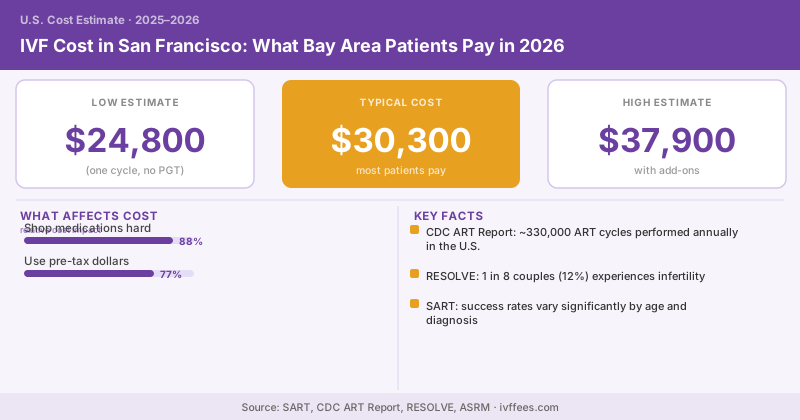
Base IVF procedure fees across San Francisco and the broader Bay Area run $18,000 to $25,000. Stack on medications, monitoring, and optional genetic testing, and an uninsured first cycle commonly totals $24,000 to $35,000.
| Cost Component | Low End | Typical | High End |
|---|---|---|---|
| Base IVF procedure (SF/Bay Area) | $18,000 | $21,000 | $25,000 |
| Fertility medications | $4,500 | $6,000 | $8,000 |
| Monitoring & labs | $1,500 | $2,200 | $3,200 |
| Anesthesia | $800 | $1,100 | $1,700 |
| PGT-A genetic testing (optional) | $4,500 | $6,000 | $8,500 |
| Frozen embryo transfer (if needed) | $4,000 | $5,500 | $7,500 |
| Total (one cycle, no PGT) | $24,800 | $30,300 | $37,900 |
There’s no mystery here. The Bay Area tops national cost-of-living rankings published by groups like the Council for Community and Economic Research, and everything a clinic pays for — lab space in some of the priciest commercial real estate in the country, embryologist salaries, downtown rents — flows straight into your bill. If you’ve ever wondered why IVF is so expensive, the Bay Area is the extreme version of every cost driver at once.
California’s Mandate Doesn’t Force IVF Coverage
This trips up a lot of people. California has a fertility insurance law, but it does not require plans to cover IVF. The state mandate requires insurers to offer coverage for the diagnosis and treatment of infertility, while specifically excluding IVF from the required benefit. Employers can decline to include it.
So despite living in a state with a fertility law on the books, most California patients are not guaranteed IVF coverage. For the bigger picture on which states truly mandate IVF — and California’s partial status — see the IVF insurance mandate by state breakdown.
Here’s where the Bay Area pulls ahead. The major tech employers — and the startups copying their playbook — voluntarily layer on rich fertility benefits, often $25,000 or more in treatment plus medication coverage. RESOLVE has documented this voluntary employer trend nationally, and Silicon Valley is its epicenter.
California’s fertility law does NOT mandate IVF coverage — plans only have to offer it, and most exclude it. But Bay Area tech employers frequently provide $25,000+ in voluntary fertility benefits. Your employer, not state law, is what determines whether SF IVF is affordable for you. Ask HR before assuming anything.
The Bay Area’s Clinic Market
The Bay Area has one of the densest, most advanced fertility markets in the world, spanning San Francisco, the Peninsula, the South Bay, and the East Bay. You’ll find premium boutique clinics, large national network locations, and academic programs through the region’s major universities, which handle complex cases and run active research.
All that density is a double-edged sword. Competition is fierce, but it’s competition for an affluent, well-insured patient base — so prices don’t fall the way they might elsewhere. The upside for patients is access to top-tier embryology labs and a deep bench of reproductive endocrinologists. The downside is the sticker price.
How to Keep Bay Area IVF Costs Down
Use your employer benefit — it’s the whole ballgame. The gap between a fully covered cycle and an uncovered one can exceed $25,000 here. Nothing else comes close.
Shop medications hard. At $4,500–$8,000, Bay Area drug bills are among the highest anywhere. National specialty pharmacies routinely undercut local options — comparing fertility medication costs can save thousands.
Consider treatment outside the city core. East Bay and some South Bay clinics can run a bit lower than premium San Francisco addresses for comparable care.
Use pre-tax dollars. California has a high state income tax, so HSA and FSA contributions deliver substantial combined federal and state savings. Max your HSA before the cycle starts.
When coverage falls short, Bay Area clinics widely offer IVF financing options through partnered lenders.
According to SART national data, the live birth rate per egg retrieval for women under 35 is approximately 49% and declines with age. At Bay Area prices, the cost of needing a second cycle is steep — budget for it. Ask any clinic for age- and diagnosis-specific success rates before committing tens of thousands of dollars.
Frequently Asked Questions
Why is IVF so expensive in San Francisco? The Bay Area is the most expensive metro in the U.S. to operate in. Lab real estate, embryologist salaries, and rent are all at the top of the national scale, and clinics pass those costs to patients.
Does California require insurance to cover IVF? No. California’s fertility law requires insurers to offer infertility coverage but specifically excludes IVF, so plans aren’t required to cover it. Confirm your own IVF coverage for 2025 with your insurer and employer.
Can I make Bay Area IVF more affordable? Yes — using an employer benefit is the biggest lever. Beyond that, shop medications, consider clinics outside the city core, and use HSA dollars. See how to reduce IVF cost.
Cost data based on Bay Area clinic fee schedules, SART national data, RESOLVE benefit analysis, and California insurance mandate status. Individual costs vary by clinic, protocol, and employer coverage.