42% of Americans say cost is the primary reason they haven’t pursued IVF — and in Texas, where the state has no fertility insurance mandate, that pressure hits harder than almost anywhere else.
The good news: Texas is actually one of the more affordable major markets for IVF procedures. Base cycle fees run lower than coastal cities, and the competitive landscape between Dallas, Houston, and Austin clinics gives patients real leverage. The challenging news: you’re almost certainly paying 100% out of pocket.
What IVF Costs in Texas
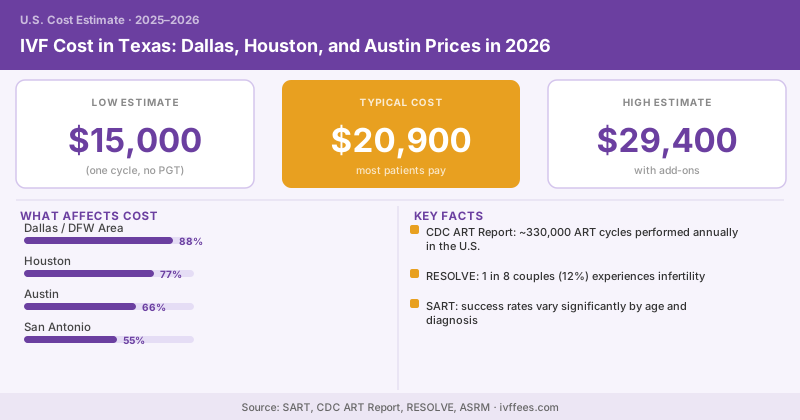
Texas clinic fees for a base IVF retrieval cycle run $11,000 to $17,000 — meaningfully below New York or LA, and roughly in line with or slightly below the national average. Add fertility medications ($3,000–$6,500) and monitoring, and you’re looking at $15,000 to $24,000 all-in for a single cycle.
Costs vary by city. Dallas and Houston tend to run similar to each other; Austin has seen price inflation in recent years as the city’s tech boom imported both population and demand.
| Cost Component | Low End | Typical | High End |
|---|---|---|---|
| Base IVF procedure (Texas) | $10,500 | $13,500 | $18,500 |
| Fertility medications | $3,000 | $5,000 | $7,000 |
| Monitoring & labs | $900 | $1,500 | $2,500 |
| Anesthesia | $600 | $900 | $1,400 |
| PGT-A genetic testing (optional) | $3,000 | $4,500 | $7,000 |
| Frozen embryo transfer (if needed) | $3,000 | $4,000 | $6,000 |
| Total (one cycle, no PGT) | $15,000 | $20,900 | $29,400 |
Texas Has No IVF Insurance Mandate
Texas does not require health insurers to cover IVF. Full stop. The state has no fertility treatment mandate, which means if you’re relying on Texas insurance law to cover your treatment, you’re out of luck.
What some Texas patients do have: voluntary employer fertility benefits. Many large Texas employers — energy companies, tech firms, financial institutions — have added fertility benefits voluntarily, separate from any state requirement. According to RESOLVE, employer-sponsored fertility benefits have grown significantly since 2020, with many Fortune 500 companies now offering $10,000–$30,000 in lifetime fertility benefit.
If you work for a Texas employer with 500+ employees, check your benefits carefully. You might have substantial fertility coverage even without a state mandate.
Check your employee benefits portal under “health” or “family planning.” If you can’t find fertility coverage listed, call your HR benefits line directly and ask: “Do we have any fertility or IVF benefits?” Large Texas employers in oil/gas, tech, and finance have quietly added these benefits — many employees don’t know until they ask.
City-by-City Cost Comparison in Texas
Dallas / DFW Area
Dallas has the densest concentration of fertility clinics in Texas, which keeps competition high and prices relatively disciplined. Base IVF runs $11,000–$16,000 at most DFW programs. The Plano/Frisco corridor in the northern suburbs has several strong programs that run $1,000–$3,000 cheaper than clinics in the Park Cities or Uptown.
Houston
Houston’s fertility market is large and competitive. Base cycle fees run $11,000–$17,000. The Texas Medical Center concentration means academic-affiliated programs are available alongside private practices, and prices reflect that range. Memorial Hermann and Houston Methodist both offer fertility programs through their health system affiliations.
Austin
Austin’s fertility market has changed substantially in the last five years. Rapid population growth and the tech-employer boom have pushed Austin pricing up toward — and in some cases past — Houston levels. Expect $13,000–$18,000 for a base procedure at most Austin clinics. That said, Austin employers (especially tech companies) are among the most likely in Texas to offer voluntary fertility benefits.
San Antonio
San Antonio runs consistently cheaper than DFW, Houston, and Austin — base procedures often in the $10,000–$15,000 range. Fewer top-tier programs than the larger metros, but solid options exist including UTHSCSA-affiliated care.
Top IVF Clinics in Texas
- CCRM Fertility (multiple Texas locations) — national network with Dallas and Houston locations; known for comprehensive genetic testing
- Aspire Fertility — large Texas-focused network with clinics in Dallas, Houston, Austin, and San Antonio; competitive pricing and transparent fee schedules
- Ovation Fertility — partner lab network with strong Texas presence
- Shady Grove Fertility Texas — Houston, Austin, and Dallas locations
- RMA of Texas — San Antonio-based program affiliated with RMA network
- UT Southwestern Fertility and Reproductive Endocrinology — Dallas; academic medical center with strong research credentials
How to Reduce IVF Costs in Texas
Shop medications. With no insurance subsidizing the procedure, every dollar saved on medications matters. Texas patients have access to specialty pharmacies nationally — MDR, Koala Meds, Fertility Pharmacy of America. Get three quotes before filling any prescription. Differences of $1,500–$2,500 per cycle are common.
Compare all three major metros. If you’re flexible on location, Dallas, Houston, and San Antonio programs vary enough in base fees to justify comparison shopping. A San Antonio program 3 hours from Austin might save you $4,000 per cycle.
Look at refund programs. Several Texas clinics offer multi-cycle or money-back guarantee packages. If you’re under 38 and your RE thinks you’re a reasonable candidate for success, these packages can provide cost certainty for patients who might need two or three cycles.
HSA and FSA maximization. All IVF expenses are qualified medical expenses. Texas’s no-income-tax environment means every dollar you can run through an HSA or FSA is a direct savings. If your employer offers a high-deductible health plan with HSA access, this is worth serious consideration before starting treatment.
Grants and assistance programs. The Baby Quest Foundation, Fertility Within Reach, and several Texas-specific programs provide grants to uninsured patients. The Tinina Q. Cade Foundation specifically targets underserved communities. These are competitive but worth applying.
Texas has seen ongoing regulatory uncertainty around reproductive medicine since 2022. If you’re pursuing treatment in Texas, confirm with your clinic that their practices and consent processes are current with the latest state law guidance. Reputable clinics are staying current — but this is a question worth asking directly.
The Bottom Line for Texas Patients
Uninsured IVF in Texas runs $15,000–$25,000 per cycle all-in — lower than coastal markets, but still a significant expense when paid entirely out of pocket. The state’s large, competitive clinic landscape gives patients real leverage to compare costs and protocols. If your employer offers voluntary fertility benefits, that can change everything.
Cost data based on Texas clinic fee schedules, SART 2023 reporting, RESOLVE state mandate analysis, and patient cost surveys. Individual costs vary by clinic, city, and treatment protocol.