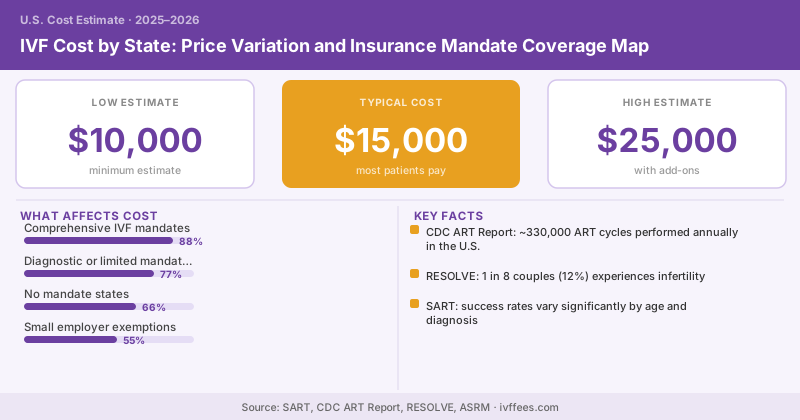
The same IVF cycle costs $9,000 in one state and $22,000 in another — and insurance makes almost none of it in 30 states. Where you live might be the biggest single factor in your fertility treatment costs.
IVF costs in the United States aren’t set by any central body. They’re market-driven, and the market varies enormously. This guide maps out the cost landscape by state, explains which insurance mandates matter and which are more limited than advertised, and helps you understand whether traveling for treatment makes financial sense.
Average IVF Costs by Region
| Region | Base IVF Cost | With Medications | Notes |
|---|---|---|---|
| Northeast (MA, NY, NJ, CT) | $14,000–$22,000 | $19,000–$30,000 | Many mandate states; high cost of living |
| Midwest (IL, OH, MI, MN) | $10,000–$17,000 | $14,000–$24,000 | IL mandate; others variable |
| South (TX, FL, GA, NC) | $9,000–$16,000 | $12,000–$23,000 | Few mandates; price competition |
| West (CA, WA, CO, AZ) | $12,000–$20,000 | $16,000–$28,000 | CA and WA expanding mandates |
| Mountain/Plains (UT, NV, KS) | $8,000–$14,000 | $11,000–$20,000 | Low-cost options; clinic scarcity |
Which States Have IVF Insurance Mandates?
As of 2025, 21 states and Washington, D.C. have enacted some form of fertility treatment insurance mandate. But not all mandates are equal.
Comprehensive IVF mandates (require insurance to cover IVF itself):
- Massachusetts, New Jersey, Illinois, Maryland, Connecticut, Rhode Island, New York, Colorado, California, Washington, and several others
Diagnostic or limited mandates (require coverage of fertility testing or IUI, but not necessarily IVF):
- Many other states fall into this category
No mandate states — the majority, including Texas, Florida, Georgia, Virginia, and most of the South and Mountain West.
RESOLVE: The National Infertility Association maintains a detailed, up-to-date map at resolve.org/what-are-my-options/insurance-coverage. This is the definitive resource — state laws change, and the RESOLVE map is updated as legislation passes.
How Mandates Actually Work in Practice
Having a mandate state on paper doesn’t always mean smooth sailing. Key caveats:
Self-insured employer plans are exempt: If your employer self-insures (which most large companies do), your plan is governed by federal ERISA law, not state law. State mandates don’t apply. Your employer can voluntarily add fertility benefits — and many large companies do — but they’re not required to.
Small employer exemptions: Many state mandates only apply to employers above a certain size (often 25–50+ employees).
HMO vs. PPO: Some mandates only apply to certain plan types.
Lifetime caps: Some mandates require coverage but cap the benefit at a specific dollar amount ($15,000–$25,000 is common).
Practically, you may live in a mandate state and still have limited or no IVF coverage if your employer is self-insured and hasn’t added fertility benefits.
- Call the member services number on the back of your insurance card
- Ask specifically: “Does my plan cover IVF treatment, including egg retrieval and embryo transfer?”
- Ask about lifetime maximum benefits and per-cycle limits
- Request the answer in writing (ask for a coverage determination or the relevant plan document section)
- If denied, ask for the appeal process — plan coverage determinations can sometimes be successfully appealed
The States Where IVF Is Cheapest
Independent of mandates, some states have lower base procedure costs due to market dynamics:
Texas: Despite no IVF mandate, Texas has robust competition among fertility clinics, particularly in major metros. Dallas and Houston have clinics offering all-in IVF packages at $10,000–$14,000.
Indiana/Ohio: Several respected fertility clinics in the Midwest offer competitive self-pay pricing in the $9,000–$13,000 range for the base procedure.
Arizona/Nevada: Growing markets with newer clinics competing aggressively on price.
South and Southeast: States like Georgia, Tennessee, and North Carolina have seen significant fertility clinic expansion with competitive pricing — partly because lower operating costs allow lower patient fees.
Medical Tourism Within the U.S.
More patients than you might expect travel to other states for IVF. The decision makes sense when:
- The cost savings exceed travel and accommodation costs
- Your home state has limited clinic options
- You want to access a specific clinic or specialist regardless of location
Common travel patterns: patients from expensive coastal markets (NYC, LA, Seattle) traveling to Texas, Ohio, or Indiana where base IVF costs can be $5,000–$10,000 lower.
A 3–4 week IVF cycle might require 6–8 visits, but many can be compressed:
- Initial consult and baseline testing: 2 days
- Stimulation monitoring: you can often do some locally and travel for key appointments
- Retrieval: 1–2 days, stay locally
- Transfer (separate cycle): 1–2 days
Hotel + travel costs for this arrangement run $1,500–$3,500 — often less than the savings from treatment in a lower-cost state.
New York’s Expanded IVF Mandate: A Case Study
In 2024, New York expanded its fertility coverage mandate to require IVF coverage for all fully insured plans without lifetime caps. This was a significant policy change that affected hundreds of thousands of New Yorkers.
However, the self-insured employer exemption still applies — and most large New York employers self-insure. The expansion primarily benefits people with small-employer fully insured plans, individual market plans, and state employee health plans.
This illustrates a pattern seen in every mandate state: the policy headline sounds comprehensive; the fine print limits actual coverage. Know which category your plan falls into.
Some fertility clinics offer lower self-pay pricing than they’d accept from insurance — because the administrative burden of insurance billing is eliminated. Before assuming insurance saves you money, ask your clinic for both their insurance-billed rates and their self-pay rates. In some cases, especially for patients with high deductibles, self-pay may be cheaper than going through insurance.
Cost Comparison: Treating IVF Like a Consumer Purchase
Fertility treatment is increasingly something patients shop for across state lines. National clinic groups like CCRM, Shady Grove Fertility (primarily Mid-Atlantic), and RMA of New Jersey have locations in multiple markets with standardized protocols and pricing.
Getting quotes from 2–3 clinics — including in adjacent lower-cost markets — before committing is standard practice for financially sophisticated patients. The $5,000–$10,000 savings available in some markets is worth the research.
The Bottom Line
Where you live or where you choose to get treatment has enormous financial implications. Check your state’s mandate status, then check whether your specific employer plan is actually covered by it. If you’re self-paying, a clinic in a lower-cost state may save you $5,000–$10,000 per cycle with comparable clinical outcomes. Do the cost comparison — it’s one of the most financially impactful decisions you’ll make in your IVF journey.