Most people assume they don’t have IVF coverage without ever actually checking. That assumption costs some of them tens of thousands of dollars in unnecessary out-of-pocket expenses.
As of 2025, 21 states have fertility insurance mandates of some kind. And even in states without mandates, large employers increasingly offer fertility benefits independently. Here’s how to figure out exactly what you have — and how to maximize it.
The State-by-State Landscape
State fertility insurance mandates fall into two categories: IVF mandates (requiring coverage of the procedure itself) and infertility diagnosis mandates (requiring coverage of diagnosis and some treatment, but not necessarily IVF).
States with strong IVF coverage requirements (as of 2025):
- Illinois — covers IVF for employer plans, up to 4 retrieval cycles
- Massachusetts — covers IVF, unlimited cycles in many plans
- New Jersey — requires coverage for medically necessary fertility treatments including IVF
- New York — requires large employer plans to cover 3 retrieval cycles
- Connecticut — covers IVF for employer plans
- Rhode Island — covers medically necessary fertility treatments
- Maryland — covers IVF for employer plans, with some limitations
- West Virginia — covers IVF for state employees
States with diagnosis-only or partial mandates: Arkansas, California (limited), Hawaii, Louisiana, Montana, Ohio, Texas (limited), and several others require diagnosis coverage or specific treatments but don’t mandate IVF coverage.
State mandates apply only to fully-insured employer plans — plans where the insurance company takes on risk. If your employer is “self-insured” (pays claims directly and just uses an insurance company for administration), state mandates don’t legally apply. Roughly 65% of covered workers at large employers are in self-insured plans. Check with HR to find out which type of plan you have.
How to Find Out What Your Plan Actually Covers
Don’t assume. Don’t rely on a coworker’s experience. Call and find out yourself.
Step 1: Get your Summary of Benefits and Coverage (SBC). Every employer-sponsored health plan is required to provide this document. Find it on your benefits portal or request it from HR. Look for a section on “fertility treatments,” “reproductive services,” or “assisted reproduction.”
Step 2: Call the member services number on your insurance card. Ask specifically:
- “Does my plan cover intrauterine insemination (IUI)?”
- “Does my plan cover in vitro fertilization (IVF), including egg retrieval and embryo transfer?”
- “Are fertility medications covered under my pharmacy benefit?”
- “Is there a lifetime maximum dollar amount or cycle limit for fertility benefits?”
- “What is the definition of ‘infertility’ my plan uses — is it time-based, diagnosis-based, or both?”
- “Does coverage require prior authorization? If so, what documentation do I need?”
Write down the name of the representative you spoke with and the date of the call.
Step 3: Request a fertility case manager. Many insurers have dedicated fertility benefits teams. They can provide written confirmation of what’s covered and connect you with in-network clinics.
Before starting a cycle, request a letter of medical necessity from your RE and submit a prior authorization request to your insurer. Get the approval in writing before you pay anything. Verbal authorizations are not reliable protection if a claim is later denied.
Understanding Coverage Limits
Even when IVF is covered, limits matter. Common restrictions include:
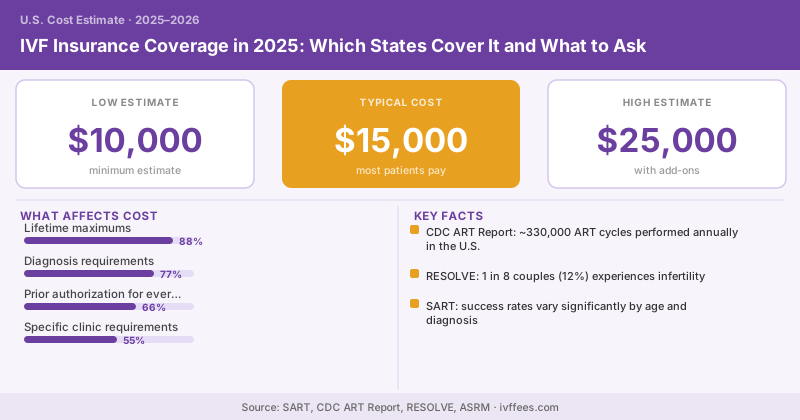
Lifetime maximums: Many plans cap fertility benefits at $15,000, $25,000, or a specific number of cycles (e.g., 3 retrievals lifetime). Once you hit the cap, you’re self-pay.
Diagnosis requirements: Most plans require a documented infertility diagnosis before covering treatment. For opposite-sex couples, this often means 12 months of unprotected intercourse without pregnancy (6 months if over 35). For same-sex couples and single individuals, many plans don’t apply this requirement — but some do, which can create barriers.
Prior authorization for every cycle: Each new cycle typically requires new authorization. Don’t assume your approval from cycle one carries over to cycle two.
Specific clinic requirements: Some insurers require you to use an in-network fertility clinic. Out-of-network care may be covered at a much lower rate or not at all.
Medication coverage: Even when the IVF procedure is covered, fertility medications may fall under a separate pharmacy benefit with different cost-sharing. Injectable gonadotropins often require specialty pharmacy authorization.
What Employer-Provided Fertility Benefits Look Like in 2025
Even without state mandates, a growing number of large employers offer fertility benefits as a recruitment and retention tool. According to a 2024 Mercer survey, 42% of large employers (500+ employees) now offer fertility benefits beyond standard diagnostic coverage — up from 27% in 2020.
Some of the most common benefit amounts:
- $10,000 lifetime: Common mid-tier benefit
- $25,000–$40,000: Offered by technology and finance companies
- Unlimited: A small number of employers (notably Google, Salesforce, and Microsoft for some plans) offer comprehensive coverage
These benefits are often administered through third-party platforms like Progyny, Carrot Fertility, or Maven Clinic, which have negotiated rates with networks of fertility clinics. If your employer uses one of these platforms, check whether your preferred clinic is in their network before assuming you can use any provider.
Appealing a Denial
Insurance denials for fertility treatment are common, and many are successfully appealed. If your claim or prior authorization is denied:
Step 1: Understand the denial reason. The denial letter must explain why. Common reasons: “experimental” designation, failure to meet infertility definition, plan exclusion.
Step 2: Get a letter of medical necessity from your RE. This should explain your diagnosis, treatment rationale, and why the specific treatment is medically indicated for your situation.
Step 3: File an internal appeal. You have the right to a formal internal appeal. Submit your RE’s documentation, any supporting medical literature, and a personal statement. This must typically be filed within 180 days of the denial.
Step 4: Request an external review if denied internally. Under the ACA, you have the right to an independent external review for most health insurance decisions. External reviewers overturn internal denials a significant portion of the time.
RESOLVE: The National Infertility Association offers free insurance advocacy resources at resolve.org and can connect you with advocates who specialize in fertility insurance appeals.
If You’re on Medicaid or ACA Marketplace Plans
Medicaid fertility coverage varies entirely by state. Some state Medicaid programs cover fertility diagnosis and treatment; most don’t cover IVF. If you’re on Medicaid, call your state’s Medicaid office or visit the RESOLVE state-by-state guide.
ACA marketplace plans are not subject to state fertility mandates in the same way employer plans are. Coverage varies by plan and insurer — some marketplace plans offer fertility riders, others explicitly exclude it. Review the plan documents before enrolling if fertility coverage is a priority.
The Bottom Line
Check before you assume. In states with strong mandates, or at employers with fertility benefits, significant coverage may already exist. Even in states without mandates, large employers increasingly provide benefits worth thousands of dollars.
If you do face costs out of pocket, fertility care qualifies as a medical expense for HSA and FSA purposes — one of the most tax-efficient ways to pay for treatment is through pre-tax health savings dollars.
State mandate information current as of 2025 legislative sessions. Coverage requirements change; verify current status with your state insurance commissioner or RESOLVE’s state advocacy pages. Employer benefit data from Mercer National Survey of Employer-Sponsored Health Plans 2024.