Your zip code might be worth $30,000. In states with strong fertility insurance mandates, patients routinely get IVF covered — while their counterparts two states over pay every dollar out of pocket.
As of 2025, 21 states plus Washington DC have passed some form of fertility insurance mandate. But “mandate” covers a wide spectrum. Some states require full IVF coverage with no cycle limits. Others only mandate diagnostic testing. Knowing which category your state falls into is the first thing you need to figure out.
According to RESOLVE: The National Infertility Association, state mandates have been the single most effective policy tool in reducing out-of-pocket fertility costs for American families.
States with Full IVF Coverage Mandates
These states require insurers (or employers, depending on plan type) to cover IVF as a medical treatment:
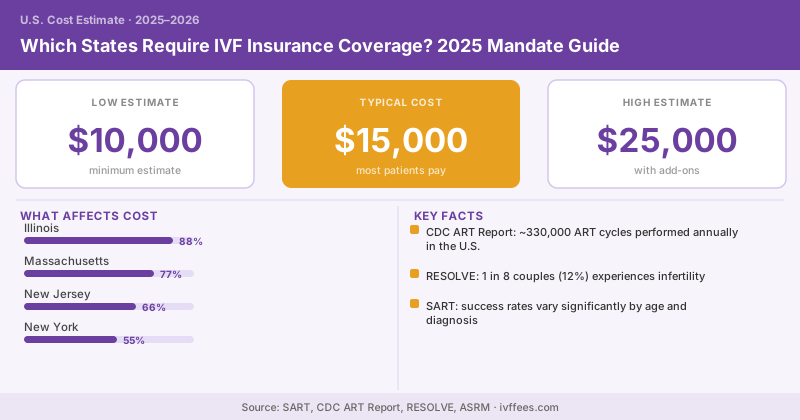
Illinois — Covers IVF for fully-insured employer plans. Up to 4 oocyte retrievals per live birth, with a prior diagnosis of infertility required. The mandate applies to group plans covering 25+ employees.
Massachusetts — One of the most comprehensive mandates in the country. Covers IVF with no specific cycle limits in many plans, including medically necessary treatment for same-sex couples and single individuals.
New Jersey — Requires coverage of medically necessary fertility treatments including IVF. Plans must also cover fertility preservation for patients facing iatrogenic infertility (e.g., cancer treatment).
New York — As of 2020, requires large employer plans (100+ employees) to cover 3 IVF cycles. Small employer plans have fewer requirements. Also mandates coverage for fertility preservation for medical necessity.
Connecticut — Requires fully-insured employer plans to cover IVF. The mandate includes coverage for same-sex couples who meet the clinical definition of infertility for their situation.
Rhode Island — Covers medically necessary fertility treatments including IVF for fully-insured plans. Prior authorization is typically required.
Maryland — Requires employer plans to cover IVF with some limitations. Excludes plans with fewer than 50 employees in some cases.
West Virginia — Covers IVF but primarily applies to state employee health plans rather than all employer plans.
New Hampshire — Passed a fertility insurance mandate effective 2023 requiring IVF coverage for fully-insured group health plans.
Colorado — Enacted a comprehensive fertility mandate in 2022 covering IVF, IUI, and diagnostics for most fully-insured group plans.
Delaware — Requires coverage of fertility treatments including IVF for state employee plans and many fully-insured employer plans.
States with Partial or Diagnosis-Only Mandates
These states have mandates, but they don’t necessarily cover the IVF procedure itself:
California — Requires coverage for infertility diagnosis and some treatment, but IVF coverage is not universally mandated. Small group plans are largely exempt.
Texas — State employee plans must offer an IVF rider, but it’s optional — not required. Private employer plans have minimal mandate requirements.
Hawaii — Requires one IVF cycle covered per lifetime for eligible employees.
Arkansas — Requires coverage for infertility treatment but limits IVF to specific circumstances.
Montana — Requires infertility coverage for state employees but doesn’t mandate private employer plans to follow suit.
Ohio — Has infertility diagnosis mandates but doesn’t require IVF coverage.
Louisiana — Prohibits destruction of embryos (which complicates standard IVF protocols) but has some diagnostic mandates.
Indiana, Kansas, Kentucky, Minnesota — Have infertility diagnostic mandates but don’t require IVF treatment coverage.
| State Category | Out-of-Pocket Range | Typical Patient Cost | Notes |
|---|---|---|---|
| Full IVF mandate states | $0–$5,000 | $1,500–$3,000 | Deductibles, copays apply |
| Partial mandate states | $8,000–$18,000 | $12,000–$15,000 | Diagnosis covered, IVF often not |
| No mandate states | $15,000–$35,000 | $20,000–$25,000 | Full out-of-pocket |
The Critical Caveat: Fully-Insured vs. Self-Insured Plans
Here’s the thing that trips up most people: state mandates only apply to fully-insured health plans.
If your employer is self-insured — meaning they pay your medical claims directly out of their own funds — state insurance laws don’t apply to them. They’re regulated under federal ERISA law instead. And ERISA doesn’t mandate fertility coverage.
According to the Kaiser Family Foundation’s 2024 Employer Health Benefits Survey, 65% of covered workers at large firms (200+ employees) are in self-insured plans. That means the majority of large-employer workers can’t rely on state mandates even if they live in mandate states.
How do you find out? Ask HR directly: “Is our health plan fully-insured or self-insured?” Most HR teams know the answer. You can also check your Summary Plan Description — self-insured plans are usually administered under ERISA.
Don’t assume a mandate applies to you just because you live in the right state. Always verify whether your employer plan is fully-insured or self-insured. This single question determines whether state law protects you.
What Mandates Actually Cover (and What They Don’t)
Even in the strongest mandate states, coverage isn’t unlimited. Common restrictions:
Diagnostic requirements: Most mandates require a documented infertility diagnosis — typically 12 months of unprotected intercourse without conception (6 months for women over 35). Same-sex couples and single individuals often have alternative pathways.
Cycle limits: States like New York cap coverage at 3 egg retrievals per lifetime. Illinois allows up to 4 per live birth. Exceeding these limits means out-of-pocket costs even in mandate states.
Medication coverage: Fertility medications are often covered under a separate pharmacy benefit and may have different cost-sharing — even when the IVF procedure is covered.
Prior authorization: Every state mandate requires prior authorization before starting treatment. Don’t skip this step or you may face a surprise denial.
ACA Marketplace Plans and State Mandates
ACA marketplace plans have a more complicated relationship with state mandates. Some states require marketplace plans to include fertility benefits; others don’t extend mandates to the individual market. If you’re buying insurance through healthcare.gov or your state exchange, review the plan documents carefully — don’t assume mandate protections apply.
Bottom Line: Check Your State, Then Check Your Plan Type
Start with RESOLVE’s state-by-state insurance guide at resolve.org/what-are-my-options/insurance-coverage/. It’s the most current tracker available and is updated as new legislation passes.
Then confirm your plan type with HR. If you’re in a self-insured plan, your coverage depends entirely on what your employer has chosen to offer — not on what your state requires. That conversation with HR is the second most important call you can make.
State mandate data sourced from RESOLVE: The National Infertility Association state insurance coverage guide and state insurance department records, current as of 2025 legislative sessions. Legislation changes; verify current status before assuming coverage.