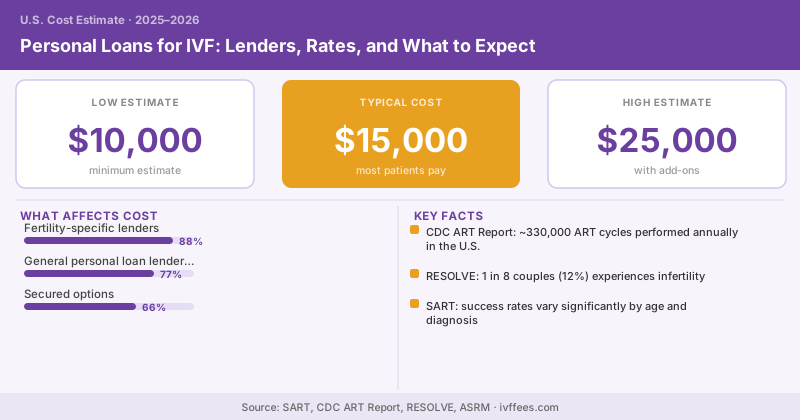
42% of IVF patients report using some form of borrowing to cover treatment costs, according to RESOLVE’s 2023 fertility financial survey. A personal loan is often the smartest option—but the rates vary wildly depending on where you apply and what your credit looks like.
Here’s a lender-by-lender breakdown.
Fertility-Specific vs. General Personal Loans
Before getting into rates, it helps to understand the two categories:
Fertility-specific lenders (CapexMD, Prosper Healthcare Lending, New Life Fertility Finance) partner directly with clinics. They know IVF costs, offer terms matched to treatment timelines, and sometimes bundle multi-cycle packages. The tradeoff: they’re often only available through your clinic’s financing partners, and rates can run higher than general lenders.
General personal loan lenders (LightStream, SoFi, Discover) offer unsecured loans for any purpose, including medical expenses. If you have strong credit, these almost always beat fertility-specific rates.
Lender Comparison
| Lender | APR Range | Loan Amounts | Min. Credit Score | Funding Time |
|---|---|---|---|---|
| LightStream | 6.49–25.49% | $5,000–$100,000 | ~670 | Same day |
| Prosper Healthcare Lending | 5.99–28.99% | $2,000–$47,000 | ~600 | 1–5 days |
| CapexMD | 7.99–29.99% | $3,500–$75,000 | ~620 | 2–7 days |
| New Life Fertility Finance | 8.99–24.99% | $5,000–$50,000 | ~640 | 3–7 days |
| SoFi | 8.99–29.99% | $5,000–$100,000 | ~680 | Same day |
APRs shown include any origination fees where applicable. Rates as of early 2026; always verify current terms directly with the lender.
LightStream: Best Rate for Strong Credit
LightStream (a division of Truist Bank) is the go-to for borrowers with credit scores above 720. It doesn’t charge origination fees, and its APRs start at 6.49%—among the lowest available for unsecured personal loans. On a $15,000 loan over 60 months at 7%, you’d pay roughly $297/month and about $2,800 in total interest. Same loan at 29.99% would cost $475/month and $13,500 in interest. That gap is real money.
LightStream approves and funds same-day in many cases, which matters if your cycle is starting soon.
Prosper Healthcare Lending
Prosper Healthcare Lending is a peer-to-peer lending platform focused specifically on healthcare expenses. It’s widely integrated with fertility clinics—your clinic’s billing coordinator can often submit the application on your behalf. Loans run up to $47,000, which covers most single IVF cycles and many multi-cycle scenarios.
The catch: origination fees of 1–5% get added to the loan, and approval can take up to 5 business days. Factor that into your treatment timeline. You don’t want to be waiting on a loan decision when your retrieval date is set.
CapexMD: Fertility-Focused with Multi-Cycle Options
CapexMD specializes exclusively in fertility and reproductive medicine. One standout feature: they offer multi-cycle loan packages that bundle 2–3 IVF cycles at a reduced per-cycle cost. If your clinic is a CapexMD partner, you may be able to pre-negotiate a package before you start.
Loan amounts go up to $75,000, which is enough to cover even a donor egg IVF cycle or surrogacy-related expenses. They also offer deferral options during the first few months—useful if you’re mid-stimulation and cash flow is tight.
New Life Fertility Finance
New Life focuses on patients who may not qualify elsewhere. Their credit score minimums are accessible, and they offer extended terms up to 84 months to keep monthly payments manageable. Longer terms mean more interest paid over time, but they can make the difference between treatment being possible and not.
Secured vs. Unsecured Loans
All the lenders above offer unsecured loans—no collateral required. That’s the standard for fertility financing.
Secured options like home equity lines of credit (HELOCs) or home equity loans can offer lower rates (5–9% range) if you own your home and have equity. The risk: your home is collateral. Many fertility patients are understandably hesitant to put their home on the line for a treatment that may not succeed on the first cycle.
If you’re considering a HELOC, the math works best when IVF costs exceed $30,000 (multi-cycle scenarios) and the rate difference is at least 5 percentage points compared to an unsecured option.
How Loan Amounts Match IVF Costs
A single IVF cycle typically runs $15,000–$25,000 including medications. Common loan scenarios:
- $15,000–$20,000: Single cycle, one clinic
- $25,000–$40,000: Two cycles or a shared-risk program
- $40,000–$75,000: Donor egg IVF or gestational carrier costs
Most lenders let you borrow within a few thousand dollars of these ranges. Apply for a loan amount slightly above your estimated cost to create a buffer for unexpected add-ons (ICSI, assisted hatching, additional monitoring).
Application Timeline vs. Treatment Timeline
This is the most overlooked part of IVF financing. Here’s a realistic timeline:
- Request quotes from 2–3 lenders — 1 day
- Submit applications (doing this within a 2-week window limits credit score impact) — 1–2 days
- Approval decisions — same day to 1 week depending on lender
- Funding to your bank account — same day to 5 business days after approval
- Payment to clinic — usually required before stims start
Start the loan process at least 3–4 weeks before your cycle begins. Most clinics need payment confirmed before your baseline appointment.
What Credit Score Do You Need?
Most fertility-specific lenders work with scores down to 600–620. General lenders like LightStream require 670 or higher for approval, and 720+ for their best rates. Per the Consumer Financial Protection Bureau’s 2024 consumer lending report, the median personal loan APR for borrowers with credit scores above 720 is roughly 11%, compared to 22–26% for scores below 640.
If your score needs work, spending 3–6 months before your cycle paying down revolving debt and disputing errors can meaningfully improve your rate. A 1-point improvement in APR on a $20,000 loan over 5 years saves about $600.
One Rule: Don’t Stop at the First Approval
Getting approved by one lender doesn’t mean you should stop looking. Multiple applications submitted within a 14–30 day window are typically treated as a single credit inquiry for scoring purposes (FICO’s rate-shopping window). Apply to 2–3 lenders, compare the actual APRs offered to you specifically, and choose the lowest. The few minutes of extra paperwork can save thousands.