The $28,000 upfront price looked terrifying — but the couple paid it. Eighteen months later, they got a refund check. And they were still childless. That’s the story behind the fine print that too many IVF patients skip.
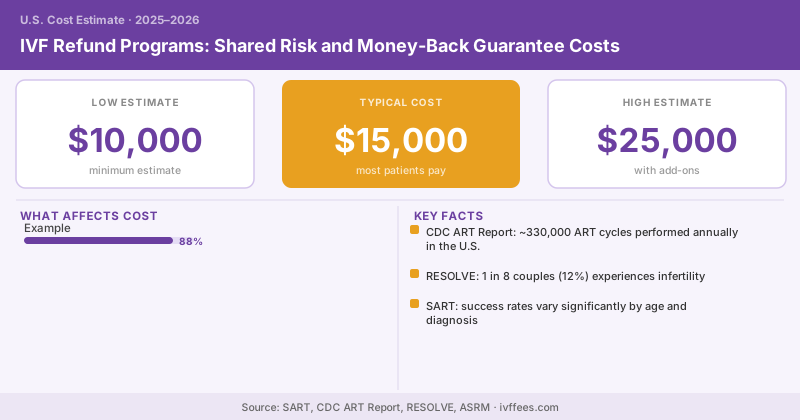
Shared-risk programs — also called money-back guarantee or refund programs — promise peace of mind: pay more upfront, and if IVF doesn’t work, get your money back. It sounds like the ultimate hedge against fertility treatment’s financial risk. The reality is considerably more complicated. Here’s everything you need to know before enrolling.
What Shared-Risk Programs Actually Cost
| Program Type | Upfront Cost | Cycles Included | Refund if Unsuccessful |
|---|---|---|---|
| Basic shared-risk (2 cycles) | $20,000 | 2 retrievals | 70–80% of program fee |
| Standard program (3 cycles) | $25,000–$35,000 | 3 retrievals + FETs | 90–100% of program fee |
| Premium (unlimited cycles) | $30,000–$45,000 | Unlimited per terms | 90–100% of program fee |
| Medications (excluded, typical) | $6,000–$15,000 | N/A | Not refunded |
| Genetic testing (excluded, typical) | $3,000–$9,000 | N/A | Not refunded |
How Shared-Risk Programs Work
The basic mechanics: you pay an elevated upfront fee that covers multiple IVF cycles. The clinic accepts the financial risk that some patients will need many cycles. If you take home a baby within the program’s terms, the clinic keeps your money. If you don’t, you receive a refund of the program fee (minus exclusions).
The program fee is typically 40–80% higher than the cost of a single cycle. That premium is the insurance cost — you’re paying extra for the guarantee.
Example: Single IVF cycle at your clinic: $18,000. Their shared-risk program: $30,000 for up to 3 cycles. If you succeed in cycle 1, you paid $30,000 for something that would have cost $18,000 — a $12,000 premium for peace of mind you didn’t need. If you succeed in cycle 3, you paid $30,000 for something that would have cost $54,000 — you came out $24,000 ahead.
The break-even point depends entirely on your success probability.
Qualification Requirements — The Most Important Part
This is what makes or breaks the value proposition of shared-risk programs: clinics don’t accept everyone.
To qualify for shared-risk, patients typically must:
- Be under a specific age (usually 40–42, though this varies)
- Have AMH above a minimum threshold (commonly ≥1.0 ng/mL)
- Have a normal uterine cavity (confirmed by SHG or hysteroscopy)
- Have an adequate antral follicle count
- Not have certain genetic conditions affecting embryo outcomes
Here’s the uncomfortable truth: the patients most likely to need multiple IVF cycles — older women, poor responders, those with complex diagnoses — are often disqualified from shared-risk programs. The patients who do qualify often would have succeeded in 1–2 self-funded cycles anyway.
According to an analysis published in Fertility and Sterility, patients accepted into shared-risk programs have average live birth rates of 45–65% per cycle — significantly higher than the general IVF population. The programs are selecting for the patients least likely to need the refund.
Calculate your expected cost both ways:
- Self-funded: (cost per cycle) ÷ (your success probability) = expected cost per baby
- Shared-risk: (program fee) + (medications and extras, excluded from refund)
If the shared-risk total is LOWER than your self-funded expected cost, it’s worth considering. If it’s higher — or if you’re likely to succeed in 1–2 cycles — self-funding is almost always the better financial choice.
What “Refund” Actually Means — The Fine Print
Most shared-risk refund programs don’t refund everything. Typical exclusions from the refund:
- Fertility medications ($3,000–$7,000 per cycle — a major exclusion)
- Genetic testing (PGT-A/PGT-M) ($3,000–$6,000 per retrieval)
- Anesthesia (when billed separately, $500–$1,200 per cycle)
- Embryo storage ($500–$1,500 per year)
- Consultation and administrative fees
On a 3-cycle program where you don’t succeed, your actual total spent might look like:
- Program fee: $30,000 (refunded: $27,000)
- Medications: $15,000 (not refunded)
- PGT testing: $12,000 (not refunded)
- Other fees: $3,000 (not refunded)
- Total spent: $60,000. Refund received: $27,000. Net loss: $33,000.
That’s the real scenario some patients face. Not the clean “$30,000 refunded” narrative.
Before enrolling in any shared-risk program, request a complete itemized list of what is and isn’t included in the program fee, and what is and isn’t covered by the refund. Get this in writing. Ask specifically about medications, PGT, anesthesia, embryo storage, and administrative fees. A verbal assurance is not enough.
When Shared-Risk Programs Genuinely Make Sense
Despite the complexities, shared-risk programs can be the right choice for specific patients:
- You qualify medically but have reason to believe success may take multiple cycles (prior failed cycles, borderline ovarian reserve)
- The psychological value of knowing you won’t be in debt forever if it doesn’t work outweighs the financial premium
- You’ve done the math and the program cost is genuinely lower than your expected multi-cycle self-funded cost
- You have the cash to pay upfront (or can finance it at a reasonable rate)
The emotional benefit shouldn’t be dismissed. For some patients, knowing there’s a financial backstop allows them to pursue treatment without the anxiety of open-ended financial exposure. That peace of mind has real value — it just needs to be weighed against the premium you’re paying for it.
Clinic-Specific Programs to Investigate
Major U.S. fertility clinic groups that commonly offer shared-risk programs include CCRM, Shady Grove Fertility, RMA of New Jersey, and UCSF. Each has different terms, qualification criteria, and refund percentages.
Shady Grove Fertility’s “Shared Risk 100% Refund Program” is one of the most comprehensive available — but you must meet their specific criteria and understand the medication exclusions.
The Bottom Line
Shared-risk IVF programs offer real financial protection — but only for the right patient, after a careful read of the terms. Run your expected cost calculation, get the fine print in writing, and never enroll based on the headline promise alone. For well-qualified patients who expect multiple cycles, the math can genuinely work. For patients who would likely succeed in one or two self-funded cycles, the premium is money you don’t need to spend.