Getting a second opinion on an IVF protocol is one of the most underused — and highest-ROI — things you can do before spending $20,000 on a cycle.
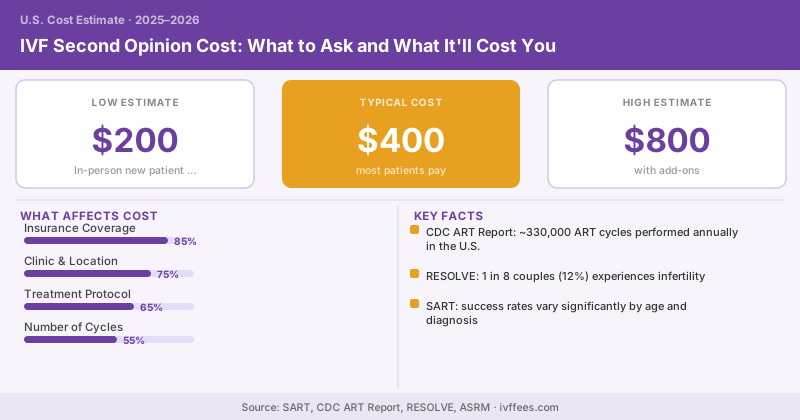
A reproductive endocrinologist (RE) charges $200 to $800 for a consultation. That’s it. And yet thousands of couples skip this step entirely, assume their first clinic’s protocol is the only option, and find out later — sometimes after multiple failed cycles — that another approach might have worked better or cost significantly less.
What a Second RE Consultation Costs
Most second-opinion consultations are structured just like an initial new-patient appointment. You’re paying for the RE’s time, review of your records, and their interpretation of your case.
| Consultation Type | Low | Typical | High |
|---|---|---|---|
| In-person new patient consult | $200 | $400 | $800 |
| Telemedicine second opinion | $150 | $300 | $600 |
| Academic medical center review | $300 | $500 | $900 |
| Insurance-covered consult (with mandate) | $0 | $30 copay | $150 |
If you live in a state with an IVF insurance mandate, your second consultation may be covered at the same rate as any specialist visit — often just a copay. Even without coverage, $300 to $500 is almost always worth it before committing to a full cycle.
Why a Second Opinion Can Change Everything
According to ASRM (American Society for Reproductive Medicine), treatment protocols vary significantly across clinics — particularly for patients with diminished ovarian reserve, recurrent implantation failure, or unexplained infertility. There’s no single “correct” protocol for most diagnoses.
Real differences you might discover from a second opinion:
- Different stimulation protocol. Your first clinic recommends a standard antagonist protocol; the second RE suggests a flare or mini-IVF approach given your ovarian reserve markers.
- Different add-on recommendations. One clinic routinely recommends PGT-A for everyone; another RE reviews your age and history and says you don’t need it.
- Different diagnosis. Your uterine cavity was cleared — but the second RE looks at your SIS results and sees a subtle polyp that was missed.
- Price difference. Clinics vary significantly in their base fees, bundling, and what they include in monitoring.
A 2022 survey by RESOLVE: The National Infertility Association found that 31% of fertility patients who sought a second opinion changed clinics or meaningfully altered their treatment plan as a result. That’s nearly one in three.
Bring everything: previous cycle summaries, semen analysis results, AMH and antral follicle count (AFC) records, saline sonogram or hysteroscopy reports, and any prior embryo grading reports. A second RE can’t give you a different perspective if they’re starting from scratch.
What Good Second-Opinion Questions Look Like
Don’t just ask “what would you do differently?” That’s too open-ended. Come in with specific questions based on what you’ve been told:
Protocol questions:
- “My current clinic has me on a long lupron protocol. Given my AMH of 1.2, would you recommend the same?”
- “My first clinic recommends doing PGT-A on all embryos. Given that I’m 31 with no known genetic issues, is that necessary?”
Diagnostic questions:
- “My AFC has been dropping. Is there anything in my prior bloodwork that would change how you’d approach stimulation?”
- “We’ve had one failed transfer. Would you recommend any additional uterine evaluation before the next attempt?”
Cost and efficiency questions:
- “My current quote is $18,500 for a full cycle with PGT. What would the same protocol cost at your clinic?”
- “Are there any components of the protocol I’ve been quoted that you’d consider optional for someone with my history?”
When a Second Opinion Is Especially Worth It
You don’t need a second opinion for every IVF cycle. But it’s worth the cost if:
- You’re considering your first cycle and you’ve only consulted one clinic
- You’ve had one or more failed cycles and your RE hasn’t proposed any protocol changes
- Your diagnosis is complex (DOR, recurrent implantation failure, endometriosis, male factor)
- Your quoted cost is significantly higher than national averages and you want to understand why
- You’re being pushed toward expensive add-ons and want an independent assessment
One important caveat: A second RE may recommend more testing, not less. Come in with realistic expectations — you’re looking for an independent clinical perspective, not necessarily a cheaper path forward.
Be cautious of “consultation mills” — clinics that offer steep discounts on second opinions but are primarily trying to recruit you as a patient. A legitimate second opinion focuses on your clinical picture, not on selling you their services.
Does Insurance Cover Second Opinions?
In states with fertility insurance mandates (including California, New York, Illinois, Massachusetts, New Jersey, and others), fertility-related consultations are typically covered under the same specialist copay structure as any other specialist visit.
Even outside mandate states, many PPO plans cover specialist consultations regardless of the specialty. Check whether the RE you’re seeing is in-network — and whether your plan requires a referral from your OB/GYN before seeing a specialist.
If you’re using an FSA or HSA, second-opinion consultation fees are qualified medical expenses, so you’re paying with pre-tax dollars either way.
The Bottom Line
A second RE opinion costs $200 to $800 and takes one appointment. Given that a full IVF cycle costs $15,000 to $30,000, spending 1–2% of that on an independent clinical review isn’t just reasonable — it’s arguably the most cost-effective step in your fertility journey. Bring your records, ask specific questions, and don’t skip it just because you feel loyal to your first clinic. Your protocol should be based on evidence, not inertia.