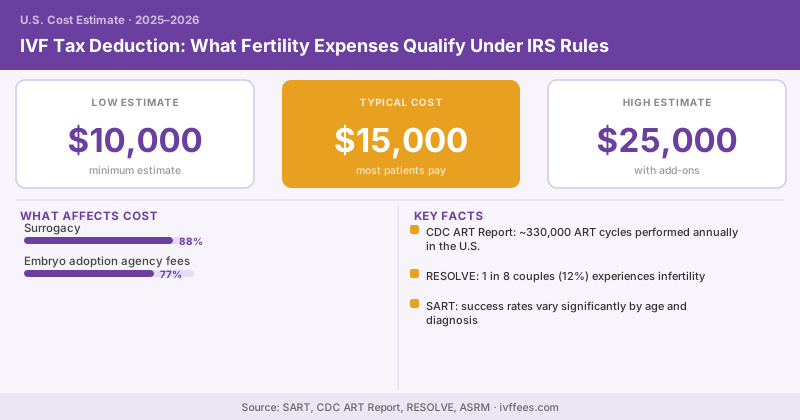
Most IVF patients overpay on their taxes. The IRS allows you to deduct qualified medical expenses—including most fertility treatments—but the 7.5% AGI threshold trips people up. Here’s how to figure out if you actually qualify, and how much you’ll save if you do.
The Rule: IRS Publication 502
Medical expenses are deductible under Section 213 of the Internal Revenue Code, with guidance in IRS Publication 502. The basic rule: you can deduct qualified medical expenses that exceed 7.5% of your Adjusted Gross Income (AGI) in the tax year you paid them.
The key phrase is “exceed”—only the amount above the 7.5% threshold is deductible. And the deduction is only valuable if you’re itemizing (using Schedule A), not taking the standard deduction.
What Fertility Expenses Qualify
The IRS explicitly addresses fertility treatments in Publication 502. These expenses qualify:
| Expense Type | Qualifies? | Notes |
|---|---|---|
| IVF procedure fees | Yes | Egg retrieval, transfer, lab fees |
| IUI | Yes | Full procedure cost |
| Fertility medications | Yes | Injectables, oral meds, suppositories |
| Egg freezing | Yes | Retrieval + initial storage |
| Embryo storage fees | Yes | Annual cryostorage |
| Sperm bank fees | Yes | Collection, analysis, storage |
| Egg donor fees | Yes | Agency fees, donor compensation |
| Sperm donor fees | Yes | Sperm purchase, shipping |
| Diagnostic testing | Yes | AMH, semen analysis, genetic testing |
| Travel to fertility clinic | Yes | Mileage, lodging if 50+ miles |
| Surrogacy fees (your own expenses) | Contested | See below |
| Embryo adoption agency fees | Generally no | Per IRS guidance |
What Doesn’t Qualify (and Why It’s Complicated)
Surrogacy: The IRS has not issued definitive guidance on surrogacy costs. Tax courts have ruled inconsistently. The intended parent’s own medical expenses (fertility medications, egg retrieval) generally qualify. The surrogate’s medical costs—which you pay—are trickier, since those are technically her medical expenses, not yours. Many tax professionals take a conservative position and exclude surrogate medical costs. Get advice from a tax attorney if surrogacy is part of your situation.
Embryo adoption agency fees: These resemble adoption placement fees more than medical expenses, and the IRS has historically not allowed them as medical deductions. The embryo transfer procedure itself, however, typically qualifies.
The 7.5% AGI Threshold: Real Math
Here’s how to calculate your actual deduction:
Example: $80,000 AGI, $25,000 in IVF expenses
- Calculate the threshold: $80,000 × 7.5% = $6,000
- Subtract threshold from expenses: $25,000 − $6,000 = $19,000 deductible amount
- Apply your marginal tax rate: $19,000 × 22% = $4,180 in tax savings
| AGI | IVF Expenses | 7.5% Floor | Deductible Amount | Savings at 22% |
|---|---|---|---|---|
| $60,000 | $20,000 | $4,500 | $15,500 | $3,410 |
| $80,000 | $25,000 | $6,000 | $19,000 | $4,180 |
| $100,000 | $30,000 | $7,500 | $22,500 | $4,950 |
| $150,000 | $40,000 | $11,250 | $28,750 | $8,050 (at 24%) |
The IRS confirmed in Publication 502 (2024 edition) that IVF and fertility preservation treatments remain explicitly deductible as medical expenses, affirming longstanding policy.
Standard Deduction vs. Itemizing
For 2025, the standard deduction is $15,000 (single) and $30,000 (married filing jointly). To benefit from your medical expense deduction, your total itemized deductions—medical expenses above the 7.5% floor, plus mortgage interest, state taxes (capped at $10,000), charitable contributions—need to exceed your standard deduction.
For a married couple with $30,000 in IVF expenses, $12,500 mortgage interest, and $10,000 in state taxes:
- Total itemized: ~$38,500 (assuming $80,000 AGI, $19,000 medical deduction + $12,500 mortgage + $10,000 SALT)
- Standard deduction: $30,000
- Benefit to itemize: roughly $8,500 more in deductions, saving $2,000+ at 24% marginal rate
Run the numbers with your tax preparer. Many fertility patients find it’s worth itemizing in the year of IVF treatment even if they typically take the standard deduction.
HSA and FSA: The Better First Move
Before chasing the deduction, maximize your HSA and FSA contributions. According to IRS data from 2023, the maximum HSA contribution for a family plan was $8,300. Using pre-tax HSA or FSA dollars to pay for IVF means you avoid income taxes on that money entirely—a guaranteed savings equal to your marginal tax rate, no threshold required.
The medical deduction and HSA/FSA don’t fully stack: expenses paid with HSA/FSA funds don’t count toward your medical deduction (they’ve already been paid with pre-tax money). Your strategy should be:
- Maximize HSA/FSA first
- Pay remaining IVF costs out of pocket
- Claim the medical expense deduction on the remaining amount above the 7.5% floor
Timing Expenses Across Tax Years
If you’re doing two IVF cycles in separate years, you might benefit from concentrating expenses into a single tax year to exceed the 7.5% floor more easily. For example, prepaying embryo storage fees in December rather than January could push more expenses into a high-spending year.
Discuss timing strategy with your accountant before your second cycle. The potential savings—especially if you’re close to a deduction threshold—can be meaningful.
Documentation You’ll Need
Keep records of every fertility-related expense:
- Receipts and EOBs from your clinic
- Pharmacy receipts for all fertility medications
- Statements from embryo storage facilities
- Invoices from sperm or egg donor agencies
- Mileage logs if you drove more than 50 miles each way for appointments
The IRS mileage rate for medical travel in 2025 is 21 cents per mile. If you drove 100 miles each way for 15 clinic appointments, that’s $630 in additional deductible expense before you count a single medication cost.