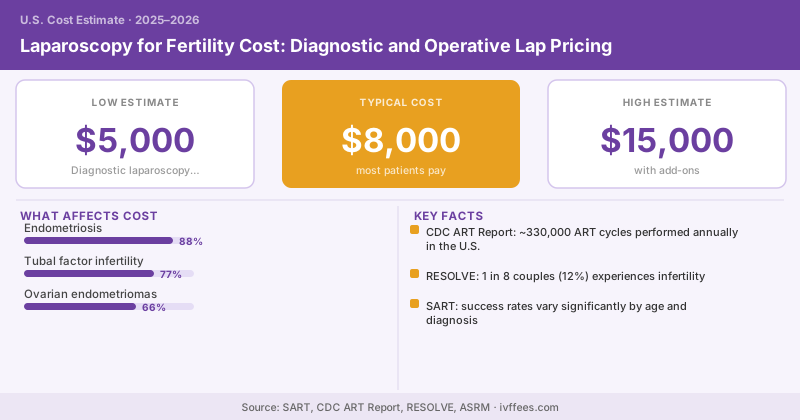
In 2010, laparoscopy was the gold standard for diagnosing endometriosis. By 2020, improved imaging and rising surgical costs had shifted thinking: many REs now recommend proceeding directly to IVF rather than operating first. But for a meaningful subset of fertility patients, laparoscopy isn’t optional — it’s necessary. And the cost difference between a diagnostic lap and a full operative procedure can be $15,000.
What Fertility Laparoscopy Is
Laparoscopy is a minimally invasive surgical procedure performed under general anesthesia. A surgeon inserts a tiny camera (laparoscope) through a small incision near the navel to directly visualize the pelvic organs — uterus, ovaries, fallopian tubes, and the surrounding peritoneum.
A diagnostic laparoscopy means the surgeon is only looking. No tissue is removed, no repairs are made. The goal is visualization and biopsy (if needed to confirm endometriosis).
An operative laparoscopy means the surgeon is both looking and doing: excising endometrial tissue, removing ovarian cysts (endometriomas), opening blocked tubes, releasing adhesions (scar tissue), or removing fibroids.
Why a Fertility Patient Might Need Laparoscopy
Endometriosis is the most common indication. About 10% of women of reproductive age have endometriosis, and it’s present in approximately 30–50% of women with infertility, according to ACOG. Laparoscopy is still the only definitive way to diagnose endometriosis — no blood test or imaging can confirm it with certainty.
Tubal factor infertility. Blocked or damaged fallopian tubes can sometimes be surgically corrected, though IVF bypasses the tubes entirely and is often preferred for moderate-to-severe tubal damage.
Ovarian endometriomas. Large endometriomas (chocolate cysts) can be removed laparoscopically, though the surgery carries a risk of reducing ovarian reserve and must be weighed carefully.
Unexplained infertility with suspected peritoneal disease. Some patients have pelvic adhesions or minimal endometriosis that isn’t visible on imaging but is contributing to infertility.
| Laparoscopy Type | Low | Typical | High |
|---|---|---|---|
| Diagnostic laparoscopy only | $5,000 | $8,000 | $15,000 |
| Operative laparoscopy (endometriosis excision) | $8,000 | $15,000 | $30,000 |
| Laparoscopy + hysteroscopy combined | $7,000 | $12,000 | $25,000 |
| Robotic-assisted laparoscopy | $10,000 | $18,000 | $35,000 |
The “Operate or IVF First?” Decision
This is the central debate in reproductive surgery. The arguments:
For laparoscopy first:
- Endometriosis excision may improve IVF outcomes by reducing the inflammatory environment
- Moderate-to-severe endometriosis with significant pelvic distortion may make egg retrieval more difficult or less safe
- Some adhesion patterns reduce chances of natural conception even between IVF attempts
For IVF first:
- IVF success rates are not clearly improved by surgical endometriosis excision before treatment, for mild disease
- Surgery carries risks (anesthesia, infection, ovarian reserve reduction with endometrioma removal)
- IVF is faster — surgery adds months to the timeline
ASRM guidelines generally support surgical treatment of moderate-to-severe endometriosis before IVF, particularly when pelvic anatomy is distorted. For minimal-to-mild endometriosis, the data supporting surgery is weaker.
If your RE is recommending laparoscopy, ask whether they’re referring you to a minimally invasive gynecological surgeon (MIGS) who specializes in endometriosis excision — not just ablation (burning). Excision of endometriotic tissue has better long-term recurrence outcomes than ablation, though it’s more technically demanding and sometimes costs more.
What Drives the Cost
Surgeon’s fee. A general gynecologist charges less than a specialist in minimally invasive surgery or a reproductive surgeon. If you have stage III–IV endometriosis or complex adhesions, you want the specialist — even if they cost more.
Facility costs. Hospital operating rooms are significantly more expensive than ambulatory surgery centers for the same procedure. Many RE-affiliated surgical practices have outpatient surgery center privileges that reduce facility fees.
Operative complexity. A straightforward diagnostic lap takes 30–45 minutes. An operative lap for stage III endometriosis with deep infiltrating disease and adhesiolysis can take 2–4 hours — and every minute of OR time costs money.
Anesthesia. Unlike IVF egg retrieval (which uses IV sedation), laparoscopy requires general anesthesia with intubation. This is billed by the anesthesiologist on a time-based rate.
Insurance Coverage
Laparoscopy for documented endometriosis, tubal factor, or other gynecological diagnoses is typically covered by insurance when medically indicated — not as part of the IVF benefit, but as a standard surgical benefit. This distinction matters: even patients with no IVF coverage may have laparoscopy covered under their general surgical benefits.
The diagnosis code matters for insurance purposes. “Endometriosis” or “pelvic adhesions” as a primary diagnosis codes differently than “infertility” and may have better coverage under standard surgical benefits.
If you have endometriosis and are planning IVF, consult with a reproductive endocrinologist AND a reproductive surgeon before proceeding. The decision about whether to operate first involves nuances that depend on your stage of disease, ovarian reserve, age, and how much pelvic anatomy has been affected.
Bottom Line
Fertility laparoscopy costs $5,000 to $25,000 depending on whether it’s diagnostic or operative and where it’s performed. For patients with suspected endometriosis, tubal damage, or complex pelvic disease, it may be a necessary step — and often one that insurance covers better than IVF treatment itself. The key question isn’t whether to have surgery, but when — before or after attempting IVF.