In 2010, Lupron was in almost every IVF protocol. Today, it’s been largely replaced in stimulation by the antagonist protocol — but it hasn’t disappeared. Lupron (leuprolide acetate) still plays an important role in certain IVF cycles, and it has a second, separate use as a trigger shot that’s entirely different from its downregulation function.
Understanding which use your doctor intends — and what it costs — makes the pharmacy conversation a lot less confusing.
Two Very Different Uses for One Drug
Leuprolide acetate is a GnRH agonist. When given continuously (as in the long protocol), it initially causes a hormone surge and then suppresses your pituitary — shutting off your body’s natural FSH and LH production so your RE can control ovarian stimulation entirely through injections.
When given as a single larger dose (the trigger shot use), it causes that initial hormone surge but is not continued — creating a brief, controlled LH surge that triggers final egg maturation before retrieval.
These two uses are pharmacologically opposite in effect and very different in dosage. The long protocol uses small daily doses over weeks. The trigger use is a single injection, typically 1–4 mg.
Cost by Use
| Use Case | Typical Dose | Low End | Typical | High End |
|---|---|---|---|---|
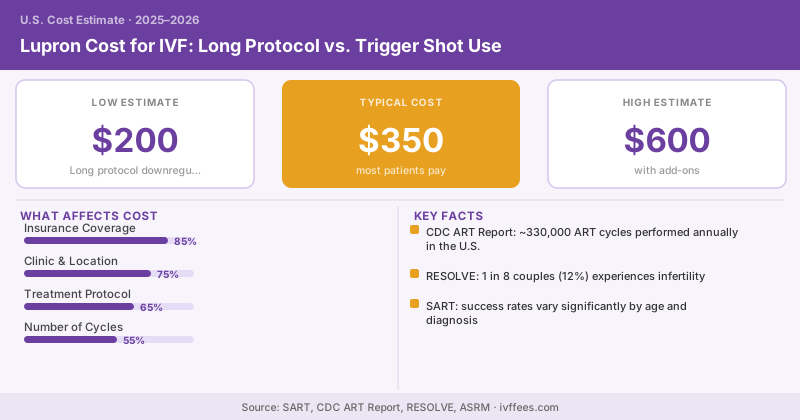
| Long protocol downregulation (generic) | 0.1–1mg/day × 2–4 weeks | $200 | $350 | $600 |
| Long protocol (brand Lupron) | 0.1–1mg/day × 2–4 weeks | $800 | $1,100 | $1,500 |
| Lupron trigger shot (generic) | Single 1–4mg dose | $40 | $70 | $120 |
| Lupron trigger (brand) | Single 1–4mg dose | $150 | $250 | $400 |
| Lupron depot (not IVF use) | Monthly injection | $900 | $1,200 | $1,800 |
Generic leuprolide acetate became available in the US after AbbVie’s patents expired, bringing long-protocol costs down substantially from brand-name prices. If you’re on a long protocol, always confirm your pharmacy is dispensing the generic — the brand Lupron at $800–$1,500 per IVF cycle represents a significant unnecessary expense for most patients.
The Long Protocol: Who Still Uses It?
Antagonist protocols (using Ganirelix or Cetrotide) have largely replaced the long Lupron protocol for standard IVF. They’re shorter, require fewer injection days, and produce comparable or better outcomes in most patients.
But the long Lupron protocol still has specific indications:
- Women with endometriosis who benefit from pre-cycle suppression
- Women being downregulated before a frozen embryo transfer
- Patients with certain uterine conditions requiring hormonal preparation
- Some fertility preservation protocols
If you’re on an antagonist protocol, you probably won’t need Lupron for downregulation at all. If you’re on a long protocol, knowing why your RE chose it is worth a conversation — and so is confirming you’re getting the generic.
Lupron as a Trigger Shot
This is where Lupron has gained significant ground in modern IVF. As a trigger shot — replacing or supplementing the standard hCG trigger — leuprolide acetate causes a natural LH surge through your own pituitary gland.
The advantage: dramatically reduced risk of ovarian hyperstimulation syndrome (OHSS). OHSS affects an estimated 1–5% of IVF cycles with standard hCG trigger. In high-risk patients (high antral follicle count, PCOS, prior OHSS), a Lupron trigger can reduce this risk substantially.
The downside: a Lupron-only trigger is associated with lower progesterone levels post-retrieval and slightly lower pregnancy rates in fresh transfers. Most clinics using Lupron trigger will therefore “freeze all” embryos and do a subsequent frozen transfer, when the OHSS risk is eliminated. Some protocols use a dual trigger — both Lupron and a low dose of hCG — to balance the benefits.
For the trigger use only, you need a small amount of generic leuprolide — typically $40–$120 versus $100–$300+ for brand hCG (Pregnyl/Ovidrel). If you’re high-risk for OHSS, it’s both the safer and cheaper option.
AbbVie Patient Assistance Program
AbbVie, Lupron’s manufacturer, offers the AbbVie myAbbVie Assist program for patients who can’t afford brand Lupron. The program provides free or reduced-cost medication for qualifying patients based on income and insurance status.
Income eligibility: typically up to $100,000 for individuals, up to $150,000 for households (thresholds vary). The application is submitted through your physician’s office or directly at myabbvieassist.com.
For most uses — long protocol downregulation and trigger shot — generic leuprolide acetate is therapeutically equivalent to brand Lupron. The AbbVie assistance program is most relevant for patients who are specifically prescribed brand Lupron for reasons their RE can explain (e.g., specific formulation requirements), or who have insurance plans that require the brand name.
For cash-pay patients, the generic is almost always the right choice.
Insurance and Prior Authorization
Leuprolide acetate is covered by many insurance plans because it has multiple indications beyond fertility — it’s used for prostate cancer, endometriosis, and precocious puberty. This broader coverage base means it’s on formulary at more plans than pure fertility drugs.
That said, insurers sometimes require prior authorization specifying the fertility indication. The PA process is standard — your RE’s office handles it routinely. The key is submitting early so approval doesn’t delay your cycle start.
Generic leuprolide is typically on tier 2 or 3 formularies. Brand Lupron is usually on the highest specialty tier and significantly more expensive even with insurance.
GnRH Agonist vs. Antagonist: The Protocol Choice
If you’re comparing protocols with your RE, here’s the short version of the cost comparison:
- Long Lupron protocol: 2–4 weeks of daily Lupron injections ($200–$600 generic) + full stimulation + trigger
- Antagonist protocol: 4–6 days of Ganirelix or Cetrotide ($280–$780) + full stimulation + trigger
On medication cost alone, the protocols are comparable. The antagonist protocol wins on convenience (fewer injection days, shorter timeline) and is now preferred by most REIs for standard responders.
If your clinic is still routinely using a long Lupron protocol for all patients without a specific indication, it’s reasonable to ask whether an antagonist protocol would be appropriate for you. This isn’t a question that will offend your doctor — it’s a standard clinical discussion, and the answer will depend on your specific history.
Bottom Line
Generic leuprolide acetate for a long protocol IVF cycle runs $200–$600 — a fraction of the brand Lupron cost. As a trigger shot, it’s $40–$120. If you’re prescribed brand Lupron and paying out of pocket, either switch to generic or apply for AbbVie’s assistance program. And if you’re on a long Lupron protocol, confirm with your RE that there’s a specific reason — antagonist protocols are now standard for most patients.