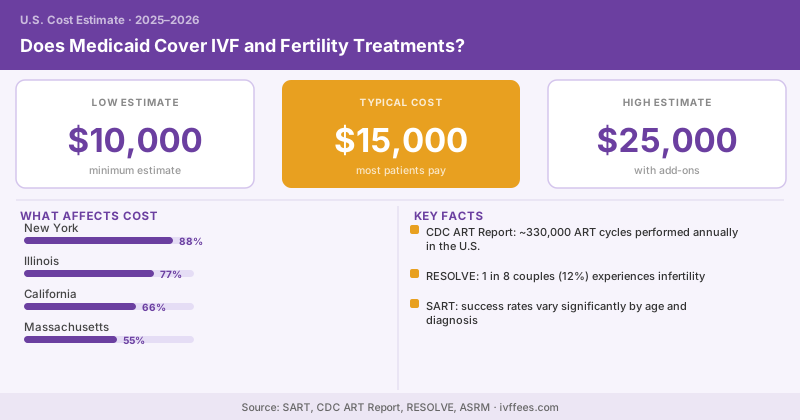
Here’s the hard truth: if you’re on standard Medicaid, IVF almost certainly isn’t covered. Federal Medicaid law requires coverage for pregnancy-related care, but it doesn’t mandate fertility treatment. Across most of the country, Medicaid pays for a prenatal appointment the week you get pregnant — just not for the fertility treatment that got you there.
That said, “almost certainly not covered” is not “never covered.” A handful of states have extended Medicaid fertility benefits, and there are alternative programs that can help. Let’s be specific about what actually exists.
Federal Medicaid and Fertility: The Baseline
The federal Medicaid program, administered jointly by the federal government and states, sets minimum coverage requirements. States must cover “family planning services and supplies,” which includes contraception, sterilization, and related counseling.
Fertility treatment falls into a different category. Federal Medicaid does not require coverage for:
- IVF or other assisted reproductive technologies
- IUI (intrauterine insemination)
- Fertility medications (gonadotropins, Clomid)
- Egg freezing
- Embryo transfer fees
Diagnostic testing to identify the cause of infertility may be covered in some states as part of gynecological care — but treatment is a different matter.
The CDC’s National Survey of Family Growth reported in 2022 that women with lower incomes are significantly less likely to receive fertility treatment, which tracks directly with the lack of Medicaid coverage for most fertility services.
States with Some Medicaid Fertility Coverage
A small number of states have expanded their Medicaid programs to cover some fertility services:
New York
New York’s Medicaid program covers limited infertility services for eligible enrollees. This includes some diagnostic services and, in certain circumstances, treatment. New York also has a robust state fertility insurance mandate for employer plans — but Medicaid is a separate program. Medicaid enrollees in NY have more access than in most states but still have more limited coverage than those with employer-based insurance.
Illinois
Illinois Medicaid offers some coverage for infertility diagnosis and, for certain enrolled populations, treatment. The state’s broader fertility mandate for employer plans doesn’t automatically extend to Medicaid, but state administrators have expanded coverage incrementally.
California
California Medi-Cal (Medicaid) covers infertility diagnosis and some treatment services for eligible enrollees. Coverage doesn’t uniformly include IVF but includes evaluation and some medical treatments. Family PACT (Planning, Access, Care, and Treatment), California’s family planning program, provides reproductive health services to income-eligible individuals — but focuses on contraception and STI prevention, not fertility treatment.
Massachusetts
Massachusetts MassHealth (Medicaid) provides limited fertility-related coverage. The state’s broader fertility mandate creates some spillover effect, and state administrators have included some fertility services in expanded coverage categories.
Title X Family Planning Programs
Title X is a federal grant program funding family planning clinics across the country. Title X clinics provide reproductive health services on a sliding fee scale based on income — but like Medicaid, the focus is on contraception, STI testing, pregnancy testing, and preventive care.
Title X does not fund IVF or assisted reproductive technologies. For fertility treatment specifically, Title X is not a primary resource. However, Title X clinics can provide fertility evaluation and referrals, which may help patients access the right specialist even if the treatment itself isn’t funded through the program.
What Medicaid Does Cover (That Helps Fertility Patients)
Even without IVF coverage, Medicaid can support fertility care in indirect but meaningful ways:
Diagnostic testing: Many states cover diagnostic bloodwork, ultrasound evaluations, and gynecological exams under Medicaid. Getting a workup done through Medicaid can clarify the diagnosis before pursuing self-pay fertility treatment.
Underlying condition treatment: If an underlying condition — like hypothyroidism, PCOS, or pelvic inflammatory disease — is contributing to infertility, treatment for that condition is typically covered under Medicaid, even if IVF isn’t.
Prenatal care after fertility treatment: Once pregnant (whether through fertility treatment or not), Medicaid covers prenatal care, delivery, and postpartum care.
Medications: Some states’ Medicaid programs cover medications that help with fertility indirectly — thyroid medications, metformin for insulin resistance in PCOS, etc.
| Service | Federal Medicaid | Medicaid in Strong States (NY, IL, CA) | Notes |
|---|---|---|---|
| Fertility diagnostics | Sometimes covered | Often covered | State-dependent |
| IUI | Rarely covered | Limited coverage in some states | Requires state expansion |
| IVF | Not covered | Minimal/no coverage | No mandate at federal level |
| Fertility medications | Not covered | Limited in some states | Varies by medication type |
| Prenatal care (after pregnancy) | Covered | Covered | Universal Medicaid coverage |
Income Thresholds for Medicaid Eligibility
Medicaid eligibility varies by state and is based on household income relative to the Federal Poverty Level (FPL). Under the ACA Medicaid expansion (adopted by most states):
- Adults without children: Eligible up to 138% of FPL (~$21,000/year for an individual in 2025)
- Pregnant individuals: Many states have higher income thresholds for pregnancy-related Medicaid, often 185–200% FPL
- Children: Generally covered at higher income levels than adults
If you’re in a non-expansion state, eligibility may be much more restrictive. Find your state’s current eligibility thresholds at healthcare.gov or your state Medicaid agency.
Medicaid enrollment rules mean that ACA marketplace plans may be more accessible than you think if your income is above the Medicaid threshold but you still need cost assistance. Marketplace plans in states with fertility mandates might provide better fertility coverage than Medicaid, depending on your income and the subsidies available.
Alternative Resources for Low-Income Fertility Patients
If Medicaid doesn’t cover the treatment you need, these programs fill some gaps:
Fertility grants: RESOLVE’s database at resolve.org/what-are-my-options/financial-assistance/ includes grants specifically for low-income patients. Baby Quest Foundation, Pay It Forward Fertility Foundation, and others provide grants that don’t require income above a threshold — they’re available to anyone who applies and qualifies.
University and research clinic programs: Academic medical centers sometimes offer fertility treatment at reduced cost in exchange for participation in research protocols. The care is real; the discount can be significant.
Clinic-based financial assistance: Some fertility clinics offer sliding-scale fees or discounted programs for patients below certain income thresholds. Ask directly — it’s not always advertised.
Pharmaceutical patient assistance programs: Drug manufacturers offer patient assistance programs for high-cost fertility medications like gonadotropins. Your RE’s office can help you apply.
The lack of federal Medicaid coverage for IVF represents a real equity gap in the US healthcare system. But knowing the landscape clearly — what’s covered, what’s not, and what alternatives exist — is the starting point for making a plan.
Medicaid coverage information based on CMS federal requirements and state Medicaid agency documentation as of 2025. State-specific coverage changes frequently; verify current coverage with your state Medicaid agency. CDC National Survey of Family Growth 2022.