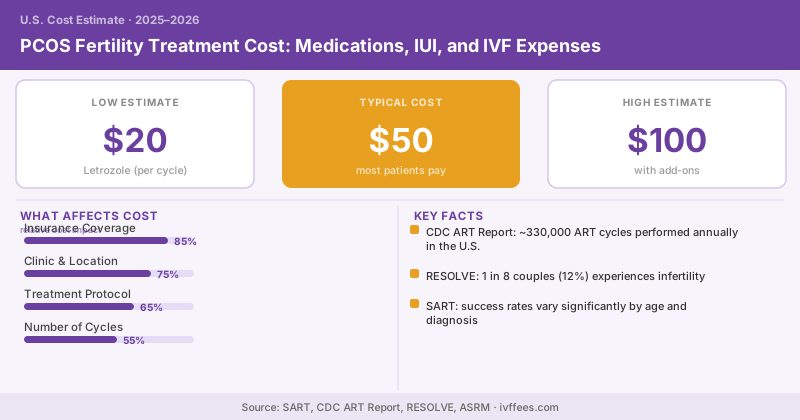
A $30 bottle of letrozole gets a lot of women with PCOS pregnant. That’s the surprising part — polycystic ovary syndrome is the most common cause of ovulatory infertility, yet it’s also one of the most treatable. The ACOG estimates PCOS affects 6–12% of women of reproductive age in the U.S., and the good news is that treatment usually starts cheap and only escalates if simpler options don’t work.
So what does the full ladder of PCOS fertility treatment cost? It depends entirely on how far up you have to climb.
Why PCOS Costs Less Than You’d Expect (At First)
The core problem in PCOS is anovulation — you’re not releasing eggs reliably. The eggs are usually there; they just need a nudge. That’s why the first-line treatment isn’t IVF. It’s oral ovulation-induction medication, and it’s remarkably affordable.
Letrozole is now the preferred first-line drug. A landmark NIH-funded trial published in the New England Journal of Medicine found letrozole produced higher live birth rates than clomiphene in women with PCOS — roughly 27.5% versus 19.1%. That’s a big deal when you consider letrozole costs almost nothing.
| Treatment Step | Low | Typical | High |
|---|---|---|---|
| Letrozole (per cycle) | $20 | $50 | $100 |
| Clomiphene (per cycle) | $15 | $40 | $90 |
| Monitoring ultrasound + bloodwork | $200 | $500 | $1,200 |
| IUI cycle (drugs + procedure) | $500 | $1,200 | $4,000 |
| Injectable gonadotropins (per cycle) | $1,500 | $3,500 | $6,000 |
| IVF cycle (PCOS-adjusted) | $12,000 | $17,000 | $25,000 |
Step One: Ovulation Induction Pills
Most REs start here. You take letrozole or clomiphene for five days early in your cycle, then track ovulation. Add a fertility testing workup to confirm the rest of your reproductive system is working, and you’re looking at a few hundred dollars per cycle including monitoring.
The catch with PCOS: you can over-respond. Women with PCOS have lots of small follicles, so the same dose that helps one person can produce too many follicles in another, raising multiple-pregnancy risk. That’s why monitoring isn’t optional — it’s the part you can’t skip.
Step Two: Adding IUI or Injectables
If pills alone don’t work after 3–6 cycles, the next rung is usually IUI, sometimes combined with the same oral meds. IUI places washed sperm directly in the uterus around ovulation. Costs stay moderate — often under $2,000 per cycle in many clinics.
Some women move to injectable gonadotropins, which are far more potent than pills. They also cost dramatically more and carry a higher OHSS risk in PCOS patients. This is where fertility medications start driving the bill upward fast.
For most women with PCOS, the cheapest treatments work. Letrozole-based ovulation induction gets a majority of patients pregnant within a few cycles for a few hundred dollars total. IVF is the last resort, not the first — don’t let anyone push you straight to a $17,000 cycle without trying the ladder first.
Step Three: IVF for PCOS
When ovulation induction and IUI fail — or when there’s a second factor like tubal disease or male-factor — IVF becomes the path. PCOS patients often respond strongly to stimulation, which can be a double-edged sword: great egg yields, but elevated OHSS risk.
A standard PCOS IVF cycle costs $12,000 to $25,000 before medications. Because of OHSS risk, many clinics use a “freeze-all” approach — retrieve eggs, freeze all embryos, then do a frozen embryo transfer in a later cycle once your ovaries have settled. That adds a few thousand dollars but improves safety. The upside for PCOS patients: high egg counts often mean more embryos banked per egg retrieval.
OHSS (ovarian hyperstimulation syndrome) is the single biggest medical risk for PCOS patients in IVF. Severe cases require hospitalization, which can add thousands in unexpected costs. Ask your clinic about freeze-all protocols and GnRH-antagonist triggers, which dramatically reduce OHSS risk — this is a safety and a budget question.
What Insurance Tends to Cover
PCOS is a recognized medical diagnosis, so diagnostic testing and metformin (often prescribed for insulin resistance) are frequently covered even by plans that exclude infertility. Ovulation-induction pills are cheap regardless. The expensive end — IVF — follows your state’s mandate rules. If you’re wondering why IVF is so expensive compared to the pills, it’s the lab work, anesthesia, and embryology that drive the gap.
Frequently Asked Questions
Does losing weight reduce PCOS treatment costs? It can. ACOG notes that even a 5–10% reduction in body weight can restore ovulation in some overweight women with PCOS, potentially letting you conceive on cheaper oral medications instead of escalating to injectables or IVF.
How many letrozole cycles before moving to IVF? Most REs try 3–6 ovulation-induction cycles (often adding IUI) before recommending IVF, assuming no other major fertility factors. Each cycle is inexpensive, so the early ladder is low-cost.
Is metformin part of PCOS fertility treatment cost? Sometimes. Metformin addresses insulin resistance and is cheap (often $10–$30/month, frequently insurance-covered). It’s not a standalone fertility drug for most patients but may be added to a letrozole protocol.
Bottom Line
PCOS fertility treatment is unusual in fertility medicine because it often starts — and ends — cheaply. Many women conceive on letrozole for under $1,000 total. IVF, at $12,000 to $25,000, is reserved for cases that don’t respond to the simpler ladder. If money is a concern, the encouraging reality is that the most affordable PCOS treatments are also the most likely to work first.