Your AMH came back at 0.4. Your antral follicle count is 4. Your RE used the phrase “diminished ovarian reserve” — or possibly “poor ovarian responder.” Now you’re facing a decision that’s equal parts medical and financial: keep trying with your own eggs, or transition to donor eggs.
Both paths cost real money. Neither is simple. Here’s an honest look at what IVF with poor ovarian reserve actually costs — and the data that should inform the decision.
What Poor Ovarian Reserve Means for IVF
Diminished ovarian reserve (DOR) is characterized by a reduced quantity of remaining eggs. Markers include:
- AMH (anti-Mullerian hormone) below 1.0 ng/mL (low) or below 0.5 ng/mL (very low)
- Antral follicle count (AFC) of 5 or fewer on baseline ultrasound
- FSH above 10–15 IU/L on cycle day 3
Low ovarian reserve doesn’t tell you anything about egg quality per se — it tells you about quantity. But with fewer eggs to work with per retrieval, each cycle yields fewer blastocysts, fewer embryos to test, and fewer transfer opportunities.
How DOR Changes IVF Costs
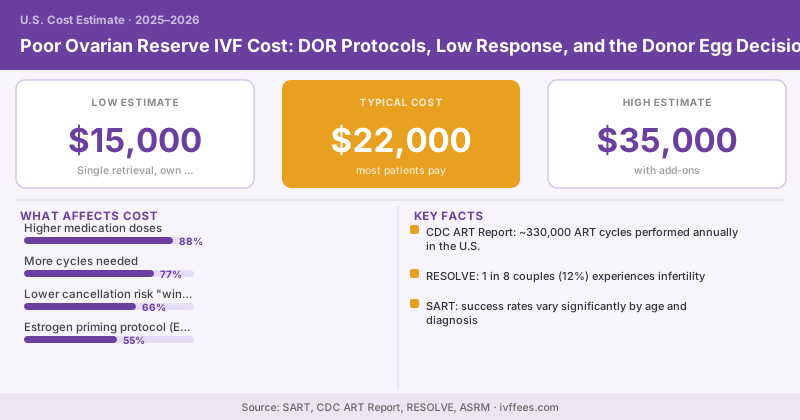
Higher medication doses. Women with DOR often require maximum-dose stimulation to recruit as many follicles as possible. FSH doses of 450–600 IU/day (compared to 150–300 IU in a normal responder) mean significantly higher medication costs.
More cycles needed. With fewer eggs retrieved per cycle, you may need multiple retrievals to accumulate enough embryos for a transfer — or to test with PGT-A. Each retrieval costs $12,000 to $18,000 in procedure fees plus medications.
Lower cancellation risk “wins.” The flip side of pushing hard on stimulation: some REs switch DOR patients to mini-IVF or natural cycle protocols to reduce cancellation risk and lower medication costs — accepting fewer eggs in exchange for a more reliable cycle.
| DOR IVF Scenario | Low | Typical | High |
|---|---|---|---|
| Single retrieval, own eggs (standard protocol) | $15,000 | $22,000 | $35,000 |
| Banking 2–3 retrievals before transfer | $30,000 | $45,000 | $75,000 |
| Donor egg IVF (fresh donor cycle) | $25,000 | $40,000 | $60,000 |
| Frozen donor egg cycle | $15,000 | $25,000 | $40,000 |
| Cumulative cost after 3 own-egg cycles | $35,000 | $60,000 | $100,000+ |
The Protocols Used for DOR
Maximum stimulation antagonist protocol. Uses highest tolerable doses of FSH/LH from cycle day 2 or 3, with a GnRH antagonist added to prevent premature ovulation. The goal: recruit every available follicle.
Estrogen priming protocol (EPP). Estrogen supplementation in the cycle before stimulation theoretically “primes” follicles for better response. Evidence is mixed but it’s widely used.
Flare protocols. A short-term agonist protocol that causes an initial LH/FSH surge before suppression kicks in — used to take advantage of natural cycle gonadotropins in the early days of stimulation.
DHEA supplementation. Some REs recommend DHEA (dehydroepiandrosterone) 75mg daily for 2–3 months before retrieval in DOR patients. Proposed mechanism: DHEA may improve follicular response. Evidence is limited but the intervention is low-cost and low-risk.
Mini-IVF for DOR. Counterintuitively, some DOR experts recommend minimal stimulation (Clomid + low-dose FSH) to reduce cancellation risk and medication costs, accepting 1–3 eggs as the expected yield. Lower cost per cycle ($5,000 to $10,000) but very low embryo yield per attempt.
The Donor Egg Decision Point
This is the hardest conversation in fertility medicine. When do you stop trying with your own eggs and transition to donor eggs?
The data is clear: IVF success rates decline sharply with age and ovarian reserve. According to SART’s 2022 national data:
- Women under 35 with own eggs: ~40–45% live birth rate per retrieval
- Women 38–40 with own eggs: ~20–25%
- Women over 42 with own eggs: ~5–7%
- Donor egg cycles (recipient any age): ~40–50% regardless of recipient age
Donor egg IVF bypasses ovarian reserve entirely — the donor’s young, healthy eggs drive success rates. This is why donor egg cycles have dramatically higher success rates for older women or those with severe DOR.
The financial inflection point: if you’ve done 2–3 IVF cycles with your own eggs and achieved no transferable embryos or no live births, the cumulative cost often approaches or exceeds the cost of a single donor egg cycle. At that point, the cost-per-chance-of-success calculation often favors donor eggs.
Keep a running total of what you’ve spent on IVF with your own eggs. If you’ve spent $50,000 across three cycles with no live birth, that’s $50,000 for zero outcome. A donor egg cycle at $35,000 with a 45% success rate represents better cost efficiency than a fourth own-egg cycle with a 5–8% success rate. This math is worth doing explicitly before each cycle decision.
Frozen Donor Eggs: The Lower-Cost Entry Point
Frozen donor egg banks (CooperSurgical Donors, TMRW, and others) allow you to purchase a cohort of frozen eggs from a pre-screened donor without a full fresh donor cycle. This typically costs $15,000 to $25,000 for 6–8 eggs, plus your FET cycle costs.
Fresh donor egg cycles (where a real-time donor undergoes ovarian stimulation and retrieval specifically for you) are more expensive ($25,000 to $50,000) but typically provide more eggs and may be preferable when fresh embryos are clinically preferred.
DOR is not a diagnosis of infertility certainty — it’s a statement of reduced probability. Some women with very low AMH (below 0.5) do respond to stimulation and produce embryos that lead to pregnancy. If you want to attempt your own eggs, that’s a legitimate choice. The goal is to make that choice with accurate cost and probability information, not false hope or unnecessary pessimism.
Bottom Line
IVF with poor ovarian reserve costs $15,000 to $60,000 or more per attempt, with cumulative costs potentially reaching $100,000 if multiple cycles are pursued before donor eggs are considered. The decision to transition to donor egg IVF is partly emotional and partly mathematical. When you’ve spent 2–3× the cost of a donor cycle on own-egg cycles without success, it’s time to have the explicit cost-vs-probability conversation with your RE.