1 in 25 Americans is a carrier for cystic fibrosis. Most of them have no idea. That’s what makes preconception genetic counseling such an underused — and undervalued — step in fertility planning.
The American College of Obstetricians and Gynecologists (ACOG) now recommends carrier screening for all patients planning a pregnancy, not just those with a known family history or ethnic risk factor. And yet most couples skip straight to fertility treatment without ever having this conversation. If you’re doing IVF, understanding your carrier status before retrieval isn’t just reassuring — it can change which embryos you transfer and how you approach the entire cycle.
Here’s exactly what genetic counseling costs, what carrier screening adds, and how to get much of it covered.
What Preconception Genetic Counseling Actually Is
A genetic counselor is a master’s-level clinician trained to interpret genetic risk and translate it into real decisions. A preconception session typically runs 45–90 minutes and covers your family history on both sides, ethnicity-based carrier risk, relevant personal health history, and options for screening or testing before conception.
This isn’t the same as genetic testing. The counselor helps you understand what tests make sense, what results mean, and what your options are if something comes back positive. Most couples find one or two sessions is sufficient.
| Service | Cost Range |
|---|---|
| Genetic counselor consultation (per session) | $200 – $600 |
| Carrier screening panel — single partner (300+ conditions) | $100 – $400 |
| Expanded carrier screening — both partners | $200 – $800 |
| Whole exome sequencing (select indications) | $1,000 – $5,000 |
| Follow-up interpretation session | $150 – $400 |
The consultation fee is where costs vary most by provider. Hospital-based genetic counselors at academic medical centers tend to bill higher than private genetics practices. Many fertility clinics now have a genetic counselor on staff or on retainer — ask about bundled pricing if you’re already working with an RE.
Carrier Screening: The Test Itself
The actual lab work is often cheaper than people expect — and sometimes free. Several major labs including Natera, Invitae, and GeneDx have historically offered expanded carrier screening panels at reduced or no cost directly to patients, particularly for a first order. That doesn’t mean the cost is always zero, but the sticker price of carrier screening has dropped dramatically over the past decade.
A standard expanded panel screens for 200–500+ conditions depending on the lab. Common inclusions: cystic fibrosis, spinal muscular atrophy (SMA), fragile X syndrome (for women), sickle cell disease, Tay-Sachs and other lysosomal storage disorders, Gaucher disease, and phenylketonuria (PKU). NIH data confirms that 1 in 40–50 people carries spinal muscular atrophy — a condition that causes progressive muscle loss in affected children. Identifying dual-carrier couples before conception is exactly what these panels are designed for.
Both partners need to be screened for the results to be actionable. If only one partner is a carrier for a recessive condition, the child’s risk is very low. The concern arises when both partners carry the same condition — that’s a 25% chance of an affected pregnancy with each conception.
When Insurance Covers It (and When It Doesn’t)
This is where it gets nuanced. Insurance coverage for genetic counseling varies significantly by plan and risk classification.
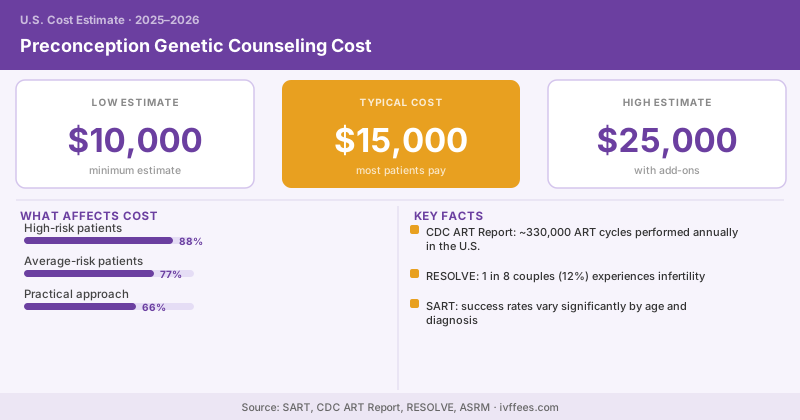
High-risk patients: If you have a personal or family history of a genetic condition, a prior affected pregnancy, or an identified chromosomal abnormality, most major insurers will cover genetic counseling at 100% as a medically necessary service. ACOG’s guidelines support this, and most carriers follow them.
Average-risk patients: Coverage is less predictable. Under the Affordable Care Act, preventive services with a USPSTF Grade B recommendation are covered without cost-sharing. Carrier screening for cystic fibrosis has had recommendation support, but coverage for the broader expanded panel isn’t guaranteed across all plans.
Practical approach: Call your insurer before booking. Ask specifically: “Is preconception genetic counseling a covered benefit? What CPT codes should the counselor use?” Getting the answer before your appointment prevents an unexpected bill afterward.
If you’re self-paying, many genetic counselors offer flat-rate self-pay packages. Budget $300–$800 for one counselor session plus a dual-partner carrier screen if you’re paying entirely out of pocket.
How This Connects to IVF and PGT
If both you and your partner are carriers for the same serious recessive condition, the path forward often includes preimplantation genetic testing for monogenic disorders (PGT-M). PGT-M screens individual embryos for that specific condition before transfer — identifying unaffected embryos so you’re only transferring those without the disorder.
PGT-M is condition-specific and adds $3,000–$6,000 to an IVF cycle on top of the standard retrieval and transfer costs. It requires a lab to develop a custom probe for your specific mutation, which takes 4–8 weeks before cycling can begin.
If you discover a serious dual-carrier finding after eggs have already been retrieved and fertilized, adding PGT-M at that point isn’t always possible — the probe development timeline means it needs to be ordered before retrieval. If there’s any reason to suspect a genetic risk before starting an IVF cycle, get genetic counseling first, not after. Retroactively adding genetic testing is expensive and sometimes not feasible.
The Bottom Line
Most couples planning pregnancy spend almost nothing on preconception genetic counseling — and that’s a missed opportunity. A single consultation costs $200–$600. Carrier screening for both partners adds another $200–$800 at most, and often less. If your insurance covers it, the out-of-pocket cost may be close to zero.
What you get in return: a clear picture of any genetic risks before you’re pregnant, time to make decisions calmly rather than reactively, and — if you’re doing IVF — information that could directly shape which embryos you transfer. That’s a high-value investment at a relatively low cost.