Your IVF cycle worked — or it might have. Now you’re in the two-week wait, giving yourself a daily intramuscular injection in the hip. Welcome to progesterone support.
Progesterone is non-negotiable after IVF. Once your ovaries are suppressed by the stimulation protocol, they can’t produce enough progesterone on their own to support the early embryo. You supplement externally, and you have several options — each with a very different price tag and a very different administration experience.
Why Progesterone Is Required After IVF
In a natural cycle, the corpus luteum (the follicle that released the egg) produces progesterone to prepare the uterine lining for implantation. In an IVF cycle, egg retrieval removes the developing follicles before they complete this process. Without supplementation, progesterone levels fall and the endometrium can’t support implantation.
ASRM guidelines confirm that luteal phase progesterone support is essential for all IVF transfers. The 2023 ASRM practice committee opinion states that progesterone supplementation “improves implantation and pregnancy rates” and should be started 1–6 days before a fresh or frozen embryo transfer.
The debate isn’t whether to use it — it’s which form to use.
Cost by Formulation
| Progesterone Form | Unit | Low End | Typical | High End |
|---|---|---|---|---|
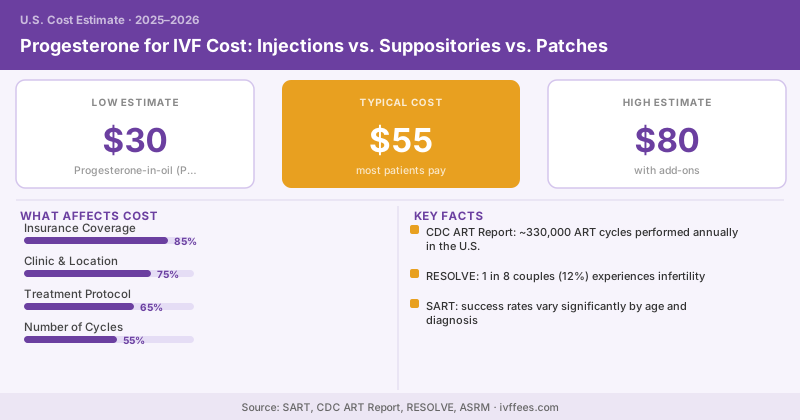
| Progesterone-in-oil (PIO) injection, 50mg/mL | Per 10mL vial | $30 | $55 | $80 |
| PIO full luteal course (6–10 weeks) | Per cycle | $60 | $180 | $400 |
| Endometrin vaginal insert (100mg) | Per insert | $15 | $20 | $28 |
| Endometrin full course (2x/day × 8 weeks) | Per cycle | $300 | $450 | $600 |
| Crinone 8% vaginal gel | Per applicator | $30 | $40 | $55 |
| Crinone full course (daily × 8 weeks) | Per cycle | $400 | $560 | $700 |
| Prometrium oral capsule (200mg) | Per capsule | $3 | $5 | $8 |
| Prometrium full course (vaginally, 2x/day × 8 weeks) | Per cycle | $50 | $100 | $150 |
The cost difference is substantial. Progesterone-in-oil injections — the original standard — are dramatically cheaper than the vaginal formulations. But “cheaper” and “easier” are not the same thing.
Progesterone-in-Oil (PIO): The Gold Standard and Its Drawbacks
PIO injections are given intramuscularly, typically in the upper outer buttock or thigh, using a 22-gauge, 1.5-inch needle. That’s not a typo. They’re big needles, and the injection goes deep.
Most patients use sesame or ethyl oleate as the carrier oil. Side effects include injection site pain, lumps, bruising, and in rare cases, oil embolism. Many patients can’t self-inject and need a partner’s help. Given daily (or twice weekly in some protocols), this continues for 8–12 weeks if there’s a positive pregnancy test.
The upside: it’s inexpensive and highly effective. At $55–$180 for a full course, PIO is far cheaper than any vaginal alternative. For clinics with cost-conscious patients, PIO is often the default recommendation.
Vaginal Suppositories: Higher Cost, Easier Administration
Endometrin (progesterone vaginal insert) and Crinone (progesterone vaginal gel) are FDA-approved for luteal phase support in IVF. Both work through vaginal absorption, bypassing the digestive system and delivering progesterone directly to the uterus — often called the “first uterine pass effect.”
Endometrin is used twice or three times daily. Crinone 8% is used once daily. The continuous vaginal dosing can cause discharge, leakage, and discomfort, but most patients prefer it to daily intramuscular injections.
The cost premium is real. Endometrin runs $300–$600 for a typical cycle; Crinone runs $400–$700. For patients doing multiple frozen embryo transfers, those costs repeat.
Prometrium Used Vaginally: The Underutilized Budget Option
Prometrium is an oral progesterone capsule — but it’s frequently prescribed for vaginal use in IVF cycles. When inserted vaginally rather than swallowed, it provides effective local progesterone delivery similar to Endometrin at a fraction of the cost.
At $3–$8 per capsule, a full course of twice-daily vaginal Prometrium runs $50–$150. That’s 3–10x cheaper than Endometrin for comparable luteal support.
ASRM data and multiple randomized trials show equivalent outcomes between vaginal Prometrium and brand vaginal progesterone products for IVF luteal support. If your clinic doesn’t proactively mention this option, it’s worth asking about.
Many patients don’t know that oral Prometrium capsules can be used vaginally. The capsules dissolve vaginally and provide effective progesterone support. If cost is a concern, ask your RE explicitly: “Can I use vaginal Prometrium instead of Endometrin or Crinone?” Many will say yes.
ASRM Equivalence Data: Do the Forms Matter?
The 2023 ASRM Progesterone Committee Opinion reviewed 47 randomized controlled trials comparing intramuscular, vaginal, and oral progesterone formulations for IVF luteal support. The conclusion: “Vaginal progesterone is equivalent to intramuscular progesterone for most patients undergoing IVF.”
In other words, you don’t have to do the big needle if you don’t want to — and your pregnancy rates shouldn’t suffer.
There is one exception: patients with prior failed cycles despite normal embryos, or those with suspected progesterone absorption issues, may be switched to PIO or a combination approach. But for most straightforward cases, vaginal administration works just as well.
Insurance and Generic Options
Generic progesterone capsules (Prometrium’s generic) are widely available and covered by most insurance plans. Generic progesterone-in-oil is also available at compounding pharmacies for significantly less than brand versions.
Endometrin and Crinone are brand-name products with limited generic equivalents. They’re often not covered at all or covered with high specialty copays.
If you’re paying out of pocket, the math strongly favors either vaginal Prometrium (generic) or PIO — both under $200 for a full course — over branded vaginal progesterone products.
Do not switch progesterone forms or stop supplementation without your RE’s guidance. Discontinuing too early is a leading cause of preventable early pregnancy loss in IVF cycles. Even if you feel fine, stay on progesterone until you reach the milestone your clinic specifies — typically 8–12 weeks.
Bottom Line
Progesterone support after IVF is required — the question is which form fits your situation and budget. PIO injections at $60–$400 per cycle are cheapest but require large intramuscular needles. Vaginal Prometrium at $50–$150 is a low-cost alternative with comparable outcomes. Brand vaginal products (Endometrin, Crinone) cost $300–$700 and offer convenience at a premium. Ask your clinic whether vaginal Prometrium is an option — for many patients, it’s the best balance of cost, effectiveness, and comfort.