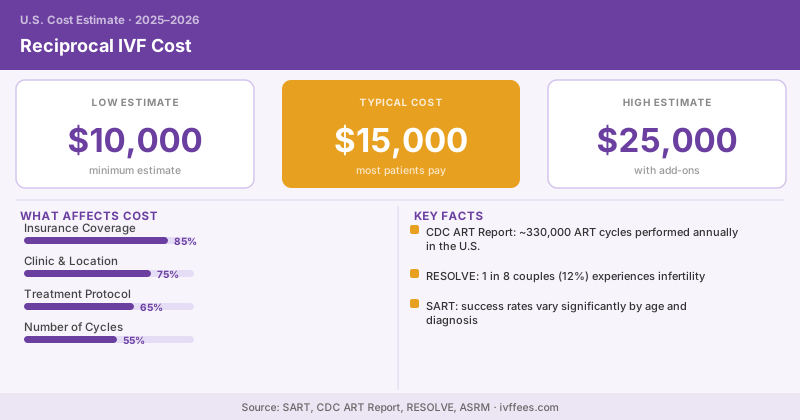
Most same-sex female couples learn about reciprocal IVF from their RE — and the first thing they want to know is: how much more does it cost than regular IVF? The honest answer: about $3,000–$8,000 more, depending on your clinic and what both partners need medically.
Reciprocal IVF — also called co-IVF, shared motherhood, or partner IVF — lets one partner provide the eggs while the other carries the pregnancy. Both women are biologically connected to the child. Partner A goes through egg stimulation and retrieval. Partner B receives the embryo transfer. You’re essentially running two simultaneous medical workups instead of one.
What It Typically Costs
The extra expense reflects the added monitoring, medications, and procedures for both partners. A standard single-partner IVF cycle runs $12,000–$17,000 all-in. Reciprocal IVF usually lands between $18,000 and $30,000 total.
| Cost Component | Low End | High End |
|---|---|---|
| Partner A: stimulation medications | $3,000 | $6,000 |
| Partner A: egg retrieval + anesthesia | $3,000 | $5,000 |
| Partner A: monitoring + bloodwork | $1,000 | $2,500 |
| Fertilization + embryo culture + lab | $3,000 | $5,000 |
| PGT-A embryo testing (optional) | $3,000 | $6,000 |
| Partner B: uterine prep + FET | $3,000 | $5,000 |
| Total estimated range | $18,000 | $30,000 |
The core driver of higher cost is that two partners each need a full medical workup — infectious disease screening, genetic carrier screening, uterine evaluation, and baseline labs. That adds $1,000–$2,500 compared with a single-partner cycle. Some clinics bundle this into their reciprocal IVF package; others bill it separately. Always ask upfront what’s included.
Why Reciprocal IVF Costs More
Standard IVF involves one person. Their ovaries are stimulated, eggs are retrieved, fertilized, and at least one embryo goes back into their own uterus. One set of monitoring appointments. One set of medications. One procedure.
Reciprocal IVF requires two full clinical pathways running in parallel. Partner A (the egg provider) needs all the same care as any egg donor — stimulation injections for 10–14 days, regular ultrasounds, an egg retrieval under sedation. Partner B (the carrier) needs uterine lining preparation and a timed frozen embryo transfer. When cycles are timed fresh, synchronization adds logistical complexity. Most clinics today freeze the embryos first and transfer in a separate FET cycle, which simplifies scheduling and slightly reduces cost.
Insurance and Fertility Mandates
Coverage varies widely, but the landscape is improving. The ASRM has affirmed that reciprocal IVF is a medically recognized treatment, not merely an elective option. As of 2025, the procedure is legally recognized in all 50 states, and in states with strong fertility mandates — including Illinois, New York, and New Jersey — insurers are increasingly required to cover same-sex couples on equal terms with different-sex couples.
Some state fertility mandates were written before reciprocal IVF became common and use language tied to “infertility diagnosis” — which same-sex couples may not qualify for biologically. Newer mandate language (post-2020) in several states explicitly covers same-sex couples regardless of diagnosis. Ask your insurance coordinator to pull the exact policy language, not just the summary.
The CDC’s 2022 Assisted Reproductive Technology report shows that IVF using eggs from a partner under age 35 achieves live birth rates of approximately 50% per transfer — nearly identical to standard IVF in the same age group. That’s a meaningful data point when you’re weighing cost against success probability.
Legal Considerations
In most states, both partners can be named on the birth certificate without adoption proceedings when reciprocal IVF is used. The ASRM and reproductive law attorneys recommend a pre-conception co-parenting agreement regardless, since state parentage laws still vary and aren’t uniformly codified.
Legal documentation typically adds $500–$1,500 to the overall cost — modest compared with what you’d pay for a separate adoption process.
If Partner A is over 35, success rates decline as they do in any IVF cycle. Some clinics recommend PGT-A testing to screen embryos for chromosomal abnormalities before transfer — this adds $3,000–$6,000 but can meaningfully improve the odds of a successful single transfer for partners in their late 30s.
Ways to Reduce the Cost
Freeze first, decide later. Partner A can do an egg freezing cycle first ($6,000–$12,000) to bank eggs before committing to full reciprocal IVF. This gives you flexibility and protects against age-related decline if you’re not ready to proceed immediately.
Mini-stim protocols. Some clinics offer low-stimulation IVF for the egg-providing partner, using lower medication doses to reduce cost. This typically yields fewer eggs but at meaningfully lower medication expense ($1,500–$2,500 vs. $3,000–$6,000 for standard stims).
Shared-risk programs. A handful of fertility centers offer reciprocal IVF packages with refund guarantees. Given the strong success rates when Partner A is young, these programs may or may not make financial sense — run the math before committing.
The Bottom Line
Reciprocal IVF typically costs $18,000–$30,000 all-in. It’s more expensive than standard IVF because two partners require separate clinical workups and procedures, but both women share a biological connection to the child. Insurance coverage is expanding — especially in mandate states — and live birth rates are comparable to standard IVF when Partner A is under 35.
Cost estimates based on ASRM guidelines, CDC 2022 ART National Summary Report, and clinic published pricing. Individual costs vary by clinic, partner age, and insurance coverage.