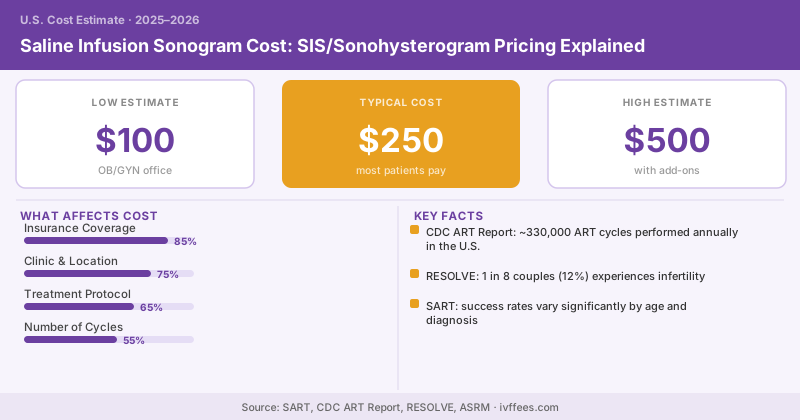
What does a saline infusion sonogram cost? The short answer: $100 to $800. The longer answer depends on whether it’s done at a fertility clinic, a hospital, or your OB/GYN’s office — and whether your insurance classifies it as diagnostic imaging or a gynecological procedure.
This is one of those fertility tests where the price range is genuinely enormous, and knowing why helps you find the lower end of it.
What a Saline Infusion Sonogram (SIS) Is
A saline infusion sonogram — also called a sonohysterogram or SHG — involves injecting a small amount of sterile saline into the uterine cavity through a thin catheter while performing a transvaginal ultrasound. The saline distends the cavity, making it much easier to see polyps, fibroids, adhesions (scar tissue), and other structural abnormalities that would be invisible or ambiguous on a standard ultrasound.
It takes about 10–20 minutes in an office setting. Most patients describe mild-to-moderate cramping during the procedure, similar to a Pap smear or IUD insertion. It doesn’t require anesthesia.
Why the SIS Is Performed
The SIS is part of the standard fertility workup for most patients considering IVF. A clear, normal-appearing uterine cavity is one of the baseline requirements before proceeding with a transfer cycle.
Conditions the SIS can detect or characterize:
- Endometrial polyps
- Submucosal fibroids (inside the cavity)
- Uterine septum (partial or complete)
- Asherman’s syndrome (intrauterine adhesions)
- Arcuate uterus or other cavity abnormalities
According to ASRM, uterine abnormalities are found in approximately 10–15% of infertility patients who undergo evaluation. The SIS is more sensitive than a standard transvaginal ultrasound for detecting cavity lesions.
| SIS Location | Low | Typical | High |
|---|---|---|---|
| OB/GYN office | $100 | $250 | $500 |
| Fertility clinic (in-house) | $150 | $300 | $600 |
| Radiology/imaging center | $100 | $275 | $500 |
| Hospital outpatient department | $250 | $500 | $800 |
Why the Hospital Price Is So Much Higher
Hospital outpatient departments charge a facility fee on top of the professional fee — this is the same phenomenon that makes a blood draw at a hospital lab cost $400 when the same test at a reference lab costs $40. If your OB/GYN is based at a hospital-affiliated practice, make sure the procedure is coded as an office procedure, not a hospital outpatient procedure.
Ask specifically: “Will this be performed and billed as an in-office procedure, or as an outpatient hospital service?” The answer changes your bill significantly.
The SIS is billed under CPT code 76831. If you’re comparing prices or checking insurance coverage, use this code. Some insurers cover it under diagnostic imaging; others under gynecological procedures. Knowing the code lets you check your benefit precisely.
SIS vs. Hysteroscopy: What’s the Difference?
If the SIS finds something suspicious — a polyp, a fibroid, unclear adhesions — the next step is typically a hysteroscopy, which involves inserting a thin camera into the uterine cavity for direct visualization and (if needed) removal of abnormalities.
The SIS is screening. The hysteroscopy is diagnostic and potentially therapeutic. Think of the SIS as the test that determines whether a hysteroscopy is needed.
Many clinics perform both in sequence if abnormalities are found at the initial SIS. Be prepared for a potential “cascade” cost: SIS → hysteroscopy → possible operative hysteroscopy if lesions are removed.
Insurance Coverage for SIS
Most insurance plans cover the saline infusion sonogram as a diagnostic procedure when there’s a medical indication — fertility evaluation qualifies at most insurers. The CPT code 76831 is widely covered.
Exceptions:
- Some HMO plans require a referral from your primary care physician before covering the SIS
- If coded as part of an IVF workup specifically (rather than general gynecological evaluation), some insurers apply different coverage rules
- High-deductible plans will apply the full cost to your deductible until it’s met
If you haven’t met your deductible for the year, the SIS will likely be charged at the negotiated (lower) rate, not the list price — and applied to your deductible.
Timing your SIS for early in the menstrual cycle (cycle days 5–10) is important for optimal image quality and to avoid disrupting an early pregnancy. Your RE or OB/GYN will schedule it accordingly. Don’t schedule it “whenever is convenient” without confirming the cycle timing requirement.
Bottom Line
A saline infusion sonogram costs $100 to $800 depending on setting, insurance status, and geographic location. It’s a standard step in the fertility evaluation process and is typically covered by insurance when indicated. If you’re paying out of pocket, ask about the procedure code, whether it can be done at an office setting rather than a hospital, and whether your fertility clinic can perform it in-house at a lower rate.