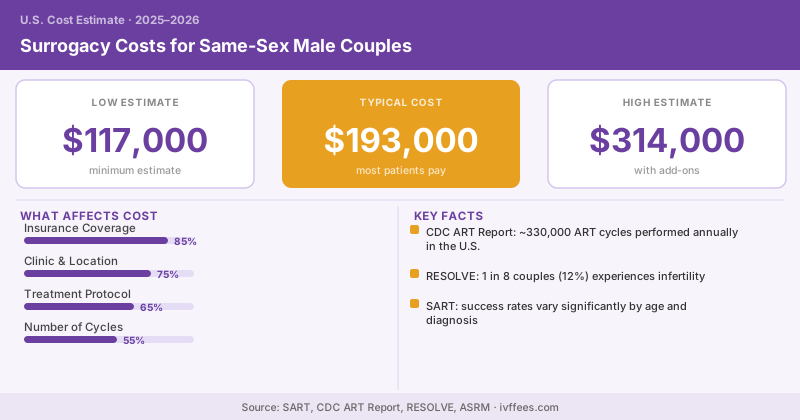
For two dads, surrogacy isn’t one journey — it’s three simultaneous ones. You’re coordinating an egg donor cycle, a surrogacy match, and an IVF cycle, all at once. Each has its own cost, timeline, and legal dimension. And in some states, you’re also fighting for parental recognition that married different-sex couples receive automatically.
The realistic all-in budget for a same-sex male couple pursuing surrogacy: $120,000 to $200,000, with many journeys landing between $140,000 and $170,000. Here’s exactly why — and where every dollar goes.
Complete Cost Breakdown: Two-Dad Surrogacy
| Cost Component | Low End | Typical | High End |
|---|---|---|---|
| Egg donor agency fee + compensation | $18,000 | $30,000 | $50,000 |
| Egg retrieval + IVF (donor cycle) | $12,000 | $18,000 | $28,000 |
| PGT genetic testing (optional) | $3,000 | $5,500 | $9,000 |
| Surrogate base compensation | $35,000 | $47,000 | $65,000 |
| Surrogate allowances and contingency fees | $8,000 | $15,000 | $25,000 |
| Surrogacy agency fee | $18,000 | $28,000 | $45,000 |
| Legal fees (intended parents + surrogate) | $8,000 | $14,000 | $22,000 |
| Second-parent adoption (if needed) | $0 | $3,500 | $10,000 |
| Surrogate health insurance | $10,000 | $20,000 | $40,000 |
| Miscellaneous / contingency | $5,000 | $12,000 | $20,000 |
| Total | $117,000 | $193,000 | $314,000 |
The Extra Layer: Egg Donation
This is the cost that doesn’t apply to different-sex couples where the intended mother provides eggs. Same-sex male couples need a separate egg donor — and that’s a significant addition.
Egg donor agency fee: $6,000–$15,000 Egg donor compensation: $8,000–$35,000 (varies by donor experience, physical characteristics, and geographic market) Egg retrieval and fertilization (IVF): $12,000–$22,000
Total egg donor component: $25,000–$50,000 before any embryos exist.
One consideration unique to two-dad couples: who provides the sperm. Some couples use one partner’s sperm; others split the batch and create embryos from both, then decide which to transfer. Using both partners’ genetic material means potentially two embryo cohorts, which can increase costs if both are tested via PGT. That said, it also provides more embryo options — which can reduce the number of costly transfer cycles.
Why Two Dads Pay More
The math is straightforward: you’re adding the entire egg donor component ($25,000–$50,000) on top of a standard surrogacy cost that already runs $80,000–$150,000. You’re not paying double for everything — the surrogate, legal, agency, and insurance costs are the same as for any intended parents. But you can’t skip the egg donor piece.
There’s also the second-parent adoption issue. In most states with favorable surrogacy law, both intended parents can be named on the birth certificate via a pre-birth order — including same-sex couples. But in states that aren’t surrogacy-friendly, the non-genetic parent (or both parents in a state that doesn’t recognize same-sex parentage) may need to complete a second-parent or step-parent adoption to have legal parental rights recognized.
Second-parent adoptions cost $3,000–$10,000 and add several months to the process. In states like California, Nevada, and Washington, this isn’t needed — both dads go on the birth certificate via PBO. In states without clear surrogacy statute, consult your reproductive attorney before assuming both parents’ rights are automatically established.
Some agencies can now fertilize half an egg batch with one partner’s sperm and half with the other’s, creating embryos from both men. This gives you flexibility and doesn’t double your egg donor cost. The added cost is primarily PGT testing both embryo cohorts ($3,000–$5,000 extra) and potentially separate embryo storage. Some couples find this approach emotionally meaningful; others prefer a simpler process.
Legal Protections for LGBTQ+ Intended Parents
The legal landscape for LGBTQ+ families in surrogacy has improved substantially since the 2015 Supreme Court ruling in Obergefell v. Hodges. But “improved” doesn’t mean “uniform.”
In surrogacy-forward states — California, Nevada, Washington, Connecticut, Colorado, Oregon — same-sex male couples have the same legal access to surrogacy that heterosexual couples do. Pre-birth orders list both dads. No adoption needed. Birth certificate is straightforward.
In states without surrogacy statute, or in states where same-sex marriage recognition is legally contested at the state level, the picture is less clear. Work with a reproductive attorney who specifically has LGBTQ+ surrogacy experience — not just any family law attorney.
RESOLVE’s LGBTQ+ Family Building resources (resolve.org) include a directory of LGBTQ+-experienced reproductive law attorneys and agencies. The organization also tracks state-level legislative changes affecting LGBTQ+ family building rights.
Choosing an LGBTQ+-Affirming Agency
Not every surrogacy agency is equally experienced with two-dad families. Some agencies have deep LGBTQ+ experience and actively recruit surrogates who are enthusiastic about carrying for same-sex couples. Others have less experience and may require more education along the way.
Questions to ask agencies:
- What percentage of your current intended parent clients are same-sex male couples?
- Do you have surrogates in your database who have specifically expressed enthusiasm for LGBTQ+ families?
- Do you have in-house experience with the egg donor matching process, or do you partner with a separate egg donor agency?
Some egg donor agencies and fertility clinics in conservative states have declined to work with same-sex male couples. Before investing in matching fees, confirm that your chosen clinic, agency, and reproductive attorney are all LGBTQ+-affirming and have documented experience with two-dad families. RESOLVE’s agency and clinic directories include LGBTQ+-affirming designations.
Realistic Budget Planning
Here’s a working budget for a two-dad surrogacy that’s neither best-case nor worst-case:
- Egg donor (agency + compensation + retrieval): $35,000
- IVF and PGT: $22,000
- Surrogate base compensation + allowances: $60,000
- Surrogacy agency: $28,000
- Legal (all parties): $14,000
- Insurance: $20,000
- Miscellaneous + contingency (10%): $17,900
- Working total: ~$196,900
Budget conservatively. First-attempt success on both the egg retrieval and embryo transfer is not guaranteed. Many two-dad journeys require a second transfer cycle — add $5,000–$8,000 per additional frozen embryo transfer. Some require a second egg donor cycle if the first doesn’t yield viable embryos — add $25,000–$35,000.
Having $200,000 in verified available funds before you start is the financially responsible baseline.
Cost ranges based on RESOLVE LGBTQ+ Family Building data, egg donor agency fee disclosures, and reproductive attorney surveys (2024).