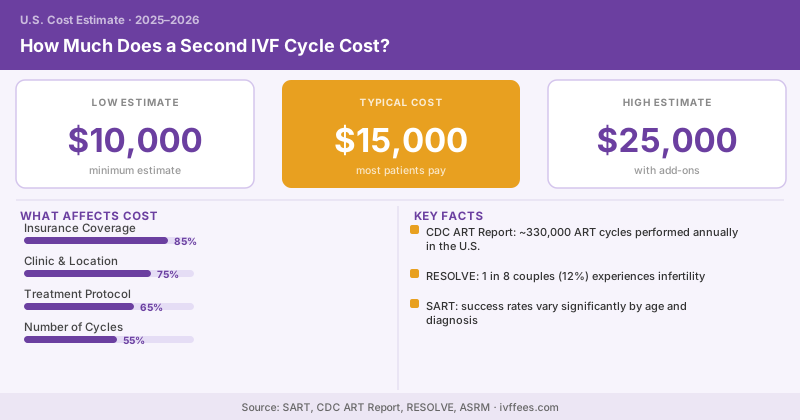
What does a second round of IVF actually cost? It’s the question nobody wants to ask before the first cycle — and the one that hits hard when that first attempt doesn’t work. Here’s the good news buried in a tough situation: a second cycle is frequently cheaper than your first, sometimes a lot cheaper. Whether it is depends almost entirely on one thing — do you have frozen embryos left over?
The Two Very Different Scenarios
Your second-cycle cost splits into two paths, and the price gap between them is enormous.
| Scenario | What’s Involved | Typical Cost |
|---|---|---|
| Frozen embryo transfer (FET) | Thaw + transfer existing embryos; no retrieval | $3,000–$7,000 |
| Full fresh cycle (no embryos left) | New stimulation, retrieval, fertilization, transfer | $12,000–$20,000+ |
| Medications (fresh cycle) | New round of injectables | $3,000–$7,000 |
| Medications (FET) | Lining prep only | $500–$2,000 |
If your first retrieval produced extra embryos and you froze them, your “second cycle” is really just a frozen embryo transfer — no egg retrieval, far less medication, and a much smaller bill. That’s why doctors push to bank embryos when they can.
Why a Second Fresh Cycle Can Still Cost Less
Even if you need a complete new cycle, it may not cost as much as the first. A few reasons:
- Diagnostics are done. You already paid for fertility testing, genetic carrier screening, and the saline sonogram. Those one-time workup costs don’t repeat.
- Your protocol is dialed in. Your doctor learned how your body responded, which can reduce wasted medication.
- Multi-cycle packages kick in. Many clinics sell 2- or 3-cycle bundles at a discount, so your second cycle is effectively pre-paid at a lower per-cycle rate.
If you suspect you might need more than one round, ask about multi-cycle and refund (or “shared risk”) programs before your first cycle. These bundle 2–3 retrievals plus transfers for a flat fee — often $20,000–$35,000 — and some refund a large share if you don’t take home a baby. Per-cycle, that can be dramatically cheaper than paying à la carte twice. See our IVF refund programs guide.
The Statistics Behind “More Than One”
Needing a second cycle is normal, not a failure. CDC ART data and SART national figures show that cumulative success climbs meaningfully across multiple cycles — many patients who don’t succeed on the first attempt do on the second or third. For a clear-eyed look, read how many IVF cycles it takes. Budgeting for two from the start is realistic financial planning, not pessimism.
Before committing to a second full cycle, ask your reproductive endocrinologist what they’d change. A second cycle that simply repeats the first protocol — when the first didn’t work — may not be the best use of $15,000. Sometimes a tweak (different stimulation, adding ICSI or PGT testing, addressing a uterine issue) matters more than just trying again. Spend money on a strategy, not a do-over.
How to Keep the Second Cycle Affordable
- Use your frozen embryos first — FET is the cheapest path by far.
- Revisit medication pricing — re-shop specialty pharmacies; prices change.
- Ask about returning-patient discounts — some clinics offer them quietly.
- Apply for grants between cycles — see our IVF grant programs and financing options guides.
Frequently Asked Questions
Is a second IVF cycle cheaper than the first? Often, yes. If you have frozen embryos, a second “cycle” is just a frozen embryo transfer costing $3,000–$7,000 — far less than a full fresh cycle. Even a new fresh cycle can cost less because your diagnostic workup is already paid for.
How much does a frozen embryo transfer cost? Typically $3,000–$7,000 including thaw, transfer, and lining-prep medications. It skips egg retrieval entirely, which is why it’s the most affordable way to attempt pregnancy again.
Do I need to repeat all the testing for a second cycle? Usually not. Carrier screening, baseline labs, and structural evaluations from your first cycle generally still apply. Your clinic may repeat a few time-sensitive tests, but the bulk of the workup is a one-time cost.
Should I change anything on my second cycle? Talk to your doctor about what they’d adjust. Repeating the exact same protocol after a failure may not be ideal — a different stimulation, adding genetic testing, or fixing a uterine issue can improve your odds more than simply trying again.
Are multi-cycle packages worth it? For many patients, yes. Bundling 2–3 cycles for a flat fee lowers the per-cycle cost, and refund programs return money if you don’t have a baby. They make the most sense if your doctor expects you might need more than one round.
How many IVF cycles do most people need? It varies widely with age and diagnosis, but needing two or three is common, and cumulative success rises across cycles. Planning financially for more than one is realistic. See our detailed how many cycles guide.
Cost ranges based on RESOLVE and ASRM patient cost data, 2023–2024. Cumulative success-rate context from CDC ART and SART national reports. Your costs depend on whether frozen embryos are available and your clinic’s pricing.