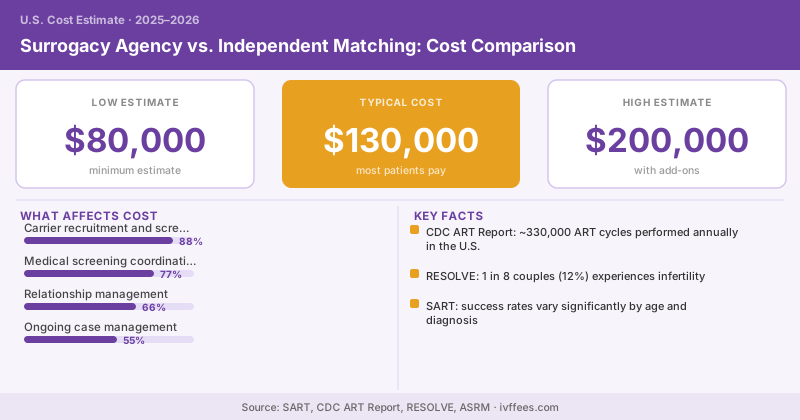
$30,000. That’s roughly what a surrogacy agency charges — and it’s the first number many intended parents decide they can skip.
Here’s the thing: you can skip it. Independent surrogacy matching is real, legal, and works for some families. But it’s not actually free, and the risks aren’t theoretical. RESOLVE: The National Infertility Association notes that the absence of agency oversight is one of the most common factors in surrogacy arrangements that fall apart. Before you decide, you need to know exactly what that $30,000 is buying.
Side-by-Side Cost Breakdown
| Cost Component | Agency Route | Independent Route |
|---|---|---|
| Agency matching & management fee | $20,000–$45,000 | $0 |
| Legal fees (intended parents) | $5,000–$10,000 | $5,000–$10,000 |
| Surrogate’s independent legal fees | $2,000–$3,500 | $2,000–$3,500 |
| Psychological screening (both parties) | Included | $1,500–$3,000 |
| Background checks | Included | $200–$500 |
| Escrow management | Included or $1,000–$2,500 | $1,500–$3,000 |
| Matching time (estimated) | 3–9 months | 6–18 months |
| Total fees (matching only) | $27,000–$58,500 | $11,200–$20,000 |
The savings are real — $15,000 to $25,000 in most cases. But notice that the independent route has its own costs once you add psychological screening, background checks, and professional escrow. “Free matching” isn’t free.
What Agencies Actually Do
A reputable surrogacy agency earns that fee through services that span the entire journey — not just the match.
Carrier recruitment and screening: Agencies maintain networks of pre-screened surrogates. Background checks, home studies, criminal history, psychological evaluation, financial stability assessment — agencies handle all of it before you ever meet a potential carrier.
Medical screening coordination: Agencies work directly with fertility clinics to ensure the surrogate clears medical requirements before a cycle begins. If she doesn’t pass, they find you another match — often at no additional matching fee.
Relationship management: This is underrated. When communication between intended parents and surrogate gets tense (and it often does), an agency case manager mediates. There’s someone whose job it is to keep the relationship functional.
Ongoing case management: Monthly check-ins, coordination between your attorney and the clinic, tracking escrow disbursements, arranging doula support if needed — agencies run the project.
24/7 crisis support: If something goes wrong at 2 a.m. — a surrogate is hospitalized, a complication arises — an agency is your first call.
Agency fees don’t include surrogate compensation, medical expenses, IVF costs, legal fees, or insurance. These are pass-through costs regardless of path. The agency fee covers management and matching only.
What Independent Matching Looks Like
Independent surrogacy means you find and vet your surrogate yourself. The most common routes: social media groups (Facebook surrogacy communities are large and active), word-of-mouth through fertility support communities, or matching platforms like Surrogacy.com that provide a directory without full-service management.
You’re not flying blind — but you are doing more work. You’ll need to:
- Arrange your own psychological evaluations (licensed therapist with surrogacy experience, approximately $400–$800 per party)
- Order background checks directly (several services offer these for $100–$250)
- Hire an independent escrow company to manage payments
- Manage all communication, scheduling, and coordination directly
Many intended parents who go independent have a pre-existing relationship with their surrogate — a sister, a close friend, a former colleague. In those cases, independent matching makes real sense. The relationship foundation is already there, screening is simpler, and the trust dynamic is established.
The Risk Calculation
RESOLVE’s guidance on surrogacy emphasizes that matching compatibility — psychological fit, shared expectations about the pregnancy, agreement on selective reduction and other difficult scenarios — is what determines long-term success. Agencies evaluate this formally. Independent matches do it informally, if at all.
Where independent arrangements fail:
- Surrogate’s insurance excludes surrogacy (often discovered late, creating a coverage crisis)
- Compensation disputes mid-pregnancy with no mediator
- Communication breakdown with no third-party to intervene
- Surrogate doesn’t pass medical screening at the clinic (no backup match)
- Psychological incompatibility that only emerges under the stress of a live pregnancy
These aren’t reasons never to go independent. They’re reasons to be specific about what professional oversight actually prevents.
Who Should Consider Each Route
Agency route makes sense when:
- You don’t have a personal surrogate candidate
- You’re risk-averse and value case management
- You’re doing this for the first time and don’t know what you don’t know
- You’re a same-sex male couple adding egg donor costs (higher total investment warrants more support infrastructure)
Independent route makes sense when:
- You already know your surrogate personally
- You have experience with surrogacy or a strong support network
- You’re comfortable managing logistics and legal coordination directly
- The cost savings are meaningful to your overall budget
Never skip professional escrow. Whether you use an agency or not, all surrogate compensation must flow through a neutral third-party escrow account managed by an attorney or licensed escrow company. This is non-negotiable and protects both parties legally and financially.
The Bottom Line
Agency surrogacy costs $20,000–$45,000 more than going independent. That’s real money. But agencies provide carrier screening, crisis management, relationship mediation, and backup matching — things that are genuinely difficult to replicate on your own. Independent matching works well when you already have a surrogate candidate and strong legal and psychological support infrastructure. For first-time intended parents without a pre-identified surrogate, most reproductive law specialists recommend working with an agency.
Cost ranges based on RESOLVE national surrogacy surveys (2023–2024), agency fee disclosures from top-10 U.S. surrogacy agencies, and reproductive attorney fee surveys.