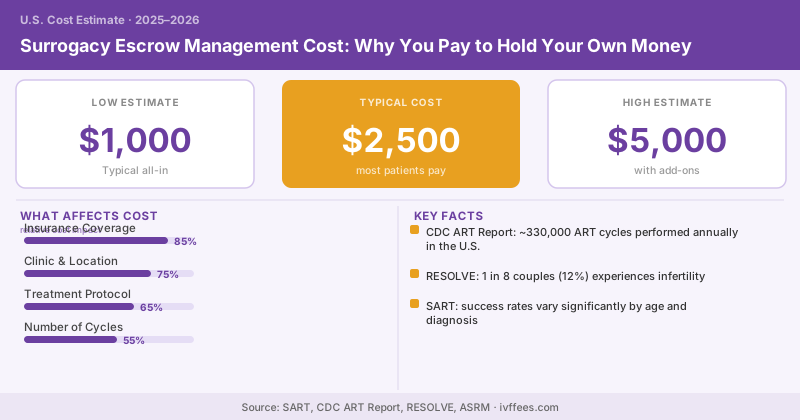
Picture this: you wire $60,000 in carrier compensation into an account, and then you’re told you have to pay another $2,500 just to have someone manage it. Why pay to hold your own money? Because surrogacy escrow management is the single most important financial safeguard in the entire journey — and the families who skip it to save a few thousand dollars are the ones who end up in disputes.
Here’s what that fee buys and why it’s not optional.
What an Escrow Agent Actually Does
In surrogacy, intended parents fund a third-party escrow account up front. The escrow agent — usually a specialized company or a law firm trust account — then disburses payments to the carrier and vendors according to the surrogacy agreement’s schedule. Monthly allowances, medical reimbursements, the transfer fee, base compensation installments: all of it flows through escrow on agreed dates and triggers.
The agent verifies that each payment matches the contract, keeps records, and acts as a neutral party between you and your carrier. Neither side touches the money directly.
Surrogacy Escrow Management Cost
| Escrow Service | Low | Typical | High |
|---|---|---|---|
| Flat escrow setup & management fee | $1,000 | $2,500 | $5,000 |
| Wire / transaction fees | $25 | $150 | $400 |
| Monthly account maintenance (if charged) | $0 | $50/mo | $100/mo |
| Final accounting & closeout | Included | Included | $250 |
| Typical all-in | $1,000 | $2,500 | $5,000 |
Most reputable escrow companies charge a flat fee for the whole journey rather than a percentage, which protects you from the cost scaling with your (large) account balance.
Why You Can’t Just Manage It Yourself
This is the question everyone asks. The answer is risk on both sides.
If you hold the money and pay your carrier directly, she has no guarantee you’ll keep paying — what if you have a falling-out, or you run short of cash mid-pregnancy? And you have no neutral record of what was paid and when. If a dispute arises, it’s your word against hers. A neutral escrow agent removes that conflict entirely.
Escrow management costs $1,000 to $5,000 — a tiny fraction of the $60,000+ flowing through the account. It guarantees your carrier gets paid on schedule and gives you a neutral, documented record of every disbursement. Trying to self-manage to save this fee is one of the riskiest cost-cutting moves in surrogacy.
The Disbursement Schedule
Escrow follows the financial terms in your surrogacy contract. A typical schedule includes:
- Confirmation of pregnancy triggers the start of monthly base compensation
- Monthly living allowance disbursed on a set date
- Medical reimbursements paid as receipts are submitted
- Procedure fees (transfer, amnio, C-section) paid on documentation
- Final balance released after birth and any post-delivery terms are met
The escrow agent enforces these triggers so no payment goes out early or late.
Not all escrow holders are equal. Use a licensed, bonded, surrogacy-experienced escrow company or an attorney trust account — never an agency’s general operating account or a personal account. There have been cases of agencies commingling escrow funds and going insolvent, leaving carriers unpaid and parents out tens of thousands. Verify the escrow holder is independent, insured, and provides regular statements before funding the account.
Escrow vs. Agency-Held Funds
Some agencies offer to hold and disburse funds themselves as part of their service. Be cautious. An independent, bonded escrow company keeps your money separate from the agency’s business finances, so if the agency hits trouble, your funds are protected. The modest separate escrow fee is cheap insurance against a much larger loss.
Where It Fits in the Total Budget
Escrow is a small line in the overall picture. A full gestational carrier journey runs $80,000 to $200,000, and escrow is well under 3% of that. It’s bundled into the same budget as surrogate compensation and surrogacy legal fees — the three pillars of protecting your money and your carrier. If cash flow is tight, surrogacy financing options can fund the escrow account itself.
Frequently Asked Questions
Is escrow legally required for surrogacy? It’s not always legally mandated, but nearly every reputable agency and attorney requires it, and it’s strongly recommended by the surrogacy industry. Skipping it exposes both parties to financial and legal risk, which is why it’s standard practice.
Can my attorney act as the escrow agent? Yes. Many reproductive attorneys hold escrow funds in a licensed trust account, which is a legitimate and well-protected option. Just confirm the trust account is properly maintained and bonded, and that you receive regular statements.
What happens to leftover escrow money after birth? Once all contractual obligations are paid and the final accounting is complete, any remaining balance is returned to you, the intended parents. The escrow agent provides a closeout statement documenting every disbursement and the returned amount.