Most intended parents assume their surrogate’s health insurance will cover the pregnancy. That assumption is wrong often enough to cause serious financial crises — mid-pregnancy, after the IVF cycle, when there’s no easy way out.
Surrogate health insurance is one of the most underestimated and misunderstood costs in the entire surrogacy journey. Get it wrong and you’re looking at $30,000–$80,000 in uninsured obstetrical and delivery expenses. Get it right and you’ve protected one of the largest financial commitments of your life.
Surrogate Insurance Cost Breakdown
| Insurance Scenario | Low End | Typical | High End |
|---|---|---|---|
| Existing employer plan covers surrogacy | $0 | $3,000 (cost review) | $5,000 (add-ons) |
| ACA marketplace plan (surrogacy-compatible) | $8,000 | $15,000 | $22,000 |
| Specialty surrogacy insurance policy | $15,000 | $22,000 | $35,000 |
| Catastrophic/NICU coverage rider | $2,000 | $5,000 | $15,000 |
| Life insurance for surrogate (required) | $400 | $800 | $2,000 |
| Insurance review by specialist (attorney/broker) | $500 | $1,000 | $2,500 |
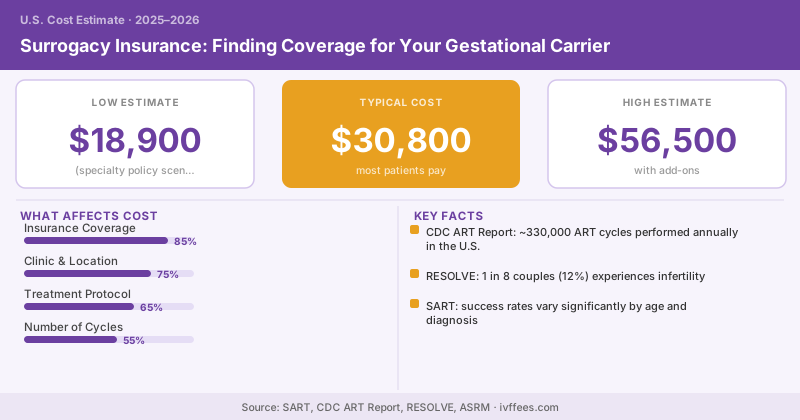
| Total (specialty policy scenario) | $18,900 | $30,800 | $56,500 |
Why the Surrogate’s Existing Insurance May Not Work
Most health insurance policies — including employer-sponsored plans — are written to cover the policyholder’s own medical care. Surrogate pregnancy is legally and medically different from a standard pregnancy in ways that insurance companies have been quick to exclude.
Check for these exact exclusions in any plan document:
- “Surrogate pregnancy” — explicit exclusion is increasingly common
- “Pregnancy carried for the benefit of another” — broader language that catches surrogacy
- “Non-compensated/compensated surrogacy” — some plans only exclude compensated arrangements
- ERISA-governed self-funded employer plans — these have their own rules and exclusions that vary by employer
The only way to know if a surrogate’s insurance will work is to have the actual policy reviewed by an attorney or insurance specialist who focuses on ART (assisted reproductive technology) coverage. Don’t rely on HR telling you “it covers pregnancy.” It’s not enough. The specific exclusion language matters.
According to RESOLVE’s guidance on surrogacy insurance, carriers increasingly update their policy language annually — a policy that was surrogacy-compatible in 2022 may have added an exclusion in 2024. Review the current policy document, not a summary.
Intended parents pay all surrogate-related insurance costs — premiums, deductibles, out-of-pocket costs, and NICU coverage if needed. This is non-negotiable. The surrogate should never be financially exposed for medical costs resulting from the surrogacy pregnancy. Every dollar of her healthcare costs is the intended parents’ responsibility.
The ART Risk Carrier List
The ART Risk carrier list (maintained by reproductive insurance specialists and agencies) tracks which insurance companies and plans have historically covered surrogate pregnancies without creating coverage disputes. This list changes regularly as insurers update their policies.
Working from the current ART Risk list helps identify ACA marketplace plans that are surrogacy-compatible in your surrogate’s state. Not every state has good options — the availability of surrogacy-friendly ACA plans varies significantly by geography.
If your surrogate is in California, Nevada, or Washington, the ACA marketplace typically has several viable options. If she’s in a smaller state with limited marketplace options, you may have fewer choices and higher costs.
Specialty Surrogacy Insurance Policies
When the surrogate’s existing insurance is unsuitable and no ACA-compatible plan is available in her state, specialty surrogacy insurance becomes the path forward.
These policies are designed specifically for surrogate pregnancies. They cover prenatal care, delivery, and complications — without the exclusion language that kills standard policies.
What specialty policies typically cover:
- Full obstetrical care through a network OB
- Labor and delivery (vaginal and C-section)
- Postpartum care for 6–8 weeks
- Complications during pregnancy
What they typically don’t cover (purchase separately):
- NICU care for the baby (NICU stays average $3,000/day; a 30-day stay is $90,000)
- Surrogate life insurance (required separately by most agencies)
Cost: $15,000–$35,000 for a specialty surrogacy policy covering the full pregnancy.
NICU Coverage: Don’t Skip This
Most surrogacy insurance — whether the surrogate’s own plan or a specialty policy — covers the surrogate’s medical care. The baby’s NICU costs are a separate question.
NICU care for a premature birth is among the most expensive medical events in U.S. healthcare. According to ACOG data, approximately 10% of babies born in the U.S. require NICU care, with average costs exceeding $75,000 per admission for premature births.
Before any IVF transfer, intended parents should confirm how NICU costs will be covered. Options include:
- The baby going directly onto the intended parents’ health insurance at birth (possible in some states with a PBO in hand)
- A newborn insurance rider purchased through the surrogacy policy
- Self-insurance / escrow reserve
This is often the last thing intended parents think about. Think about it first.
Life Insurance for the Surrogate
Most agencies require intended parents to purchase a term life insurance policy for the surrogate, naming her family as beneficiaries, for the duration of the pregnancy.
This is inexpensive relative to other costs — $400–$2,000 for a $500,000 term policy depending on the surrogate’s age and health history. It’s also the right thing to do. The surrogate is taking a physical risk on your behalf; protecting her family in a worst-case scenario is part of your responsibility.
Never begin the IVF cycle for a surrogacy without confirmed, reviewed insurance coverage in place for the surrogate. Discovering an insurance problem after a positive pregnancy test leaves you legally exposed and financially at risk for all pregnancy costs. Insurance review must happen before the embryo transfer.
Step-by-Step: How to Handle Surrogate Insurance
- Obtain the actual policy documents (not just a summary) for your surrogate’s current insurance
- Have a reproductive insurance specialist review the documents — not a general insurance broker
- Determine whether the plan is ERISA self-funded (employer plan) or ACA-regulated
- If the plan is unsuitable, check the current ART Risk carrier list for ACA options in her state
- If no ACA option works, get quotes on specialty surrogacy insurance policies
- Purchase a separate life insurance policy for the surrogate
- Confirm NICU coverage strategy before the transfer
Estimated total time: four to eight weeks. Build this into your pre-cycle timeline.
Cost ranges based on specialty surrogacy insurance broker disclosures, RESOLVE guidance on ART insurance, and ACOG 2024 data on NICU utilization rates.