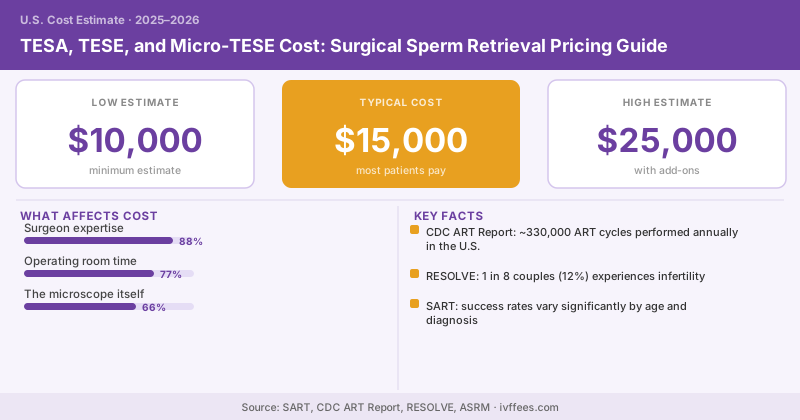
The quote was $12,500 — just to retrieve sperm. If your doctor has mentioned TESE or micro-TESE, that number probably stung. Here’s the thing: the price difference between a $1,200 TESA and a $12,500 micro-TESE isn’t arbitrary markup. It reflects genuinely different procedures, different operating room time, and dramatically different success rates depending on your diagnosis.
Understanding which procedure you actually need — and why — can save you from either overpaying or undergoing a procedure that won’t work.
The Four Main Surgical Sperm Retrieval Methods
Not all sperm retrievals are created equal. The right procedure depends on what’s causing the azoospermia and whether sperm production is happening at all.
TESA (Testicular Sperm Aspiration) uses a fine needle inserted into the testicle to aspirate sperm. It’s minimally invasive, usually done under local anesthesia or light sedation, and takes about 20–30 minutes. It works well for obstructive azoospermia (OA) — where sperm are being produced but can’t exit due to a blockage.
PESA (Percutaneous Epididymal Sperm Aspiration) aspirates sperm from the epididymis rather than the testicle itself. Like TESA, it’s best suited for obstructive cases.
TESE (Testicular Sperm Extraction) involves a small open biopsy — a surgical incision in the testicle to remove tissue samples. It’s more invasive than TESA and can be used for both obstructive and some non-obstructive cases.
Micro-TESE (Microsurgical Testicular Sperm Extraction) is the gold standard for non-obstructive azoospermia (NOA). It uses an operating microscope at 16–25x magnification to identify and extract the tiny pockets of sperm-producing tissue that exist even in men with severely impaired spermatogenesis. It requires a urology subspecialist and significantly more OR time.
Cost Breakdown by Procedure
| Procedure | Typical Cost Range | Best For |
|---|---|---|
| PESA | $800 – $2,500 | Obstructive azoospermia |
| TESA | $1,000 – $3,500 | Obstructive azoospermia |
| TESE (conventional) | $3,000 – $7,000 | OA or select NOA |
| Micro-TESE | $7,000 – $15,000 | Non-obstructive azoospermia |
| Sperm freezing (post-retrieval) | $500 – $1,500 | All cases |
| Anesthesia (if billed separately) | $500 – $1,500 | Varies by facility |
These costs are typically billed separately from IVF. The retrieval itself doesn’t include the ICSI add-on you’ll need to fertilize eggs with surgically retrieved sperm — budget an additional $1,000–$3,000 for that.
Why Micro-TESE Costs So Much More
The price gap between TESE and micro-TESE isn’t padding. Three factors drive the difference:
Surgeon expertise. Micro-TESE requires a fellowship-trained reproductive urologist or andrology-specialized urologist comfortable with the operative microscope. These specialists are rare. Many couples travel to academic centers specifically for this procedure.
Operating room time. A TESA takes 20–30 minutes. A micro-TESE typically runs 2–4 hours, sometimes longer. That’s OR time, anesthesia time, scrub tech time, and recovery room time — all multiplied.
The microscope itself. The operative microscope is expensive equipment, not found in every surgical suite. Facilities that offer micro-TESE have invested significantly in infrastructure.
Success Rates: Where the Real Decision Lies
This is where the cost comparison gets meaningful. According to ASRM guidelines, micro-TESE retrieval rates in men with non-obstructive azoospermia reach 40–60%, compared to roughly 15–30% for conventional TESE in the same population. For men with obstructive azoospermia, TESA/PESA retrieval rates exceed 90% — so the expensive micro-TESE offers no benefit there.
The WHO 2021 data puts the picture in context: male factor contributes to approximately 50% of infertility cases, and azoospermia (complete absence of sperm in the ejaculate) affects about 1% of men overall and 10–15% of infertile men.
Obstructive azoospermia (OA): Sperm are produced but blocked (vasectomy reversal failure, congenital absence of vas deferens, prior infection). TESA or PESA works well. Cost: $1,000–$3,500.
Non-obstructive azoospermia (NOA): The testes produce little or no sperm (Klinefelter syndrome, Y-chromosome deletions, cryptorchidism, prior chemotherapy). Micro-TESE is the best option. Cost: $7,000–$15,000.
Your semen analysis plus FSH/LH/testosterone levels and genetic testing will indicate which category you fall into.
What’s Typically Included in the Quoted Price
Ask your clinic to clarify exactly what’s included. Quotes vary widely in what they bundle:
- Surgeon fee (usually the largest component)
- Facility/OR fee
- Anesthesia (sometimes billed separately by the anesthesia group)
- Pathology (tissue processing to identify sperm)
- Sperm processing in the embryology lab
- Initial sperm cryopreservation (first year of storage)
Some clinics quote “all-in” prices; others quote the surgeon alone. A $4,000 quote from one clinic might cost $6,500 once anesthesia and facility fees are added. Always ask for an itemized estimate.
Timing: Fresh vs. Frozen Retrieval
You have two approaches for coordinating retrieval with IVF:
Fresh retrieval happens on the same day as egg retrieval. Sperm go directly from the OR to the embryology lab. No freezing costs, no thaw damage risk — but scheduling must be perfectly coordinated, and if the retrieval finds no sperm, you’ve already committed to a full IVF cycle.
Freeze-ahead retrieval is done weeks or months before the IVF cycle. If the procedure is successful, sperm are frozen and thawed when needed. This approach eliminates the scheduling risk and lets you confirm sperm availability before your partner starts stimulation medications.
If you’re planning micro-TESE for NOA, most reproductive endocrinologists strongly recommend freeze-ahead retrieval. A failed same-day retrieval after a full IVF cycle is an extremely costly scenario — both financially and emotionally.
Insurance Coverage
Coverage is limited but not zero. Some plans cover the surgical retrieval when it’s deemed medically necessary for azoospermia treatment. The diagnostic workup leading to the decision (male fertility testing, hormone panels, genetic screening) is more likely to be covered than the procedure itself.
Contact your insurer with the specific CPT codes before proceeding:
- TESA: CPT 54500
- TESE: CPT 54505
- Micro-TESE: CPT 54505 (same code, but more facility and surgeon charges)
Even if the retrieval isn’t covered, ICSI and the broader IVF cycle may be partially covered in mandate states. Check your state’s fertility insurance mandate status.
Finding the Right Surgeon
For TESA/PESA, most reproductive urology practices can perform the procedure competently. For micro-TESE, seek out centers that perform it regularly — at least 50–100 cases per year. Ask directly: “How many micro-TESEs do you perform annually?” Outcomes vary significantly with surgeon volume.
The Society for Male Reproduction and Urology (SMRU) maintains a directory of fellowship-trained reproductive urologists. University medical centers with dedicated male fertility programs (Cornell, Cleveland Clinic, Baylor, UCSF) are often the best options for complex NOA cases.
Total Cost When Combined with IVF
When you factor in the full picture, here’s what a male factor IVF cycle typically costs:
| Component | Estimated Cost |
|---|---|
| IVF base cycle | $12,000 – $20,000 |
| ICSI add-on | $1,000 – $3,000 |
| Micro-TESE (if needed) | $7,000 – $15,000 |
| Sperm freezing/storage | $500 – $1,500 |
| Genetic testing (NOA workup) | $500 – $2,500 |
| Total (NOA + IVF) | $21,000 – $42,000 |
That’s a wide range, but knowing your diagnosis category upfront helps you plan. A man with obstructive azoospermia from a prior vasectomy needs a much simpler — and cheaper — retrieval than a man with Klinefelter syndrome. Get the diagnostic workup done before the expensive decisions.