Here’s something that surprises most men: testosterone replacement therapy is, in effect, a contraceptive. A highly effective one. Exogenous testosterone suppresses the pituitary signals (FSH and LH) that drive sperm production — and it does so quickly and reliably. If you’re on TRT and planning to have children, you need to understand this before it becomes an expensive, time-consuming problem to reverse.
This isn’t a fringe concern. Prescriptions for testosterone therapy increased by more than 300% between 2001 and 2011 in the US, according to data published in the Journal of Clinical Endocrinology and Metabolism, and the trend has continued. Men starting TRT in their 30s are often not told that fertility preservation should be discussed first.
How Testosterone Therapy Suppresses Fertility
The hypothalamic-pituitary-gonadal (HPG) axis controls sperm production. The hypothalamus releases GnRH, which signals the pituitary to release FSH and LH. FSH stimulates Sertoli cells (which support sperm development), while LH stimulates Leydig cells (which produce testosterone inside the testes).
When you take exogenous testosterone — whether by injection, gel, patch, or pellet — your brain detects adequate testosterone levels and suppresses GnRH production. Without GnRH, FSH and LH drop. Without FSH, spermatogenesis slows to a halt. Without LH, intratesticular testosterone (which differs from serum testosterone) drops, even if your blood levels look normal.
The result: azoospermia in up to 90% of men on TRT, typically within 3–6 months of starting. This is not rare, theoretical, or dose-dependent — it’s the expected pharmacologic outcome.
Recovery time from TRT-induced azoospermia correlates loosely with duration of therapy:
- Less than 6 months: most men recover within 3–6 months of stopping
- 1–2 years: recovery often takes 6–12 months
- 3+ years: recovery may take 12–24 months; some men don’t fully recover
- Long-acting pellets: can suppress fertility for 4–6 months after the last insertion
The longer the suppression, the longer and more expensive the recovery process.
Reversing TRT-Induced Infertility: Protocols and Costs
When a man wants to conceive while on TRT, or wants to reverse suppression, there are two approaches: stop TRT and wait, or use fertility-stimulating medications to accelerate recovery.
Option 1: Stop and Wait (Low Cost)
Simply discontinuing TRT allows the HPG axis to recover naturally in many men. The downside: it takes time — often 6–12 months — and testosterone levels will drop, potentially causing symptoms (fatigue, low libido, mood changes) during recovery.
Cost: essentially nothing, aside from follow-up semen analyses every 6–8 weeks to track recovery ($50–$200 each).
Option 2: Assisted Recovery with Gonadotropins (Higher Cost, Faster)
Clomiphene (Clomid) and hCG, alone or combined, can accelerate spermatogenic recovery by stimulating the HPG axis.
Clomiphene citrate: A selective estrogen receptor modulator (SERM) that blocks estrogen feedback at the pituitary, causing FSH and LH to rise. Taken orally at 25–50 mg/day or every other day. Cost: $30–$100/month generic.
Human chorionic gonadotropin (hCG): Acts like LH, directly stimulating Leydig cells and restoring intratesticular testosterone. Injected 2–3x per week. Cost: $100–$400/month depending on source and dosing.
FSH (recombinant FSH or hMG): Sometimes added for men with poor response to hCG alone. More expensive — $300–$1,500/month.
Anastrozole or letrozole (aromatase inhibitors): Used if estrogen is elevated, which suppresses FSH. $20–$60/month generic.
| Recovery Approach | Monthly Cost | Expected Timeline |
|---|---|---|
| Stop TRT, wait | $50 – $200 (monitoring) | 6–18+ months |
| Clomiphene alone | $50 – $150/month | 3–9 months |
| hCG alone | $150 – $500/month | 3–9 months |
| hCG + clomiphene | $200 – $600/month | 3–9 months |
| hCG + FSH (if needed) | $500 – $2,000/month | 3–12 months |
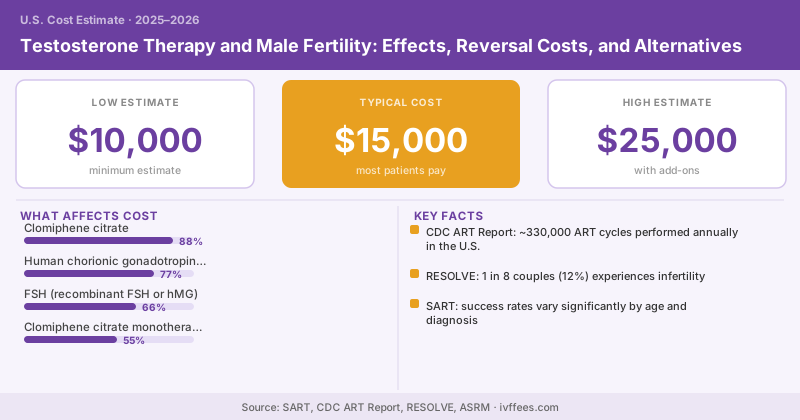
Total recovery protocol costs typically run $1,500–$8,000 for a 6–12 month course including monitoring. More complex cases (long-term TRT, prior secondary hypogonadism) can run $10,000–$15,000 over 18–24 months.
Fertility-Preserving Alternatives to TRT
If you have low testosterone and want to preserve fertility, you have options that don’t shut down sperm production:
Clomiphene citrate monotherapy: Rather than replacing testosterone exogenously, clomiphene stimulates the pituitary to produce more LH and FSH, which raises natural testosterone production. It works for secondary hypogonadism (pituitary/hypothalamic origin) and preserves fertility. Cost: $30–$100/month. Testosterone increases are typically more modest than TRT (to 400–600 ng/dL range), but fertility is preserved.
hCG monotherapy: Same principle — stimulates Leydig cells directly without suppressing the HPG axis. Can maintain intratesticular testosterone and sperm production. Cost: $150–$500/month. Often used in men who need the effects of testosterone but want to maintain fertility.
Anastrozole (aromatase inhibitor): For men with obesity-related low T from elevated estrogen, reducing estrogen conversion can raise testosterone. Cost: $20–$60/month.
If you’re on testosterone therapy and starting fertility treatment, tell your reproductive endocrinologist and reproductive urologist. Don’t stop TRT abruptly without medical supervision. The recovery period needs monitoring, and if a semen analysis shows you’re already azoospermic, the timeline to IVF may be longer than your clinic expects.
Should You Bank Sperm Before Starting TRT?
Yes. Absolutely. If you’re starting testosterone therapy and there’s any possibility you’ll want children in the future, sperm banking before you start TRT is straightforward and inexpensive.
Sperm freezing costs $300–$600 for the analysis and initial freeze, plus $200–$500/year for storage. Compared to 12 months of fertility recovery medications and multiple male fertility testing visits, it’s a dramatically cheaper insurance policy.
The American Urological Association recommends that physicians discuss fertility preservation with men before initiating testosterone therapy. If your prescribing doctor didn’t bring this up, raise it yourself.
When IVF Becomes Necessary
In some cases — particularly after years of TRT or when recovery is incomplete — a man’s post-TRT sperm parameters may not be sufficient for natural conception or IUI. If count and motility remain severely impaired after a full recovery protocol, IVF with ICSI may be the next step.
If recovery fails entirely (persistent azoospermia despite 18+ months off TRT), a semen analysis combined with FSH levels will help determine whether underlying testicular function was already impaired before TRT — or whether extended suppression caused lasting damage. In rare cases, micro-TESE can retrieve testicular sperm even when the ejaculate remains azoospermic post-TRT.
The full IVF cost adds $12,000–$20,000+ to an already costly recovery process. Prevention — either banking sperm or using fertility-sparing alternatives to TRT from the start — is far cheaper than remediation.