Unexplained infertility is one of the most frustrating diagnoses in medicine: you’ve been trying for a year or more, every standard test has come back normal, and nobody can tell you why it’s not working. About 15–20% of couples seeking fertility care receive this diagnosis.
What it doesn’t mean: nothing is wrong. It means the standard evaluation didn’t find what’s wrong — and there are important biological questions that routine testing simply can’t answer (embryo quality, sperm-egg interaction, endometrial receptivity at a cellular level).
Here’s what the treatment progression looks like and what you’ll spend at each stage.
Stage 1: The Complete Workup ($500–$2,000)
Before an unexplained infertility diagnosis is made, both partners need a thorough evaluation. This isn’t always done as comprehensively as it should be.
For the female partner:
- Day 3 FSH, LH, estradiol
- AMH (ovarian reserve)
- Antral follicle count (AFC) by ultrasound
- Thyroid function (TSH)
- Uterine anatomy (saline infusion sonogram or hysteroscopy)
- Tubal assessment (HSG or laparoscopy)
For the male partner:
- Complete semen analysis
- Hormone panel (FSH, LH, testosterone) if SA is abnormal
- DNA fragmentation if SA is borderline or after failed IVF
If all of these come back normal, “unexplained infertility” is an accurate label. If some were skipped — particularly uterine anatomy or sperm DNA fragmentation — the diagnosis may be premature.
| Treatment Stage | Low | Typical | High |
|---|---|---|---|
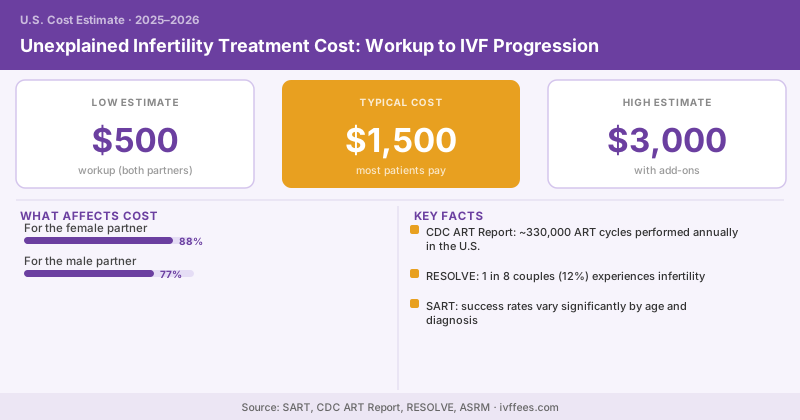
| Complete workup (both partners) | $500 | $1,500 | $3,000 |
| Clomid/letrozole IUI (3–6 cycles) | $1,500 | $4,500 | $9,000 |
| Injectable IUI (gonadotropin + IUI, 3 cycles) | $5,000 | $9,000 | $18,000 |
| IVF (first cycle, all-in) | $15,000 | $22,000 | $35,000 |
| Total progression to IVF | $5,000 | $20,000 | $45,000 |
Stage 2: Oral Medication IUI ($500–$1,500 per cycle)
The first-line treatment for unexplained infertility is typically oral ovulation induction (Clomid or letrozole) combined with intrauterine insemination (IUI). This approach:
- Increases the number of eggs ovulated per cycle (usually 1–2 instead of 1)
- Times insemination precisely to ovulation
- Places sperm directly in the uterus, bypassing the cervix
Per-cycle success rates: approximately 8–12% per cycle for women under 35 with unexplained infertility. After 3 cycles of Clomid/IUI, cumulative success rates are roughly 25–35%.
Cost per cycle: $500 to $1,500 (Clomid or letrozole is inexpensive; monitoring and IUI procedure are the main costs).
Stage 3: Injectable IUI ($2,000–$4,000 per cycle)
If oral IUI fails, the next step is gonadotropin (injectable FSH) stimulation with IUI. This recruits more follicles and increases the number of eggs available for fertilization.
Per-cycle success rates: approximately 15–20% for women under 35 with unexplained infertility.
Cost per cycle: $2,000 to $4,000 (gonadotropins add $1,000 to $3,000 in medication costs over oral IUI).
Risk: multiple gestation (twins, triplets) is higher with injectable IUI than with IVF, where the number of embryos transferred is tightly controlled.
ASRM guidance suggests proceeding to IVF after 3–6 failed IUI cycles for most unexplained infertility patients. For women over 35, many REs recommend moving to IVF after 3 cycles. The data shows that cumulative success rates with continued IUI beyond 6 cycles plateau, while IVF offers a significantly higher per-cycle success rate.
Stage 4: IVF — The Diagnostic and Treatment Step
IVF is more than a treatment for unexplained infertility — it’s also diagnostic. When eggs are retrieved and fertilized in the lab, you learn things that couldn’t be seen before:
- Fertilization rate: Do sperm and eggs fertilize normally?
- Embryo development: Do embryos develop normally to blastocyst stage?
- Egg quality: Does the embryologist note any quality concerns?
- Chromosomal status: If you add PGT-A, you can determine whether embryos are chromosomally normal.
For couples with unexplained infertility who have never done IVF, the first cycle often reveals something that changes the picture — whether that’s unexpectedly poor fertilization, a low blastocyst conversion rate, or a high proportion of aneuploid embryos.
According to SART’s national data, IVF success rates for unexplained infertility patients under 35 are approximately 40–50% per transfer. This is substantially higher than the 10–15% per IUI cycle for the same population.
The “Skip IUI and Go to IVF” Debate
Some REs, particularly for women over 35 or couples who have already tried for 1–2 years, recommend skipping IUI entirely and going directly to IVF. The argument: IUI’s incremental benefit per cycle is modest, it requires months of additional waiting, and the cumulative cost of 3–4 failed IUI cycles often approaches the cost of a single IVF cycle.
The counterargument: IUI is meaningfully cheaper per attempt and less physically demanding. For couples in their early 30s with genuinely unexplained infertility and no age pressure, a trial of IUI before IVF is reasonable and may avoid the need for IVF entirely.
Age is the decisive variable. At 28, you have time to try IUI. At 37, you may not.
“Unexplained infertility” sometimes gets stuck as a label long past when it should be revisited. If you’ve had 3 failed IUI cycles and a failed IVF cycle, revisiting the diagnosis — perhaps with advanced testing for sperm DNA fragmentation, endometrial receptivity, or immune factors — is reasonable, even if earlier testing was normal.
Total Cost: Workup Through IVF
For a couple who follows the standard progression — full workup, 3 Clomid/IUI cycles, 3 injectable IUI cycles, and then IVF — the total expenditure is:
- Workup: ~$1,500
- Oral IUI × 3: ~$4,500
- Injectable IUI × 3: ~$9,000
- IVF (first cycle): ~$20,000
- Total: ~$35,000
Many couples skip some IUI cycles (going to injectable or directly to IVF). Some pursue IVF as first-line treatment. The range of $5,000 to $45,000 reflects those real-world variations.
Bottom Line
Unexplained infertility treatment costs $5,000 to $45,000 as you move through the diagnostic-to-treatment progression. The key financial decision points are: when to move from oral to injectable IUI, and when to move from IUI to IVF. Both decisions should be guided by your age, the number of failed cycles, and what IVF-specific diagnostics might reveal that simpler testing couldn’t.