42% of women diagnosed with uterine fibroids are in their reproductive years — and a surprising number of them find out about the fibroids only after struggling to conceive. If that’s where you are right now, you’re probably asking two questions at once: what will treatment cost, and will removing the fibroids actually improve your chances?
The short answers: treatment runs $5,000–$25,000 depending on the type of surgery, and yes — for submucosal fibroids especially — removal before IVF substantially improves success rates.
How Fibroids Affect Fertility
Not all fibroids are equal. The ASRM classifies them by location, and location is what determines whether they hurt implantation.
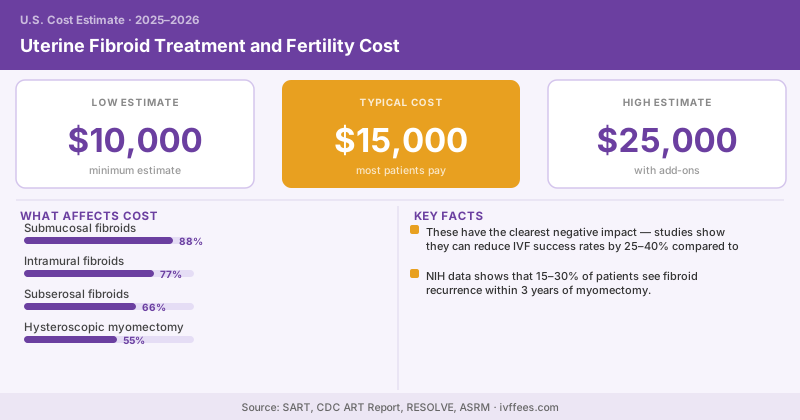
Submucosal fibroids grow into the uterine cavity itself. These have the clearest negative impact — studies show they can reduce IVF success rates by 25–40% compared to women with no fibroids. The ASRM strongly recommends removing submucosal fibroids before IVF.
Intramural fibroids (within the uterine wall) are more common and more controversial. Large intramural fibroids (4+ cm) that distort the cavity likely reduce implantation. Smaller ones that don’t affect the cavity have a less clear impact.
Subserosal fibroids grow outward from the uterus. These generally don’t affect implantation and are usually left alone unless they’re causing other symptoms.
Treatment Costs by Procedure
| Procedure | Typical Cost | Notes |
|---|---|---|
| Hysteroscopic myomectomy | $5,000–$15,000 | Submucosal fibroids; no abdominal incision |
| Laparoscopic myomectomy | $8,000–$20,000 | Small-to-medium fibroids; minimally invasive |
| Abdominal (open) myomectomy | $10,000–$25,000 | Large or multiple fibroids |
| Uterine fibroid embolization (UFE) | $10,000–$20,000 | NOT recommended if fertility is a goal |
Hysteroscopic myomectomy is the preferred approach for submucosal fibroids. A surgeon removes the fibroid through the cervix using a hysteroscope — no abdominal incision. Recovery is typically 1–2 days, and it’s often performed as an outpatient procedure. Cost runs $5,000–$15,000, and many insurers cover it as a general gynecologic procedure rather than a fertility treatment.
Laparoscopic myomectomy uses small abdominal incisions and a camera to remove fibroids from the uterine wall. It’s appropriate for intramural or subserosal fibroids that aren’t accessible hysteroscopically. Recovery is 1–2 weeks. Cost is $8,000–$20,000.
Abdominal myomectomy (open surgery) is reserved for large or numerous fibroids, or when laparoscopy isn’t feasible. Recovery is 4–6 weeks. Cost is $10,000–$25,000. This approach is effective but carries more scar tissue risk, which can occasionally affect the uterus structurally.
Uterine fibroid embolization (UFE) shrinks fibroids by cutting off their blood supply. It’s effective for symptom relief but is generally not recommended for women who want to preserve fertility — the procedure can affect uterine blood flow in ways that may compromise a future pregnancy. If fertility is your goal, discuss surgical myomectomy with your RE and OB/GYN before pursuing UFE.
Fibroids, Recurrence, and IVF Timing
Here’s a frustrating reality: fibroids come back. NIH data shows that 15–30% of patients see fibroid recurrence within 3 years of myomectomy. That’s not a reason to avoid surgery — it’s a reason to time it strategically relative to your fertility treatment plan.
Most reproductive endocrinologists recommend waiting 3–6 months after myomectomy before beginning an IVF cycle or FET. The uterus needs time to heal completely before embryo transfer. If you’re already mid-cycle or have frozen embryos ready, ask your RE about the optimal timing window.
If you’re in your late 30s and time is a factor, your RE may recommend doing an egg freezing cycle first — while your ovarian reserve is still strong — and then having fibroid surgery. This lets you bank embryos now and optimize your uterus for transfer later. The two goals don’t have to happen in the same order.
Insurance Coverage: Better Than You’d Expect
This is where fibroid treatment diverges from most fertility care: myomectomy is usually covered by health insurance as a gynecologic procedure. Insurers generally don’t categorize it as infertility treatment — they cover it to address a documented medical condition (fibroids causing heavy bleeding, pain, or structural distortion).
The practical implication: if your insurer covers general surgery, they likely cover myomectomy at standard in-network rates. You’d pay your deductible and cost-share, not the full $10,000–$20,000 out of pocket. Always get a prior authorization in writing before scheduling.
What insurance typically won’t cover: the IVF cycle itself (unless you’re in a mandate state), and any fertility-specific monitoring or procedures tied to the IVF workup rather than the fibroid treatment.
The IVF Math After Myomectomy
The ASRM reports that removing submucosal fibroids before IVF restores implantation rates close to those seen in women without fibroids. A meta-analysis cited in ASRM practice committee guidelines found that hysteroscopic myomectomy for submucosal fibroids improved live birth rates by approximately 13 percentage points per transfer cycle — meaningful when a single IVF cycle costs $12,000–$17,000.
Put another way: spending $8,000–$15,000 on surgery to improve your chances from 30% to 43% per transfer may save you from a second or third IVF cycle at $12,000–$17,000 each.
The Bottom Line
Uterine fibroid treatment costs $5,000–$25,000, depending on surgical approach. Submucosal fibroids should almost always be removed before IVF — the evidence is clear and the cost is often covered by general health insurance. For intramural fibroids, discuss with your RE whether size and cavity involvement warrant surgery before starting treatment. Don’t assume fibroids are irrelevant to your fertility plan until you’ve had a saline infusion sonogram or hysteroscopy to evaluate their exact location.
Cost estimates based on ASRM practice committee guidelines, NIH fibroid recurrence data, and published procedure costs. Individual costs vary by insurer, facility type, and fibroid complexity.