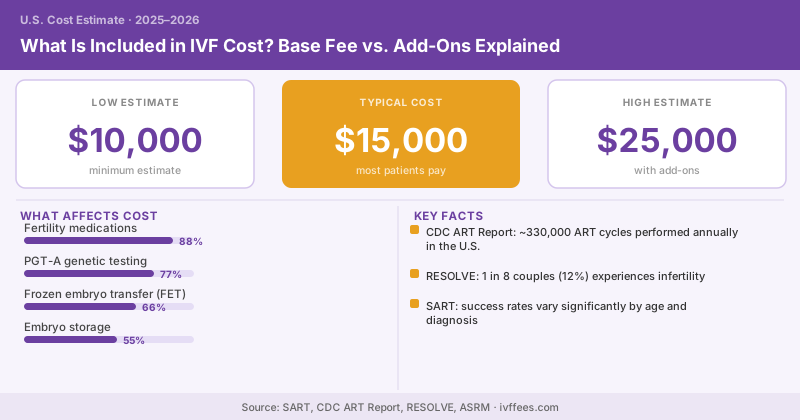
42% of IVF patients report that the final bill was higher than the initial quote. That’s not a coincidence — it’s a feature of how fertility clinics price their services. The base fee is real, but it’s the starting line, not the finish.
Here’s a complete map of what’s inside that number, what gets added on, and what clinics routinely leave off the sticker price.
What the Base IVF Fee Typically Covers
When a clinic quotes you $13,500 for an “IVF cycle,” they’re generally including:
| Included Service | Notes |
|---|---|
| Initial cycle consultation | Usually included; second opinions may not be |
| Ovarian stimulation monitoring | 6–10 ultrasounds + blood draws during stimulation |
| Egg retrieval procedure | Operating room time, surgeon fee |
| Sperm preparation / wash | Basic prep; ICSI is usually extra |
| Standard fertilization (insemination) | Placing sperm near eggs in a dish |
| Embryo culture (5–7 days in lab) | Monitoring development to blastocyst stage |
| One fresh embryo transfer | If a transfer is attempted during the same cycle |
| Embryo freezing setup fee | The vitrification process — not annual storage |
That’s a meaningful package. But notice what’s not on that list.
What’s Almost Always Extra
This is where the sticker shock happens. Nearly every clinic bills these separately:
Fertility medications — typically $3,000–$7,000 per cycle, billed directly by the pharmacy or as a separate clinic charge. The base fee never includes medications. ASRM estimates the average medication spend is $4,500 per retrieval cycle.
ICSI (Intracytoplasmic Sperm Injection) — injecting a single sperm directly into each egg. Used in ~70% of IVF cycles but costs $1,000–$2,500 extra. If you have any male factor diagnosis, you’ll almost certainly need this. See the full ICSI cost breakdown.
PGT-A genetic testing — screening embryos for chromosomal abnormalities before transfer. Costs $3,000–$6,000 for the biopsy plus lab analysis. Not universally recommended, but common for patients over 37 or after recurrent loss. See PGT genetic testing costs.
Frozen embryo transfer (FET) — if your fresh transfer is cancelled (common for medical reasons) or you have frozen embryos from a prior cycle, each FET is $3,000–$5,500. It’s an entirely separate cycle. See frozen embryo transfer cost.
Embryo storage — annual fees for cryopreserved embryos run $500–$1,200 per year. Clinics often include the first year in the base fee, then bill annually. See embryo storage cost.
Anesthesia — many clinics bill anesthesia separately ($500–$1,200). Ask specifically whether the anesthesiologist fee is included in the base quote.
Diagnostic tests before treatment — pre-cycle testing (AMH, antral follicle count, HSG, infectious disease screening) adds $500–$2,500 and is almost never in the base fee.
Before signing any financial agreement, request a written itemized estimate that includes: medications (estimated), ICSI if applicable, one year of embryo storage, and one frozen embryo transfer cycle. That total is your real starting budget.
The Add-On Economy: What’s Proven vs. Marketed
Clinics increasingly offer premium add-ons. Some have real evidence behind them. Others are still experimental.
| Add-On | Typical Cost | Evidence Level |
|---|---|---|
| Assisted hatching | $500–$1,500 | Limited; ASRM says not routinely recommended |
| Endometrial receptivity testing (ERA) | $800–$1,500 | Mixed; may help recurrent implantation failure |
| Time-lapse embryo imaging (EmbryoScope) | $500–$1,000 | Modest evidence for embryo selection |
| Endometrial scratch | $200–$500 | Controversial; some RCTs show no benefit |
| IMSI (morphological sperm selection) | $500–$1,500 | Limited evidence over standard ICSI |
| Platelet-rich plasma (PRP) uterine infusion | $1,000–$3,000 | Emerging; not standard of care |
| Sperm DNA fragmentation testing | $300–$500 | Useful for repeat failures; not routine |
ASRM’s 2023 committee opinion warns patients that “the clinical benefit of many add-on procedures has not been established in well-designed randomized controlled trials.” That’s not a reason to refuse them all — but it is a reason to ask your doctor specifically why they’re recommending any add-on for your situation.
What Clinics Often Don’t Mention Upfront
Beyond the explicit add-ons, a few cost categories regularly surprise patients:
Cycle cancellation fees — if your cycle is cancelled before egg retrieval (poor response, ovarian hyperstimulation risk), some clinics charge a partial fee of $1,000–$4,000 for monitoring already completed. Read the cancellation policy before starting.
Freeze-all cycles — increasingly common when PGT-A is used or OHSS risk is elevated. No fresh transfer happens; all embryos are frozen. This means your “cycle” automatically incurs an FET fee down the road.
Multiple embryo biopsies — if you have 4 embryos to test for PGT, you pay for 4 biopsies. The per-embryo cost typically drops with volume, but a large cohort can still mean $5,000+ in testing alone.
Mock transfer fee — some clinics charge $300–$700 for a trial (mock) embryo transfer to map the uterus before the real thing.
Never assume something is included. Ask specifically: “Is anesthesia billed separately? Is the embryo storage fee for one year or indefinitely? If my fresh transfer is cancelled, what do I owe?” Get answers in writing before you start medications.
A Realistic All-In Budget
For a patient doing one complete IVF cycle with a fresh or frozen transfer, here’s a realistic total:
| Budget Scenario | What’s Included | Estimated Total |
|---|---|---|
| Bare minimum (no add-ons, fresh transfer works) | Base fee + meds + anesthesia | $16,000–$22,000 |
| Typical cycle (ICSI + meds + FET) | Base + ICSI + meds + FET | $22,000–$30,000 |
| Full workup (ICSI + PGT-A + FET + year storage) | All above + PGT-A | $28,000–$38,000 |
The $13,500 base fee is real. It just doesn’t tell the whole story. Go in with the full picture, and you won’t be caught off guard.