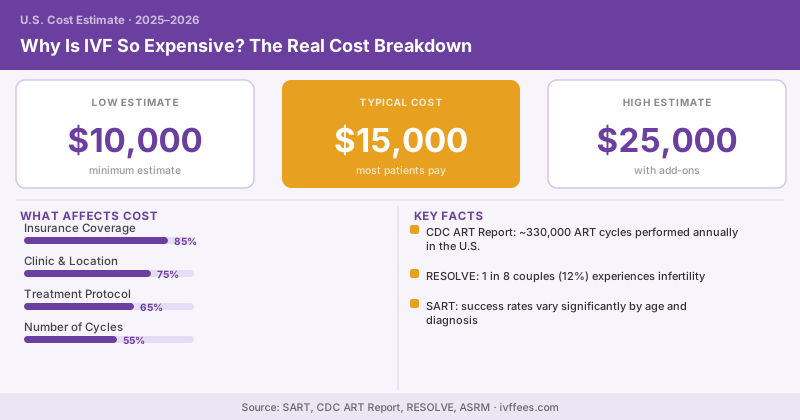
$18,000 for one attempt at pregnancy. It’s a number that stops most people cold. And when you dig into why IVF costs what it does, you realize the price isn’t arbitrary — it reflects real, specific, expensive things. Here’s where every dollar actually goes.
The Short Answer
IVF is expensive because it requires:
- A specialized embryology laboratory with highly precise equipment
- Multiple trained specialists over 4–6 weeks
- Expensive injectable hormones with real manufacturing costs
- 24/7 monitoring of developing embryos
No corner of that process is cheap. But understanding each piece helps you see where costs might be negotiable — and where they’re fixed.
The Embryology Lab: Your Biggest Hidden Cost
The embryology lab is the engine of any IVF clinic, and it’s brutally expensive to run. According to the American Society for Reproductive Medicine (ASRM), outfitting a new embryology lab can cost $500,000 to $2 million upfront before a single patient is treated.
What’s in that lab?
| Equipment | Approximate Cost |
|---|---|
| IVF incubators (per unit) | $40,000–$80,000 |
| Time-lapse imaging system (EmbryoScope) | $80,000–$120,000 |
| ICSI micromanipulator workstation | $50,000–$100,000 |
| Vitrification system for freezing | $20,000–$40,000 |
| Laminar flow hoods and biosafety cabinets | $15,000–$30,000 each |
| Air filtration / VOC monitoring systems | $30,000–$80,000 |
Labs also require a stable environment: dedicated HVAC, backup power generators, and continuous air quality monitoring. One power outage at the wrong moment can destroy embryos worth tens of thousands of dollars in patient treatments. Clinics price their services to cover that risk.
Embryologist Salaries Are Not Low
An embryologist is a PhD-level specialist who handles your eggs, sperm, and embryos directly. They fertilize eggs under a microscope, monitor embryo development, perform genetic biopsies for PGT testing, and execute vitrification. The Bureau of Labor Statistics reports that clinical laboratory scientists (the closest tracked category) earn a median of $57,000 nationally — but experienced embryologists at fertility centers typically earn $80,000–$140,000 annually, with senior lab directors earning more.
A mid-size IVF clinic employs 3–8 embryologists. That’s $300,000–$600,000 in annual labor cost just for the lab team — before any of the clinical staff.
Medications: The Most Variable Cost
Fertility medications are legitimately expensive, but they’re also one area where patients face the widest price variation. The same vial of follitropin alfa (Gonal-F) can cost:
- $75–$90 at a specialty pharmacy with a discount program
- $150–$200 at a standard retail pharmacy
- $200–$300 when purchased through the clinic’s in-house pharmacy
That markup matters when you’re using 30–60 days of injections. Most patients spend $3,000–$7,000 on medications alone per retrieval cycle, according to ASRM’s published cost estimates.
You don’t have to fill fertility prescriptions at your clinic’s pharmacy. Ask for a paper prescription and compare prices at Freedom Fertility, MDR, and Mandell’s specialty pharmacies. Savings of $1,000–$2,500 per cycle are common.
Physician and Staff Time
A single IVF cycle involves:
- 6–10 monitoring appointments with ultrasound and bloodwork (during stimulation)
- Egg retrieval procedure — a reproductive endocrinologist operating under ultrasound guidance, with an anesthesiologist present
- Embryo transfer — another procedure
- Phone consultations and results interpretation throughout
Your reproductive endocrinologist typically earns $250,000–$450,000 annually. Anesthesiologists bill separately, usually $500–$1,200 per procedure. Nurses, medical assistants, coordinators, and billing staff add another significant layer of overhead.
Clinic Overhead: The Infrastructure Tax
IVF clinics don’t just pay for equipment and people. They pay for:
- Accreditation — SART accreditation requires ongoing reporting, audits, and compliance
- Malpractice insurance — extremely high in reproductive medicine
- Regulatory compliance — FDA oversight of donor tissue, CAP laboratory accreditation
- Facility costs — specialized clean rooms aren’t cheap to build or maintain
A 2022 analysis in Fertility and Sterility estimated that clinic overhead accounts for approximately 20–30% of the total charge per cycle.
Why US Prices Are Higher Than Other Countries
The same IVF procedure costs $3,000–$8,000 in Spain, Czech Republic, or Mexico — often with comparable success rates. The gap isn’t primarily technology. It’s:
- Higher physician compensation in the US
- Malpractice liability costs — US tort system versus universal healthcare systems
- No price regulation — unlike most developed countries, the US has no government ceiling on fertility treatment pricing
- Insurance patchwork — only 19 states mandate any fertility coverage, so most patients pay out of pocket, and clinics price accordingly
The absence of insurance for most American IVF patients creates a system where clinics can charge market rates with minimal downward pressure. Until more states mandate coverage, prices are unlikely to drop significantly for cash-pay patients.
What You’re Actually Paying For
When you add it all up, here’s a rough breakdown of where a $15,000 IVF cycle fee goes:
| Cost Category | Estimated Share | Dollar Estimate |
|---|---|---|
| Embryology lab (equipment amortization + consumables) | 20–25% | $3,000–$3,750 |
| Physician and clinical staff labor | 30–35% | $4,500–$5,250 |
| Medications (excluded from base fee) | billed separately | $3,000–$7,000 |
| Facility / overhead / compliance | 20–25% | $3,000–$3,750 |
| Administration and profit margin | 15–20% | $2,250–$3,000 |
IVF is expensive because it’s genuinely hard to do well. The costs are real. But knowing the breakdown helps you ask better questions — about medication alternatives, clinic pricing transparency, and whether add-ons like time-lapse imaging or assisted hatching are worth the premium for your specific situation.